Describe the intended result in ordinary use
A wish list such as “refresh the bedroom” leaves too many decisions hidden. It may mean repainting walls, repairing damaged plaster, replacing curtains, adding sockets or moving furniture. Start with what the room should do when the work is complete, then list the physical changes required.
Walk the room and name surfaces and components separately. Walls, ceiling, door leaves, frames and skirting are not one automatic painting package. Identify what remains, what is removed and what requires investigation before a price can be reliable.
Keep this scope as a household planning record. It does not replace a contract, professional specification or statutory approval. Where work involves regulated trades, structural issues or hazardous materials, obtain the appropriate assessment and local requirements. A clear written boundary helps those discussions without pretending the homeowner can certify the technical solution.
Make the physical boundary visible
Use a marked room sketch and numbered photographs. Identify each included surface and fitting with the same name in the written list. If the door has two faces and only one is included, say which one. If a cupboard interior remains unchanged, record that explicitly because it affects access and expectations.

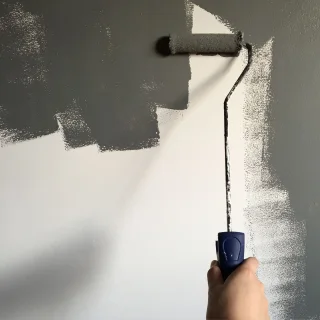
The roller is working on one face of a projecting wall corner, with another face visible beside it. Give each included face a consistent name on the room sketch and written scope; record exclusions and provisional investigation separately. The photograph cannot identify the coating or establish what preparation, trim or ceiling work is included.
Photo & usage
U.S. Air Force photo by Airman 1st Class Ashley Garcia · Public domain · Source. Display copies resized and encoded as WebP; no instructional details were fabricated or removed.
Separate known work from provisional investigation. A visible stain may need its cause assessed before decorative repair is specified. EPA's remodeling guidance supports addressing underlying problems. Ask the responsible professional what information is missing and how the scope will be updated after investigation.
Do not fill uncertainty with a guessed repair method. “Assess loose area beside window and provide proposed repair” is more honest than directing a particular filler or coating without knowing the substrate. The quotation should identify allowances and exclusions so a later change is understandable.
Assign preparation and protection
List who empties furniture, moves heavy items, removes curtains and provides storage. Confirm what the contractor's service includes and what the household must do before arrival. A job can be delayed by an uncleared wardrobe even when the decorative work is fully specified.
Discuss protection of floors, furniture and the route through the home. Ask which methods are suitable for the surfaces and work stages. Do not prescribe adhesive coverings on a newly finished floor without the relevant product guidance.
Identify responsibility for waste, packaging and the final clean. Distinguish ordinary household tidying from specialist cleanup required by the work. EPA's lead programme and indoor-air publications provide context for relevant US work, but the exact controls and qualifications depend on the project and jurisdiction.
Compare quotations with the same work units
This illustrative USD comparison has two painting quotations. Quote A is USD 900 for walls and ceiling, with USD 120 for agreed furniture moving and USD 80 for waste removal. Its comparable total is USD 1,100. Quote B is USD 1,020 including those same named services, giving a USD 80 difference.
If Quote B excludes the ceiling, the totals are not comparable even though B appears lower. Obtain a revised scope or a separate ceiling amount before choosing. Do not invent a ceiling price by subtracting an assumed percentage from the room total.
The example says nothing about workmanship, product suitability, tax treatment or commercial terms. Those need their own review. Its purpose is to show why a scope table should precede a price comparison: arithmetic can be correct while the underlying work packages remain different.
Record products and decisions that remain open
For finishes, record the selected product family, colour reference, sheen and surfaces, then obtain the actual application requirements from the manufacturer or contractor. A colour name alone does not identify a complete coating specification.
For curtains or furniture, identify which dimensions must be confirmed after other work. Put a decision owner and latest sensible date beside each open choice. A fabric decision made after the maker's order cutoff can shift completion even if all building work finishes on time.
Ask how substitutions will be proposed and approved within the agreement. A different product may have different appearance, preparation or service-readiness requirements. Keep the agreed substitution in writing and update the maintenance record so the household later knows what was actually installed.
Give added work a deliberate route
When a new problem or request appears, describe it separately from the original scope. Ask what it changes in cost, time, access and dependent tasks. Do not allow a casual conversation beside the work area to become the only record of an expensive addition.
Use the contract's actual change process and retain the written record. Distinguish necessary work to complete the original result from an optional improvement. Both may be worthwhile, but the household should understand which decision it is making.
If the change reveals a safety or underlying-condition issue, pause affected work while the appropriate person assesses it. Avoid pressuring a contractor to cover the problem simply to preserve a planned delivery date. Revise the sequence using the new evidence.
Define completion through specific observations
List the practical checks that match the scope: specified surfaces finished, agreed fittings installed, doors and drawers operating, waste removed and instructions supplied. Ask the contractor how workmanship and product requirements will be assessed under the agreement.
Do not substitute a distant room photograph for a walkthrough. View relevant surfaces under normal lighting and identify specific concerns by location. A completion list should distinguish unfinished work, an agreed limitation and a new request outside the scope.
Record remaining actions with the responsible person and agreed timing. Keep the language factual. “Lower door edge has an uncoated strip” is easier to assess than “painting poor,” while an unsupported claim of professional certification would overstate what a household walkthrough establishes.
Keep a usable handover file
Save the final scope, approved changes, product references, care instructions and relevant service documents together. Include a small room plan if future maintenance depends on dimensions or hidden-service information supplied by qualified installers.
Check that the file describes the final installation. Remove confusion from superseded choices without deleting the record of authorised changes. If leftover paint is retained, label it with the actual room, surface and specification under the product's storage guidance.
The scope work is complete when the delivered result can be compared with the agreed work and future maintenance can identify what was used. A clear file will not eliminate every disagreement, but it makes the remaining questions specific and reviewable.
List assumptions that can change the quotation
Ask each bidder to identify assumptions about access, substrate condition, working hours and material availability. Keep these beside the work list. A quotation based on an empty room is not directly comparable with one that includes moving and protecting a furnished room.
Separate an allowance from a confirmed amount or specified item. If a fixture has not been chosen, record what the allowance is intended to cover and how the final selection will be reconciled under the agreement. Do not treat an attractive total as fixed when important choices remain open.
Before booking, read the scope back against the room photographs. Check corners, recesses and surfaces that are easy to omit from a short description. Ask about the actual boundary of making good after installation. A clear answer now is more useful than discovering at handover that the visible surrounding finish belonged to nobody's price.
THE REFERENCE FILE
Sources & scope
Documentation reviewed 1 Nov 2026. Examples are illustrative; this article does not claim hands-on product testing. Follow the instructions for your actual material, model and location.