Describe the local discomfort precisely
Two people sharing a room can disagree about whether it is cold because their seats experience different conditions. One may sit near glazing while the other sits beside an interior partition. Before increasing the room setting, describe the specific complaint: a cool feeling on the window side, moving air around ankles, or general cold throughout the room.
Choose an interior seat that is realistically usable for the same activity. A chair in the corridor is not a useful alternative if the person wants to read with family. Keep similar posture, clothing and activity for the comparison. The aim is to identify a local pattern, not persuade anyone that their discomfort is imaginary because the thermostat looks normal.
HSE's thermal comfort guidance recognises influences beyond air temperature. Use that framework to keep the observation open. A cool window surface and a local air current can coexist, and this simple exercise cannot precisely allocate the effect between them. It can show whether seat position deserves attention before broader changes.
Map the two occupied positions
Draw the window, both seats, any heater or cooling outlet, curtains and the normal walking route. Measure roughly from each seated position to the glazing using a tape measure without stretching across fragile objects. Record these as layout notes, not required clearances. Manufacturer instructions determine clearances around heating equipment and furnishings.
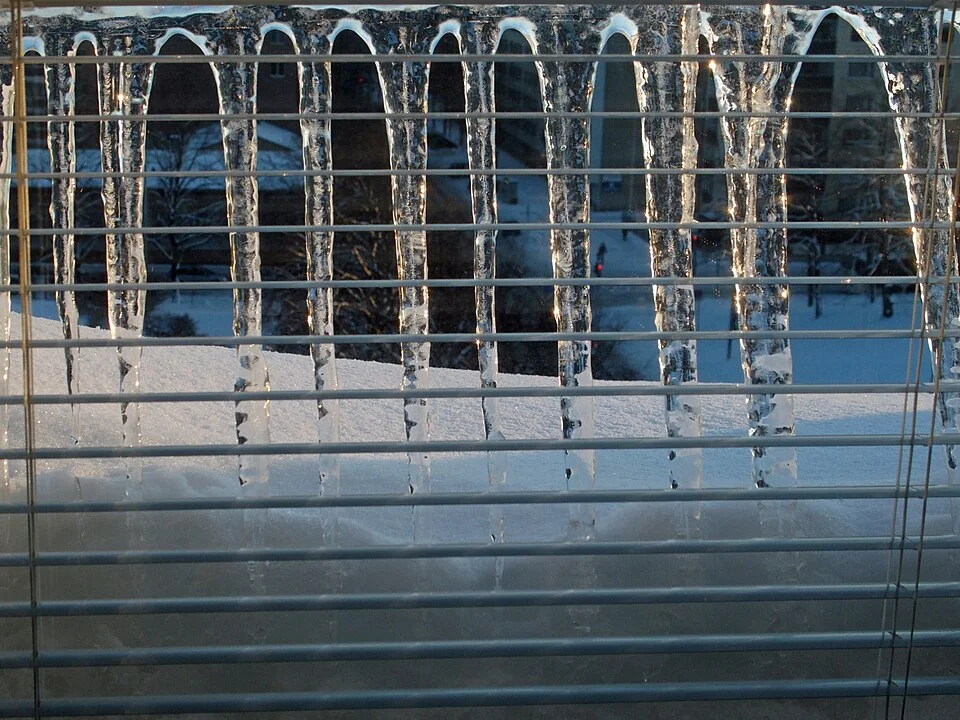
The reference shows horizontal blinds with snow and icicles outside. It provides a cool-weather window context, not evidence of indoor air temperature, a draught or the thermal performance of the pictured glazing.
Photo & usage
Kotivalo · CC BY-SA 4.0 · Source. Display copies resized and encoded as WebP; no instructional details were fabricated or removed.
Check whether a curtain rests against a heater, covers an air outlet or prevents normal window operation. Correct obvious unsafe arrangements before comparing comfort. Do not seal ventilation openings, cover equipment or interfere with the household's normal safety arrangements to create a more dramatic difference between the chairs.
Sit in both positions and look for confounders. The interior chair may have a thicker cushion or sit beneath an outlet. If possible use the same movable chair at each marked location, provided it can be moved safely and leaves access clear. Otherwise note the chair difference as a limitation and avoid attributing the entire result to distance from glass.
Use a short, balanced sequence
Begin when the complaint normally appears, such as after sunset on a cool evening. Sit quietly in position A for a comfortable settling period, then record the experience in plain words. Move to B and do the same. On another evening, reverse the order so the later part of the evening is not always associated with the interior seat.
A ten-minute observation at each position may be practical for a reading activity, but it is an editorial trial interval, not a standard test. Extend or stop according to comfort. Do not remain in unpleasant conditions simply to complete a schedule. Record whether the heating cycled or a door opened between the two positions.
Use the same book, blanket choice and clothing unless the purpose is explicitly to test one of those changes. A hot drink during only one period or walking around before one reading can alter the comparison. These small details explain why a balanced repeated sequence is more convincing than trying the second chair once and declaring it better.
Read an illustrative comparison honestly
In this invented example, a person rates local cool discomfort from zero, meaning none, to four, meaning they choose to move. This is a private descriptive scale, not a medical or validated comfort instrument. Each evening includes both seats and the same reading task.
| Evening | Window seat | Interior seat | Order |
|---|---|---|---|
| One | 3 | 1 | Window first |
| Two | 2 | 1 | Interior first |
| Three | 3 | 0 | Window first |
The window seat scores total eight; the interior seat scores total two. Their descriptive means are about 2.7 and 0.7. The difference of two scale points summarises this person's notes but should not be interpreted as a percentage change or a physical temperature reduction.
If air readings near both seats were similar, the repeated preference still matters. It supports trying the interior position for this activity. It does not prove the window has a construction defect or identify radiant temperature. A different person may report a different experience and should have their own comparison.
Distinguish moving air from proximity to glass
Without altering ventilation, note whether a light tissue held safely by hand shows an obvious air current near the occupied area. Keep it away from flames, heaters and equipment. This is a rough observation only. Do not use candles, smoke or aerosol sprays as homemade draught detectors around a furnished room.
If discomfort follows an obvious moving current, note its source and whether normal door or window operation changes it. If the window-side sensation persists without a detectable current, proximity to a cool surface may be relevant, but absence of tissue movement does not rule out air movement. The exercise is diagnostic description rather than precise measurement.
OSHA's workstation environment guidance cautions about direct supply air at occupied positions. Apply that limited principle when one chair sits directly beneath an outlet. A chair move might solve the local complaint without covering the outlet. Fixed-system changes and suspected faults call for the relevant service provider rather than improvised deflectors or blocked vents.
Try one realistic layout adjustment
If the interior position consistently feels better, move the normal chair modestly inward or rotate it so the person is less exposed on one side. Retain comfortable reach to the reading light and side table. Recheck television view, conversation distance and walking space. A thermally pleasant chair that blocks the route is not a successful layout.
If existing curtains are part of the trial, use them normally and maintain all equipment clearances. Compare the same seat with curtains open and closed on separate suitable evenings. YourHome's passive heating material provides context for managing heat flow, but do not assign a universal insulation value or saving to an unspecified curtain.
Observe the glass and nearby surfaces for moisture as a separate housekeeping issue. A new furniture position should not conceal an emerging problem or prevent routine inspection. Persistent condensation belongs in its own record. Keep this article's decision narrow: whether the evening activity benefits from a different position under the conditions you observed.
Complete the decision with the whole room in use
Repeat the chosen arrangement with everyone using the room normally. The person should be able to remain seated for the intended activity without the original local complaint becoming distracting. Others should retain access, light and comfortable seats. Check during a heating cycle as well as between cycles if that variation affected the earlier notes.
Keep a simple final statement: interior position preferred on three cool evenings; air readings were similar; mechanism not established. That wording preserves useful evidence without pretending the exercise measured window performance. It also tells another household member why the chair moved and when the choice may need revisiting.
If both seats remain uncomfortable, or a strong persistent draught or equipment problem is evident, the next step is a targeted investigation rather than more chair comparisons. Finish when a practical position works or the record clearly shows that rearrangement is insufficient. Either conclusion is valuable when it follows a repeatable observation.
THE REFERENCE FILE
Sources & scope
Documentation reviewed 1 Nov 2026. Examples are illustrative; this article does not claim hands-on product testing. Follow the instructions for your actual material, model and location.