Storage products often advertise liters, gallons or a large total capacity. Those figures are useful for comparison only when you understand the shape and access. A narrow opening can exclude a rigid object that has far less volume than the box, while a deep shelf can hide a second row you rarely retrieve.
Compare the assigned collection with the complete storage geometry. Measure the opening, usable interior and removal path separately. This workshop helps reject misleading capacity claims for your own room without pretending that one universal packing percentage applies to every household category.
Separate three different measurements
Write down external dimensions for fitting the product into the room, internal dimensions for fitting the contents and opening dimensions for getting the contents through. A lid, rim, taper or frame can make all three different. Do not substitute one set simply because a listing gives only that information.
The IKEA — SAMLA Box, Article 701.029.72 page provides specific dimensions and nominal volume for one container. Use it as an example of product information to examine, not as proof that all boxes in a range have identical wall shapes or opening proportions. Check the exact size and any lid purchased separately.
Record what remains unknown. If a rigid item requires a particular opening and the manufacturer does not provide it, ask for that dimension or inspect a sample before ordering. A guessed interior size based on the exterior can turn an apparently economical bulk purchase into a collection of unsuitable containers.
Sort the contents by packing behavior
Separate rigid objects, soft textiles, loose small parts and fragile items. Each category uses capacity differently. Soft contents may conform to a shape but still need appropriate support and storage conditions. Rigid contents cannot be made smaller by choosing a more optimistic fill percentage.
Measure the awkward object first: a folder, a broad case or the longest item. Include any protective enclosure. Do not count an object as fitting if it must bend, lose support or have a lid forced over it. The storage should preserve the object's intended form and condition.
For mixed categories, consider smaller defined groups. An oversized box may offer ample total volume while forcing every retrieval to begin with sorting unrelated contents. A pair of smaller suitable containers can use more wall and lid space yet provide more useful independent access. Compare the actual retrieval benefit rather than assuming the larger nominal volume wins.
Calculate one illustrative shape mismatch
All dimensions here are illustrative. A rectangular internal space measures 40 by 30 by 20 cm. Its simple geometric volume is 24,000 cubic centimeters, or 24 liters. A rigid case measuring 35 by 32 by 10 cm has a volume of 11.2 liters, well below that total.
Yet the case cannot lie flat in the 40 by 30 cm base because its 32 cm side exceeds the 30 cm side by 2 cm. The lower object volume does not solve that orientation problem. Other orientations would need their own dimensional checks, and the opening may restrict them further.
Now compare a 38 by 34 by 12 cm internal space. Its geometric volume is 15.504 liters, smaller than 24 liters, but it can accommodate the case flat under these assumptions. This illustrates why a smaller-volume container may suit a specific rigid object better. Real wall taper, protective clearance and opening geometry still require verification.
Check the shelf opening before multiplying box counts
Measure the shelf's clear width between uprights and its usable support depth. The IKEA — BAGGEBO Shelf Unit, Article 504.811.72 listing illustrates that overall furniture dimensions and product documentation are separate information. A frame, raised lip or back structure can reduce what a container actually has available.
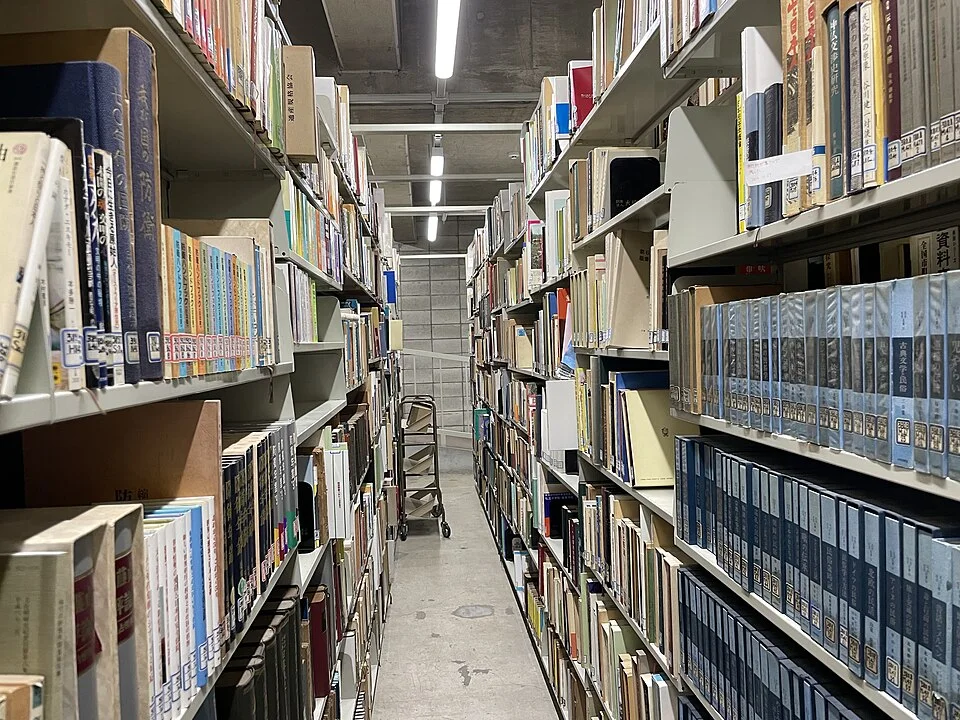
The shelf edges, dividers and vertical supports separate the usable openings in this book-storage example. Measure between the actual obstructions on your own unit before multiplying container counts. Include the box exterior, lid and a grip for removal; neither the photograph nor a nominal volume gives a shelf load limit or a completed retrieval test.
Photo & usage
Eugene Ormandy · CC BY-SA 4.0 · Source. Display copies resized and encoded as WebP; no instructional details were fabricated or removed.
Count complete exterior box widths with lids and handles. Allow the observed hand space needed for removal rather than arranging a theoretical row that leaves no grip. If a box must tilt to clear a lip, include the height and width of that movement.
Do not multiply shelf levels by nominal box volume until a representative position has passed the retrieval test. A row of containers that cannot be removed independently is not equivalent to a row of accessible positions. Note any stacking dependencies and whether the upper container has a suitable temporary destination when the lower one is needed.
Use depth only when the back row remains appropriate
A deep container can make small items difficult to see and reach. Test identification and removal from the back, not just the front. The U.S. Access Board — Operable Parts guide explains how obstructions affect access; in household storage, a deep front row can become exactly such an obstruction.
Two rows may be acceptable for a clear occasional category if the front row is manageable and easily returned. They are less suitable for daily mixed items whose labels disappear. A detailed inventory helps locate a hidden object but does not eliminate the work of moving the front row.
Compare one deep box with shallower containers arranged for independent access. Include the extra material and shelf width in the comparison, and avoid claiming a universal efficiency advantage. The right choice depends on contents, frequency and handling. Your observation should state which particular retrieval becomes easier or harder.
Compare cost only after establishing useful fit
If money is part of the decision, use current verified prices or clearly labeled illustrative USD figures. Include lids and necessary accessories rather than comparing an incomplete base with a complete container. Do not assume a low cost per advertised liter represents a low cost per useful storage position.
For example, an illustrative USD 12 box that does not fit its assigned object has no useful capacity for that task. A USD 9 box that fits and can be retrieved may be the better purchase even if it advertises fewer liters. The decision concerns the assigned job, not a universal judgment about the product's value.
Buy one sample where uncertainty remains. The sample trial can reveal grip, lid and taper details that dimensions alone miss. Do not order an entire room's matched system until the actual objects and shelf position have been checked. Visual consistency is a secondary benefit after suitable function is established.
Record the rejected object as a fit boundary
Keep a note of the largest object that failed and the dimension responsible. If a rigid case cannot pass the opening, write that fact beside the accepted container size. This prevents a later purchase being justified by the same nominal liter figure after the original mismatch has been forgotten.
Check any replacement container against that object before comparing cosmetic features or bulk discounts. A slightly larger exterior can still have a smaller useful opening because of its rim or taper. The completion decision depends on the actual object entering, resting with suitable support and leaving again. A numerical volume advantage does not overrule a failed step in that sequence.
Record capacity as accepted categories and positions
Write the result in practical terms: two document cases on the middle shelf, one bedding container in the existing cupboard, or three independently removable supply boxes. Include the accepted exterior envelope and any category restriction. This is easier to maintain than an impressive total volume nobody can translate into daily use.
Run a complete retrieve, use and return cycle with a representative loaded container. Check that labels remain visible, contents are supported and nearby room activities continue normally. Recheck product limits separately; a dimensional fit does not establish load capacity or stability.
Completion means the storage supports the assigned objects and their retrieval sequence. Keep nominal volume as background information, not the final verdict. Useful capacity is the collection you can store appropriately and find again without dismantling the room.
THE REFERENCE FILE
Sources & scope
Documentation reviewed 1 Nov 2026. Examples are illustrative; this article does not claim hands-on product testing. Follow the instructions for your actual material, model and location.