A bill divided by total kWh gives an average account cost, but that number can exaggerate the savings from using less electricity. Some charges remain even when consumption falls. Estimate the avoidable portion before deciding whether a small device change is financially meaningful.
Use the actual tariff for a personal decision and keep illustrative numbers separate. This guide explains the accounting boundary of a savings estimate. It does not promise a lower future payment, recommend a particular supplier or assume every tariff has only one energy rate and one fixed charge.
Mark which charges respond to consumption
Copy each electricity line into a record and identify its basis: kWh, days, billing cycle, percentage or another stated quantity. Do not classify by name alone. A service-related line can be usage-based in one tariff and fixed in another.
Portland General Electric — Understanding My Bill explicitly distinguishes its basic charge from its energy-use charge. That is a useful example of why the basis matters, but use your own account's official definitions. Retain the date and plan because charging structures can change.
Keep previous balances, payments and one-off credits outside the consumption model. Those affect the amount due but are not energy saved by a household action. Likewise, a temporary assistance credit may alter the payment without changing equipment consumption. Write the scope of the estimate before using the total bill as a shortcut.
Keep the original bill total in a separate reference column so the model can be checked without confusing the account payment with the avoidable energy amount. Label the calculated saving as a scenario until its consumption assumptions have independent support.
- Identify each charge’s stated basis instead of classifying it from its name.
- Keep balances, payments and fixed service amounts outside the avoided-energy multiplication.
- Check tiers, timing and minimum-charge conditions before presenting the scenario as a payment reduction.
Define the energy reduction independently of price
State what change is being considered and how the reduced kWh was established. It might come from a documented mode measurement, a representative usage record or a labeled scenario. Do not begin with a desired dollar saving and work backward to an unsupported energy claim.
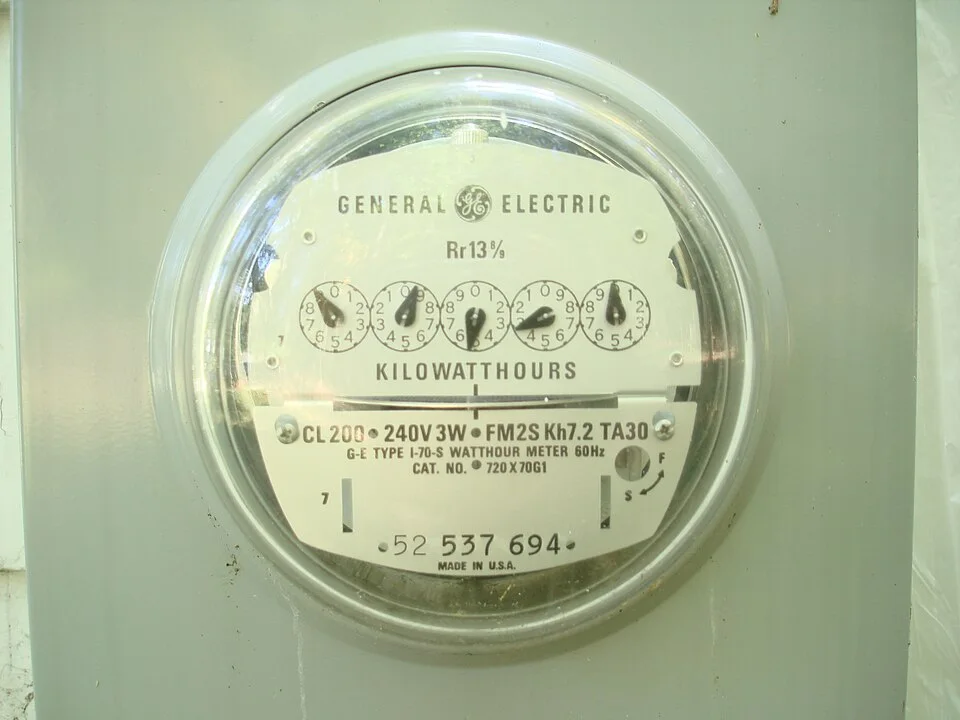
The face identifies accumulated energy in kilowatt-hours, separating the physical quantity from any monetary saving. Establish the proposed reduction over a consistent interval and keep its evidence source explicit. A whole-supply register alone cannot identify an individual appliance’s reduction or show that fixed charges will change.
Photo & usage
user:Stilfehler · Public domain · Source. Display copies resized and encoded as WebP; no instructional details were fabricated or removed.
EIA — Measuring Electricity distinguishes energy accumulated over time from instantaneous power. If the proposed reduction is expressed in watts, include the applicable hours and convert to kWh before assigning a price. For cycling equipment, a nameplate rating multiplied by all plugged-in hours is generally not a measured consumption estimate.
Keep essential functions and manufacturer requirements intact. A monetary model does not establish that equipment should be disconnected or operated differently. If the action would interrupt refrigeration, communications needed by the household or safety-related equipment, obtain the relevant guidance rather than treating a favorable number as permission to proceed.
Choose the applicable avoidable rate
For a simple flat tariff, identify all energy components that change with each reduced kWh. Check whether the quoted rate already includes supply and delivery or whether additional usage-based lines apply. Avoid counting the same component twice.
The PG&E — Understand Your Bill explanation shows that a bill may contain several distinct charge concepts. A baseline credit or time-related rate can mean the last kWh removed has a different price from the month's average. Preserve those distinctions in the scenario rather than applying one convenient number indiscriminately.
If the reduction crosses a tier boundary, split it by the applicable rates. If it occurs at different times under a time-of-use plan, allocate the hours appropriately. Where a minimum charge or other non-linear feature applies, clarify the rules before claiming an exact saving. A simple rate multiplication may only be an approximation.
Work through an illustrative fixed-plus-energy bill
All figures here are illustrative. A household uses 300 kWh at USD 0.20 per kWh and pays a USD 18 fixed charge. The energy portion is USD 60 and the modeled total is USD 78 before taxes or other adjustments.
Dividing USD 78 by 300 kWh gives USD 0.26 per kWh as an average account cost. Reducing use by 30 kWh changes the energy portion to 270 × USD 0.20 = USD 54. The fixed charge remains USD 18, giving a modeled total of USD 72 and a saving of USD 6.
Using the average USD 0.26 would predict USD 7.80, overstating this example by USD 1.80. Consumption falls 10 percent, while the modeled total falls about 7.69 percent. Those percentages differ because the fixed charge remains. The example excludes other tariff features and is not a prediction for an actual household.
Include percentages and rounding only when justified
Some taxes or adjustments depend on usage charges, some on other bases, and some may be fixed. Read the relevant line definitions before adding them to the avoided cost. Do not apply a single tax percentage to the whole bill unless that is how the account actually works.
Keep calculations unrounded until the final display. Rounding each tiny component early can make a small device estimate appear materially different. Conversely, do not display excessive decimal places when the energy reduction itself is an approximate scenario.
State the boundary plainly: energy charges only, selected usage-based components, or a fuller tariff model. An incomplete estimate can still be useful when its scope is clear. It becomes misleading when a partial energy result is labeled total bill savings without considering the charges that remain or respond differently.
Compare the estimate with the effort and cost
If a proposed accessory costs money, compare its incremental cost with the estimated avoidable electricity amount. Use verified prices for a real purchase or label all USD values illustrative. Keep convenience, necessary features and equipment compatibility separate from the electricity arithmetic.
A small estimated saving may justify a simple setting change but not a replacement purchase made only for electricity reduction. That is a decision boundary to consider, not a universal spending rule. The household's priorities and the reliability of the estimate matter.
Do not imply that a favorable simple payback guarantees future savings. Rates, hours, equipment condition and behavior can change. Record a range when assumptions are uncertain, and avoid claiming a precision that the underlying measurement does not support. A clear limitation is more useful than an impressive single number.
Inspect minimum-charge conditions before using a straight line
A minimum charge can make the relation between consumption and payment non-linear. If the account would remain at a minimum after a small reduction, the immediate bill difference may be smaller than a simple kWh multiplication suggests. Read the applicable rule rather than assuming a line labeled minimum is another fixed fee to add.
Use a clearly separated scenario when explaining the issue. Under an illustrative energy-only minimum of USD 25, a calculated energy amount falling from USD 24 to USD 22 would leave the modeled payable minimum unchanged. This simplified example does not describe an actual tariff or determine how taxes and other charges interact with a real minimum.
The completion decision is whether the ordinary avoidable-rate model applies over the proposed change. If the baseline or comparison lies near a minimum, obtain the precise account rules and preserve the uncertainty until they are understood. Do not promise an immediate payment reduction from energy savings alone when a threshold can absorb the difference.
Close the record with the charges that stay
Save the baseline quantity, proposed reduction, applicable avoidable rates and fixed components. Include the evidence for the energy estimate and the date of the tariff. Another household member should be able to reproduce the result without dividing the full payment by kWh.
After any authorized change, compare appropriate consumption records rather than expecting the next total payment to fall by exactly the modeled amount. Billing days, weather, occupancy and rate changes can obscure a small device effect. Use a suitable device-level observation if that is the question being tested.
Completion means the estimate states what can change, what remains and what is uncertain. The useful figure is the avoidable cost under explicit conditions. It is a decision record, not a promise that the household can remove the fixed portion of its electricity bill.
THE REFERENCE FILE
Sources & scope
Documentation reviewed 1 Nov 2026. Examples are illustrative; this article does not claim hands-on product testing. Follow the instructions for your actual material, model and location.