Give the bigger bill a question to answer
A higher electricity payment can send a household straight into switching things off. First establish what actually increased: the electricity used, the price of that electricity, the number of days billed, or an account adjustment. Each calls for a different response. A longer billing period does not tell you that your routines have become wasteful.
Put the full current statement beside the previous one, including the pages listing electricity charges. Have a calculator, a notebook and your supplier’s rate schedule available. If possible, add the statement covering roughly the same dates last year. Use electricity figures alone when the account also includes gas.
Write this question at the top of your notes: What explains the change in this bill? Leave appliance shopping and household targets until you can answer it. The worked figures below are hypothetical, expressed in US dollars (USD), and are not current tariffs or a prediction of anyone’s savings.
Separate the money due from this period’s electricity
Check the service address, account and electricity supply identifier first. Then find the service dates, billed days, electricity consumption in kilowatt-hours (kWh), and current electricity charges. The statement date and payment deadline serve different purposes from the consumption dates.
The US Energy Information Administration explains that kW measures power and kWh measures energy over time. A hypothetical device drawing a steady 0.5 kW for two hours uses 1 kWh. You need the bill’s kWh figure for consumption comparisons, rather than an appliance’s wattage or the amount collected from your bank.
Make a separate money trail for any previous balance, payments received, credits, adjustments and current charges. If you pay a level monthly amount, ask whether that payment reflects this period’s consumption or an account-balancing arrangement. A change in the payment alone cannot establish a change in use.
For example, a hypothetical USD 190 amount due might consist of USD 160 in current charges plus USD 30 carried forward. Investigate the USD 160 as this period’s cost; investigate the USD 30 as account history. Keep both visible so you do not accidentally describe an unpaid balance as extra electricity.
Let two bills tell the same-length story
Divide each period’s kWh by its billed days. Use the day count printed on the statement; if it is missing or appears inconsistent with the dates, ask the supplier to confirm it. This avoids confusion about how endpoints are counted.
| Item | Earlier bill | Later bill |
|---|---|---|
| Billed days | 28 days | 35 days |
| Electricity | 420 kWh | 525 kWh |
| Daily consumption | 15 kWh/day | 15 kWh/day |
| Illustrative single energy rate | USD 0.20/kWh | USD 0.24/kWh |
| Illustrative fixed charge | USD 12 | USD 12 |
| Subtotal before taxes or other items | USD 96 | USD 138 |
The subtotal rose by USD 42. At the earlier rate, the extra seven days account for 105 kWh × USD 0.20/kWh = USD 21. Applying the rate increase to the later period’s 525 kWh accounts for another USD 21. Together they explain the increase without any rise in kWh per day.
This calculation isolates length and price in a deliberately simple bill. Real statements may require several rate lines. Daily use also needs context: compare weather, occupancy and electric heating or cooling before treating a difference as a failed habit. Last year’s matching period is a useful second comparison, not a controlled experiment.
Decide whether the consumption figure is firm
Look beside the opening and closing readings for the supplier’s description of actual, customer-submitted or estimated data. Use its legend rather than assuming that a particular letter means the same thing everywhere. Record whether either endpoint is estimated.
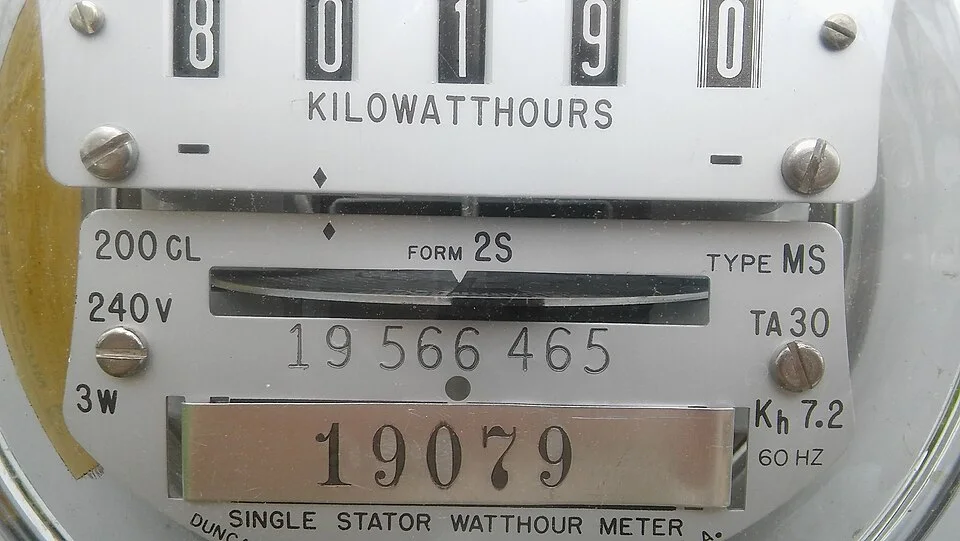
The KILOWATTHOURS wording identifies accumulated energy, while the lower face carries separate equipment markings. Retain the meter identifier, complete register, observation date and read status when checking a bill. This close view does not establish service dates or how the supplier allocated an estimated period.
Photo & usage
LordShadowWing · CC BY-SA 4.0 · Source. Display copies resized and encoded as WebP; no instructional details were fabricated or removed.
Portland General Electric’s billing guide explains that a communication failure can lead to estimated use followed by a correction. That is a reason to check the reading basis even when you have a communicating meter. A correction may cover electricity from earlier periods; ask which dates it reconciles before assigning it to this month’s routines.
If an ordinary meter display is readily accessible, follow your supplier’s instructions to record its identifier, reading, register labels, date and time. Stay with observation: leave seals, covers, wiring and electrical panels alone. If access requires climbing, opening equipment or entering a locked communal area, request help from the supplier or building manager.
Today’s reading will usually be later than the closing reading on the bill. Do not report the difference as an error without accounting for elapsed time. For multiple registers, a meter replacement, an unexplained multiplier or a reading that seems to go backwards, send the details to the supplier instead of improvising a conversion.
Find which price a changed habit would affect
Put a mark beside each line that changes with kWh and another beside each fixed or daily charge. Portland General Electric describes its basic charge as payable even with no consumption. Consequently, cutting use cannot remove every line on a bill. Check how your own supplier calculates each item.
Supply or generation and delivery can appear separately. For a saving estimate, include the applicable variable components together, while checking for offsetting credits. Do not assume every delivery charge is fixed. PG&E’s bill glossary distinguishes generation, distribution, customer charges and other components; the labels and calculation rules on your statement govern your calculation.
- Single-rate plan: find the applicable per-kWh components and their effective dates.
- Tiered plan: identify the consumption band affected by the units you would avoid. Do not price every saved unit at the cheapest band automatically.
- Time-of-use plan: copy the relevant season, weekdays, weekends and time windows from your actual schedule.
Dividing the entire amount due by kWh produces an average that can include fixed fees and old balances. It is unsuitable for estimating the value of one avoided kWh. If your statement includes demand charges, solar export credits or an annual settlement, ask for an explanation of those calculations before using this simple method.
Turn the diagnosis into one proportionate change
If billing days and rates explain the increase, you can finish with a documented explanation. If daily use has risen, list what changed during the service dates: more people at home, heating season, a new appliance or extra laundry. Start with the event that fits the timing.
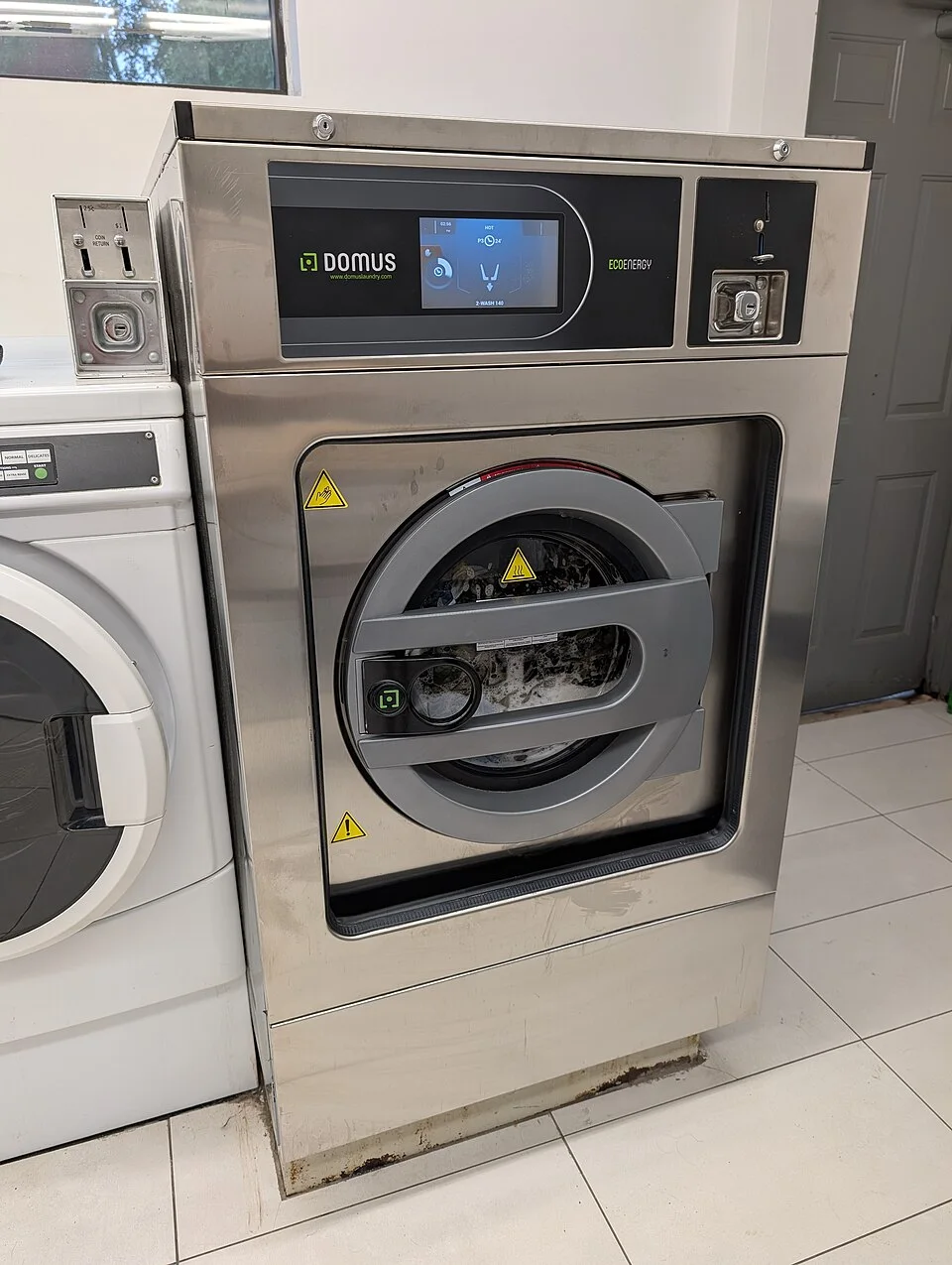
The washer’s loaded drum and programme display provide observable task context for an appliance record. Note the actual programme, load description, dates and any changed routine when investigating higher use. A countdown or busy drum is not an energy measurement; retain appropriately sourced consumption evidence and keep whole-home bill conclusions bounded.
If your account offers interval consumption data, inspect the units and timestamps before comparing days. Mark the dates of household changes. A whole-home graph can suggest when a rise occurred; it does not, by itself, identify which appliance caused it.
For a hypothetical time-of-use calculation, suppose 12 kWh of an existing monthly activity can move from USD 0.30/kWh to USD 0.18/kWh. The energy-charge difference is 12 kWh × USD 0.12/kWh = USD 1.44. Consumption remains 12 kWh; timing changes its cost. This assumes no other charge changes and excludes taxes.
Choose a convenient activity you already supervise, at a cheaper time when you are present, using its normal controls and manufacturer instructions. Record the intended change and start date. A small calculated benefit helps you decide whether the inconvenience is worthwhile; it does not justify disrupting essential household functions.
THE WORKING FILE / LEDGER
A larger bill can conceal lower daily consumption
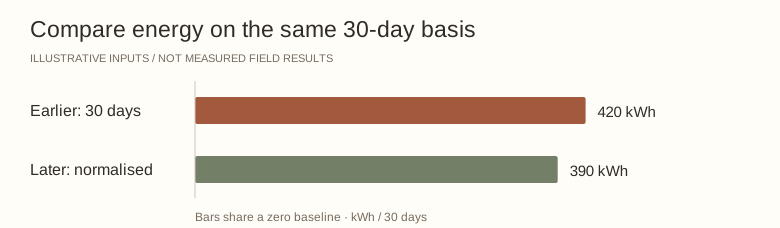
Consider two invented bills with unchanged USD 0.20/kWh energy pricing. The first covers 30 days; the second covers 35. Compare both total energy and energy per day before blaming a new household habit. Fixed charges, taxes, credits and debt payments are excluded from this small example.
| Measure | Earlier bill | Later bill |
|---|---|---|
| Billing days | 30 | 35 |
| Metered electricity | 420 kWh | 455 kWh |
| Daily use | 14 kWh/day | 13 kWh/day |
| Energy charge only | USD 84.00 | USD 91.00 |
| Same 30-day basis | 420 kWh / USD 84.00 | 390 kWh / USD 78.00 |
Read the result
The energy charge rose USD 7, yet the later daily average fell by 1/14, about 7.1%. The extra five days explain why a lower daily rate still produced a larger total. A 30-day equivalent makes the comparison readable; it does not rewrite what the supplier is entitled to bill. Next compare the actual price per kWh and fixed-charge days separately.
Your ledger record Blank worksheet
Separate higher consumption from a longer billing period or a higher unit price.
- Bill reference
- ________________________________
- Start read and date
- ________________________________
- End read and date
- ________________________________
- Actual or estimated
- ________________________________
- Billing days
- ________________________________
- kWh
- ________________________________
- USD/kWh
- ________________________________
- Fixed charges USD
- ________________________________
- kWh/day
- ________________________________
- Question for supplier
- ________________________________
Before closing the file
- Both readings use the same meter and multiplier.
- The elapsed-day count matches the bill.
- Energy, fixed charges and payment adjustments are recorded separately.
Finish with an explanation you can check again
Before filing the bill, confirm that your notes contain the service dates, billed days, kWh/day, reading basis, rate name and the items responsible for the money difference. Mark unresolved amounts explicitly. Recheck the next statement using the same fields, allowing for weather, visitors and rate changes.
For unexplained readings or charges, contact the supplier using the details on your statement. Give the two periods, relevant readings, disputed line and your calculation. Ask: “Is this a correction, a rate change or additional measured consumption?” Request the dates involved and a written explanation or corrected statement where appropriate.
The UK Office for Product Safety and Standards advises contacting the supplier about suspected meter inaccuracies and explains that there is no simple household accuracy test. Stop at documenting the concern and requesting investigation. If the bill arithmetic is resolved but consumption remains unexplained, ask about a household energy assessment rather than opening equipment. Keep the explanation with the next bill so the same puzzle does not start again.
THE REFERENCE FILE
Sources & scope
Documentation reviewed 1 Nov 2026. Examples are illustrative; this article does not claim hands-on product testing. Follow the instructions for your actual material, model and location.