Household papers often occupy several small piles because the actions and the records have become mixed. A bill waiting for a response, a document retained for reference and an empty envelope do not need the same destination. A compact station can fit on one suitable shelf when those decisions are separated.
Measure the actual paper formats and the shelf opening before choosing organizers. This guide addresses physical handling and storage, not legal retention periods or financial advice. Keep documents for the periods required by your own circumstances and relevant official guidance.
Start with decisions rather than folder colors
Sort a manageable sample into action required, retained reference, uncertain and material suitable for disposal through your normal secure process. Do not discard another person's documents or assume an unfamiliar paper is unnecessary. Keep uncertainty visible for a specific follow-up.
Name the next action on each active group: reply, check a figure, obtain a document or file after completion. A folder labeled important is less useful because it does not explain what happens next. Keep deadlines in an appropriate private record rather than relying on the paper's position alone.
Separate privacy requirements from convenience. An open shelf may suit ordinary household instructions but not sensitive personal records. Use suitable protected storage where needed and keep identifying information out of shared labels. A compact room arrangement should not make private account details visible to every visitor.
Measure the largest ordinary paper enclosure
Include folders, protective sleeves and document cases already needed for the collection. Measure their complete width, height and depth in the intended orientation. Paper sizes alone do not account for tabs, fasteners or supporting covers that must pass through the shelf opening.

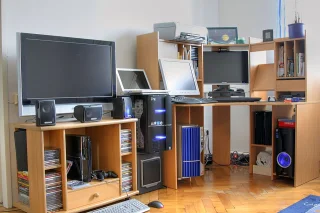
The differing book formats and their shelf positions illustrate why a collection’s largest ordinary format needs its own fit check. For household papers, measure the complete folder, sleeve or case, including tabs and fasteners, in its intended orientation. Allow grasping room without bending documents. This photograph shows books, not a measured paper enclosure or verified archival storage material.
Photo & usage
Roman Eisele · CC BY-SA 4.0 · Source. Display copies resized and encoded as WebP; no instructional details were fabricated or removed.
The Library of Congress — Care, Handling, and Storage of Works on Paper guidance recommends supportive protective enclosures for works on paper and cautions against unsuitable handling materials. Use appropriate care for original or valued documents. Do not treat every generic sleeve as suitable for fragile media, and do not fold a document merely to fit a smaller organizer.
Check the shelf's usable dimensions between supports. Include room to grasp and remove a folder without bending its contents. If the largest format is occasional, it may deserve a separate flat destination rather than forcing every daily paper into an oversized box. Record that exception clearly so it does not become an unexplained loose pile.
Give the active queue a visible capacity
Choose a small defined space for papers requiring action. It should be easy to inspect and separate from retained records. Avoid stacking the active queue behind reference files where it disappears whenever the shelf looks tidy.
Set a review trigger linked to an existing household routine. The purpose is to make the next decision before the queue fills, not to promise an unrealistic daily filing ritual. If the queue repeatedly grows, inspect whether actions are unclear, documents are missing or the review point is not happening.
Use one uncertain folder only if it has a review plan. Otherwise it becomes a permanent destination for every difficult decision. Keep that group separate from completed records, and note the question that needs answering. The storage cannot resolve a missing retention rule or a disputed bill simply by giving it a neatly labeled place.
Work through an illustrative shelf allocation
This example is illustrative. A shelf has 76 cm of usable width. An active-paper tray requires 28 cm, three reference files require 9 cm each, and a protected document case requires 16 cm. The allocation is 28 + 27 + 16 = 71 cm, leaving 5 cm overall.
A fourth 9 cm reference file would raise the total to 80 cm, exceeding the width by 4 cm. The decision is to review the reference categories, move an appropriate group to another suitable location or choose a different format that still supports the documents. Compressing files until they cannot be removed is not additional useful capacity.
The calculation assumes the heights and depths already fit, which must be checked separately. It also excludes hand clearance beyond the observed trial. A 5 cm remainder is not a universal handling allowance. Try the actual files and intended user before approving the layout or ordering matching organizers.
Keep retained records identifiable and supported
Group retained papers by the way they will be retrieved, such as a specific appliance or household service. Keep the current version distinguishable from superseded information. Where retention questions arise, obtain appropriate official or professional guidance rather than deleting records to satisfy a shelf target.
The Library of Congress — Storing Your Books guide discusses protective housings and the limitations of vague archival descriptions. For important paper collections, look for relevant material specifications rather than treating an attractive storage box's marketing language as a preservation guarantee.
Avoid overstuffing files. A swollen folder can snag, bend papers and obscure labels. Divide the category when needed while preserving the room's capacity boundary. If additional retained records require more positions than the shelf provides, assign another suitable location explicitly. Do not hide overflow behind the active tray, where it can be mistaken for completed filing.
Test access from the ordinary working position
Retrieve an active paper, a middle reference file and the protected case. Check visibility and grip, then return them. The U.S. Access Board — Operable Parts guide explains how obstructions affect access. A deep front tray can make rear files difficult even when their labels remain visible above it.
Use a suitable clear surface for reviewing papers and returning them to order. Keep food and drink away from valued documents, and follow the care appropriate to their condition. A shelf can hold the station while a nearby desk serves the active task, provided that surface is ordinarily available when needed.
If the station is shared, ask another regular user to find a named category without coaching. Confusion may indicate unclear labels rather than insufficient storage. Simplify the language before adding another level of folders. The system should match household vocabulary, not a filing convention only its author understands.
Check the active queue for blocked decisions
At review, separate papers waiting on an outside response from papers whose next action is still unclear. Both may remain active, but they need different notes. Record a reference or next review date for a pending response rather than repeatedly handling the paper without knowing why it remains.
Keep unresolved retention questions separate from routine filing. A shelf-size target should never decide whether an important document is discarded. Obtain the relevant guidance and preserve suitable temporary storage while the question remains open. Completion means the active queue has understandable reasons for what stays, not that every paper disappears from view by the end of a tidy-up.
Close the loop at the first ordinary review
At the next review point, process the active queue through its real decisions. File completed records, follow up unresolved questions and remove material suitable for your normal secure disposal process. Record what prevented completion without treating every delay as a storage failure.
Check whether the tray, files and protected case still fit independently. If an organizer has become a catchall for unrelated objects, restore the category boundary or assign those objects a real destination. Keep the usable shelf envelope visible in the record so future additions trigger a decision.
Completion means incoming papers have clear next actions and retained records can be found without searching a mixed backlog. The station's small size works because decisions keep categories distinct, not because important documents are discarded or forced into a container that is too small.
THE REFERENCE FILE
Sources & scope
Documentation reviewed 1 Nov 2026. Examples are illustrative; this article does not claim hands-on product testing. Follow the instructions for your actual material, model and location.