Give the next service visit a clear starting point
A folder of invoices may show that someone attended without explaining which symptom was reported, what was found or whether follow-up remained. Build a hot-water service file around those questions. The file should let a qualified provider understand the history without asking the household to diagnose the equipment.
Start with the exact equipment identity and the responsible service contact. Use existing documentation or an accessible label photograph. Do not remove covers, climb into an unsuitable space or touch hot components merely to obtain a serial number.
EPA's hot-water material distinguishes system design and delivery issues, CDC discusses home-water microbial considerations and FTC explains written warranty records. These are context sources for the file. None supplies a universal servicing interval, thermostat setting or repair instruction for every hot-water system.
Record equipment and system scope
List the heater model, serial where available, installation date if documented and the manual reference. Mark unknown dates as unknown rather than treating the age of the house as the equipment age.
Record whether the household has its own equipment or receives hot water through a shared building arrangement. Identify the manager or provider responsible for access and service. A tenant should not assume authority to alter shared controls because the symptom occurs at a private tap.
Keep related equipment identified only where documented: controls, mixing devices or recirculation components may have separate instructions and service responsibilities. Do not infer the full system layout from a visible pipe. Ask the qualified provider to describe the relevant scope in its report.
Write the household observation before the visit
Describe the affected fixture, ordinary task, first noticed date and pattern. Include whether the issue is sudden, intermittent or linked to a known event. Keep waiting-time notes and visible observations separate from measured temperatures or professional findings.
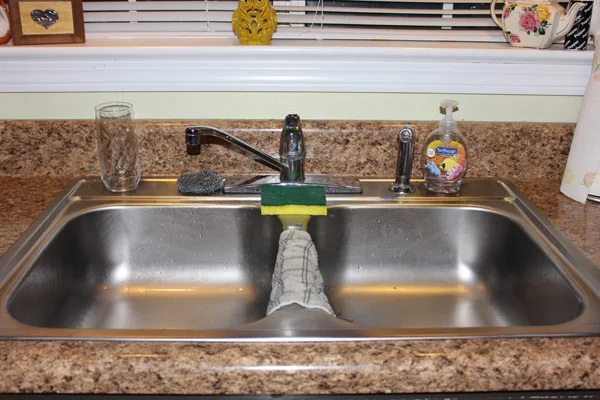
The kitchen tap, sink bowls and separate sprayer are visible fixture details that can identify the outlet in a service report. Record the ordinary task and observed pattern beside dates and any properly obtained measurements. The photograph does not reveal hidden plumbing, prove a hot-water temperature or diagnose an internal fault.
Photo & usage
Angelsharum · CC BY-SA 3.0 · Source. Display copies resized and encoded as WebP; no instructional details were fabricated or removed.
Do not provoke a fault or run repeated hot draws to make a more dramatic record. Follow the manufacturer's and building's reporting guidance. A leak, unusual heat, smell or other potential danger may require immediate appropriate action rather than a routine documentation exercise.
State what has not been checked. If the household has no reliable temperature measurement, write that. A clear absence of evidence is more useful than a guessed number that later appears in the technician's file as though it were measured.
Capture the actual service handover
Record attendance date, provider and the symptom supplied. Ask for the work description and any findings in writing. Attribute technical conclusions to the provider rather than rewriting them as household facts.
Keep a distinction between inspection, adjustment, part replacement and a proposal for later work. An invoice saying “checked system” should not be interpreted as proof that every component was inspected or that a reported symptom has been resolved.
Ask what remains unavailable or restricted, what ordinary operation is permitted and whether another visit is required. Keep those instructions accessible to the people using the system. Do not change a professional setting simply because an older internet recommendation appears different.
Reconcile an illustrative invoice and open action
This illustrative USD service record lists a USD 95 attendance charge, USD 120 labour and a USD 45 authorised part. The subtotal is USD 260 before any tax or other stated charge. A separate proposed return visit is quoted at USD 80.
The completed invoice remains USD 260; the proposed USD 80 is not an incurred cost until the relevant work is authorised and performed under the agreement. If it later occurs at that amount, the combined recorded cost becomes USD 340 before any excluded charges.
This distinction matters when comparing service history or a replacement proposal. Do not add every quotation as though it were paid, and do not omit a completed return visit because it arrived on a second invoice. Link costs to the actual work and its status.
Keep coverage questions separate from technical findings
Save the receipt, written warranty and relevant service correspondence. FTC's guidance recommends retaining those records and reading coverage and claim terms. The publication is US consumer guidance; local rights and the actual warranty need their own review.
Ask which party handles the claim and what documentation is required. Keep any authorisation reference with the work. Do not assume that a technician's visit automatically confirms coverage or that an invoice proves the manufacturer has accepted responsibility.
If a service contract exists, file it separately from the product warranty and identify overlaps or exclusions. Record the provider and duration. A paid contract is a distinct purchase whose terms should not be inferred from the appliance brand.
Preserve system-specific operating instructions
Keep the professional handover and current manual together. If temperature-control or microbial-management questions arise, ask the appropriate qualified provider to reconcile the system requirements. CDC's home-water guidance and other safety publications address different risks; a household should not resolve them through a generic thermostat rule.
Do not publish security details or private service information in a shared household checklist. The working summary can name the contact, permitted routine and review date while the detailed equipment record remains secure.
Record which instructions supersede earlier advice. Preserve the earlier document as history but mark the current operating guidance clearly. Conflicting handwritten settings in a folder can be more confusing than a missing note.
Confirm closure through the appropriate process
After work, record the provider's completion statement and any ordinary-use observation allowed by the instructions. If the original symptom remains, report it with a link to the visit rather than inventing a different diagnosis.
Keep a short open-action list: missing report, quoted part, return visit or unresolved symptom. Give each an owner and the actual next step supplied by the service process. Do not assign a universal deadline from this article.
The service file is complete when equipment identity, attributed findings, performed work, costs and outstanding actions can be followed. It should improve the next conversation while leaving diagnosis, temperature management and invasive work to the people responsible for the system.
Link a recurring symptom without rewriting the previous visit
If the symptom returns, add a new dated entry linked to the earlier service. State whether the fixture, starting conditions and reported behaviour appear the same. Keep the earlier completion report intact so the sequence remains traceable.
Do not rename the original visit a failed repair without the evidence or provider's assessment to support that conclusion. The earlier work may have addressed one component while a new or intermittent issue remains. Describe what was observed after service and when the recurrence was noticed.
Send the provider the relevant history rather than the entire unindexed folder. Include the original symptom, performed work, any restrictions and the new observation. Ask whether the issue falls under the previous visit, warranty process or a new assessment.
Keep technical terminology attributed. If one provider calls a component by a different name, retain both references with the source rather than combining them into an invented diagnosis. Part numbers and the written report can help the next technician identify what actually changed.
The file should reduce repeated explanation while preserving uncertainty. Its value is an accurate service history, not a household claim to have independently verified the internal system.
THE REFERENCE FILE
Sources & scope
Documentation reviewed 1 Nov 2026. Examples are illustrative; this article does not claim hands-on product testing. Follow the instructions for your actual material, model and location.