A list of everything in a small room can become a long document that changes nothing. To make it useful, record how the objects are retrieved. Daily items, occasional references and fragile keepsakes do not deserve identical locations merely because they fit in boxes of the same size.
This inventory is for reorganizing an occupied room, rather than estimating moving cartons. Work a little at a time so belongings do not block the floor. The outcome is a category-to-location plan with explicit decisions about convenience, support and the possessions that still lack a suitable home.
Define the room's jobs before counting possessions
Write down the activities the room must support: sleeping, working, dressing or shared leisure. Identify the routes, surfaces and controls needed for those activities. Preserve them as constraints before listing new storage opportunities. Otherwise, the inventory can become an argument for filling every usable surface.
Choose a manageable starting area such as one cupboard shelf. Keep its contents on a suitable clear surface while recording them, and return or reassign them promptly. Avoid emptying the entire room into piles that prevent ordinary use. Several short sessions can produce a more reliable inventory than one overwhelming clearance.
Record categories at a level useful for decisions. Daily writing kit is often more useful than twenty separate entries for pens, while valuable documents may need individual identification. Use detail where it changes location, handling or retrieval. Do not create elaborate item numbers for interchangeable objects unless the household has a practical reason to maintain them.
Add frequency without pretending to know exact counts
For each category, record observed or honestly estimated frequency: daily, weekly, seasonal or rarely retrieved. Note the last remembered use when helpful. An uncertain answer should remain uncertain until a short observation period clarifies it; do not invent precise retrieval numbers to make the spreadsheet look complete.
Include return behavior. An item used daily but left out because its storage is awkward deserves attention. An item rarely used but easy to return may tolerate a less convenient location. Write the actual problem beside the frequency rather than assuming all visible clutter has the same cause.
Check categories shared by several people. A kit may appear occasional to one person but be used daily by another. Ask users before moving it to a remote cupboard. The inventory should explain the household's combined needs, not merely reflect the person doing the sorting.
Record size, support and handling separately
Measure category groups in their intended containers. Include exterior dimensions, lids and handles. The IKEA — SAMLA Box, Article 701.029.72 page shows why a nominal volume is not a complete fit specification. A category can occupy the right number of liters while requiring a shape that does not fit the available opening.

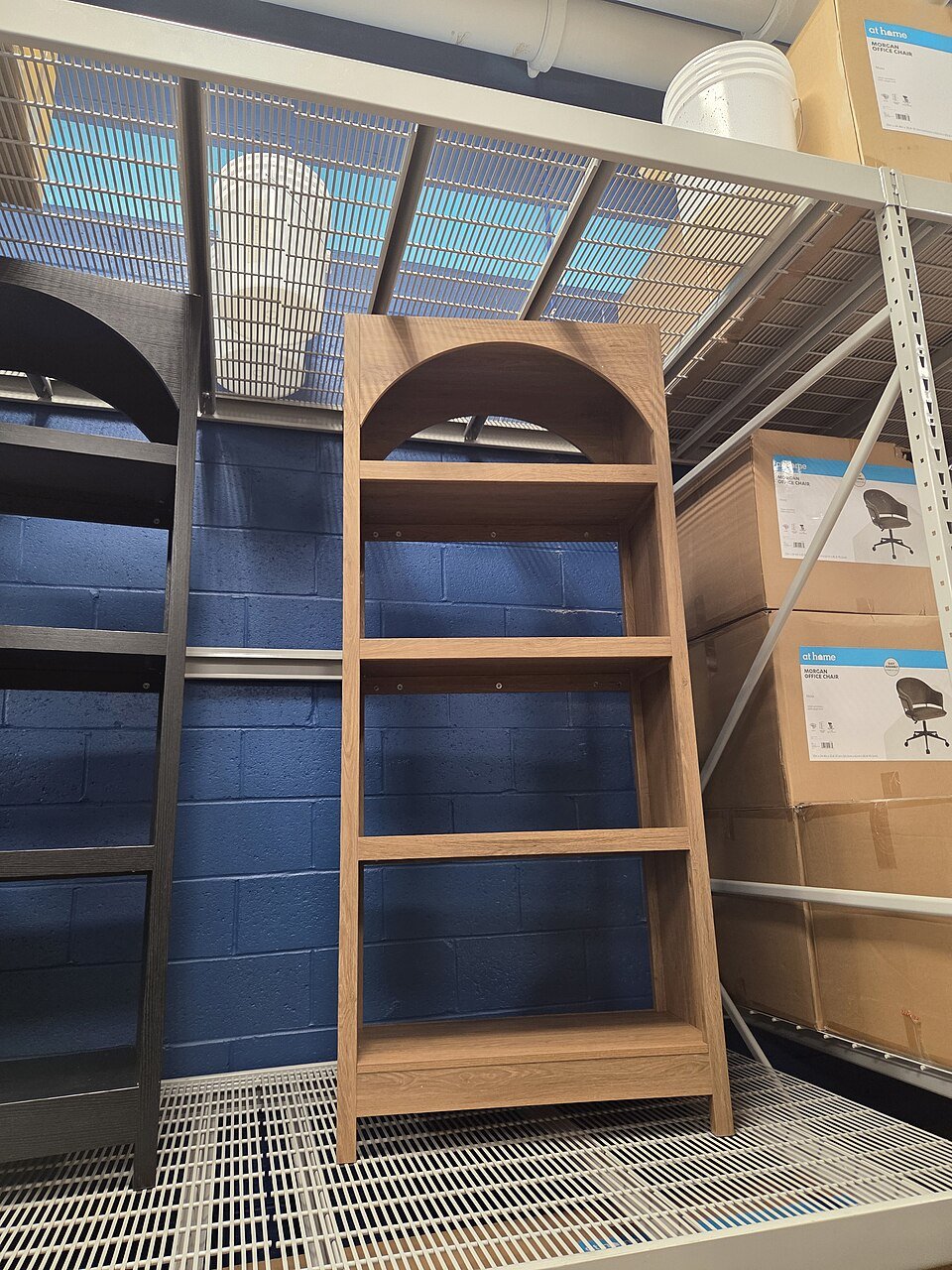
The varied book formats illustrate why one category count is not enough for a storage inventory. Record complete group dimensions, any protective enclosures and the way the assigned person retrieves them. Keep loose or fragile papers as a separate handling decision. The shelf photograph supplies neither object weights nor load ratings for this or another cabinet.
Photo & usage
Roman Eisele · CC BY-SA 4.0 · Source. Display copies resized and encoded as WebP; no instructional details were fabricated or removed.
Add any handling limits or support requirements. Dense books, awkward equipment and fragile papers should not be treated as equivalent box loads. For valued books, Library of Congress — Storing Your Books discusses protective enclosures; allow those enclosures in the plan where appropriate rather than counting only the bare collection.
Mark whether one person can handle the category comfortably or whether it needs smaller groups or assistance. Do not turn this into a generic weight threshold for everyone. The practical decision is whether the assigned user can retrieve and return it appropriately from the proposed position, using the product within its intended conditions.
Allocate an illustrative set of shelf positions
All figures here are illustrative. A room has eight usable front-access shelf positions. Three daily categories need one position each, two weekly categories need one each, and three occasional categories need one each. That assigns all eight positions: 3 + 2 + 3 = 8.
If two occasional categories can be combined suitably into one supported container, seven positions are used and one becomes available. That change is useful only if combining does not make the container too awkward or hide frequently retrieved contents. The inventory count cannot establish that by itself.
Now suppose a new daily kit arrives. The room does not gain a ninth position merely because the kit is important. Decide whether to reduce a category, combine suitable occasional contents or assign another real location. The example makes the capacity boundary visible before an extra box appears on the floor.
Match convenience to the whole retrieval movement
Place daily categories where the intended user can identify, grasp and return them from a comfortable position. The U.S. Access Board — Operable Parts guide distinguishes reach height from reaching over an obstruction. Use that concept to inspect deep shelves and furniture placed in front of storage, rather than assigning convenience solely by shelf height.
A front row on a lower shelf may be more usable than a high shelf advertised as easy access. Test with the actual user. Keep less convenient locations for categories whose handling remains appropriate there; do not send a heavy box overhead merely because it is rarely opened.
Include the temporary working surface in each assignment. A document box may need a clear table for sorting, while a daily tray may be used in place. If the destination depends on a surface that is normally occupied, the inventory has identified a dependency. Resolve it before describing the category as successfully stored.
Mark unresolved categories rather than hiding them
Use a short unresolved list for possessions without a suitable destination. Record the reason: too large, too heavy, sensitive to conditions or simply beyond current capacity. A visible unresolved category is more useful than a miscellaneous box that disappears into the least accessible gap.
Choose a decision for each category. Retain it with an appropriate location, reduce or reassign it with the owner's agreement, or obtain more suitable storage after measuring the room. Do not treat extra furniture as the default response before checking the existing collection and access needs.
Give temporary possessions an end point. A borrowed object, repair project or item awaiting collection can occupy space indefinitely when no review date exists. Set a realistic follow-up in your own household record. This is a practical inventory decision, not a promise that another person will collect or approve anything.
Keep uncertain frequency out of permanent assignments
If an item’s use is uncertain, give the category a provisional position and observe it during an ordinary routine. Record actual retrievals without demanding a detailed log of every small object. A category repeatedly used during the trial should not remain classified as rare merely because the original inventory guessed incorrectly.
Update the location decision when the evidence changes. Keep an occasional category from occupying the only convenient position for a daily kit, but do not move a difficult load somewhere unsuitable just because it is rarely used. The inventory’s purpose is to connect real tasks with workable storage. Its first classification is a hypothesis that ordinary use can correct.
Validate the inventory through ordinary use
Follow the plan for several normal days and record exceptions. Which category is repeatedly left out? Which box is opened more often than expected? Which stored item cannot be found by another user? Those observations are evidence for revising the assignment, not a failure of the person maintaining the room.
Check that the inventory still describes the real locations. Use simple names such as desk shelf, left side rather than a complex code nobody remembers. Update it when a category moves, and keep sensitive inventory information appropriately private.
Completion means every retained category has a suitable home, unresolved items have explicit next decisions and the room's essential activities remain available. The inventory's value is the relationship between use and location. Its success is measured by reliable retrieval and return, rather than the number of lines in a document.
THE REFERENCE FILE
Sources & scope
Documentation reviewed 1 Nov 2026. Examples are illustrative; this article does not claim hands-on product testing. Follow the instructions for your actual material, model and location.