Treat the reset as a plan awaiting observations
This plan was reviewed on November 1, 2026 for a November 6 release. It proposes observations to make when you use it; it does not report that a November change has already occurred. November can bring different solar and weather conditions in different places, and the room’s use may matter as much as the calendar. Begin with the actual window and the activity beside it.
Choose a narrow question for each window: has direct sun begun reaching the reading chair, has a formerly bright task area become dim, or does a surface stay warm after the sun moves away? Avoid resetting every blind to one angle simply because a seasonal checklist says to do so. A shaded apartment and an exposed room on the opposite side of the same building can need different decisions.
YourHome’s orientation guidance links sun access to direction and changing solar angles. Its Australian setting matters when interpreting compass examples. Use the general principle of observing sun through your own opening, then document the local result. Do not translate November automatically into winter, summer, heating mode or cooling mode.
Make a card for one occupied window
Write the room, window identity, usual occupied seat and approximate looking direction. Add the covering type and its ordinary controls. Describe the current setting clearly enough to restore: fully drawn curtains, blind raised to a known point, or slats tilted with a sketch. Include any fixed obstruction outside that you can see safely, such as a balcony or neighbouring building.
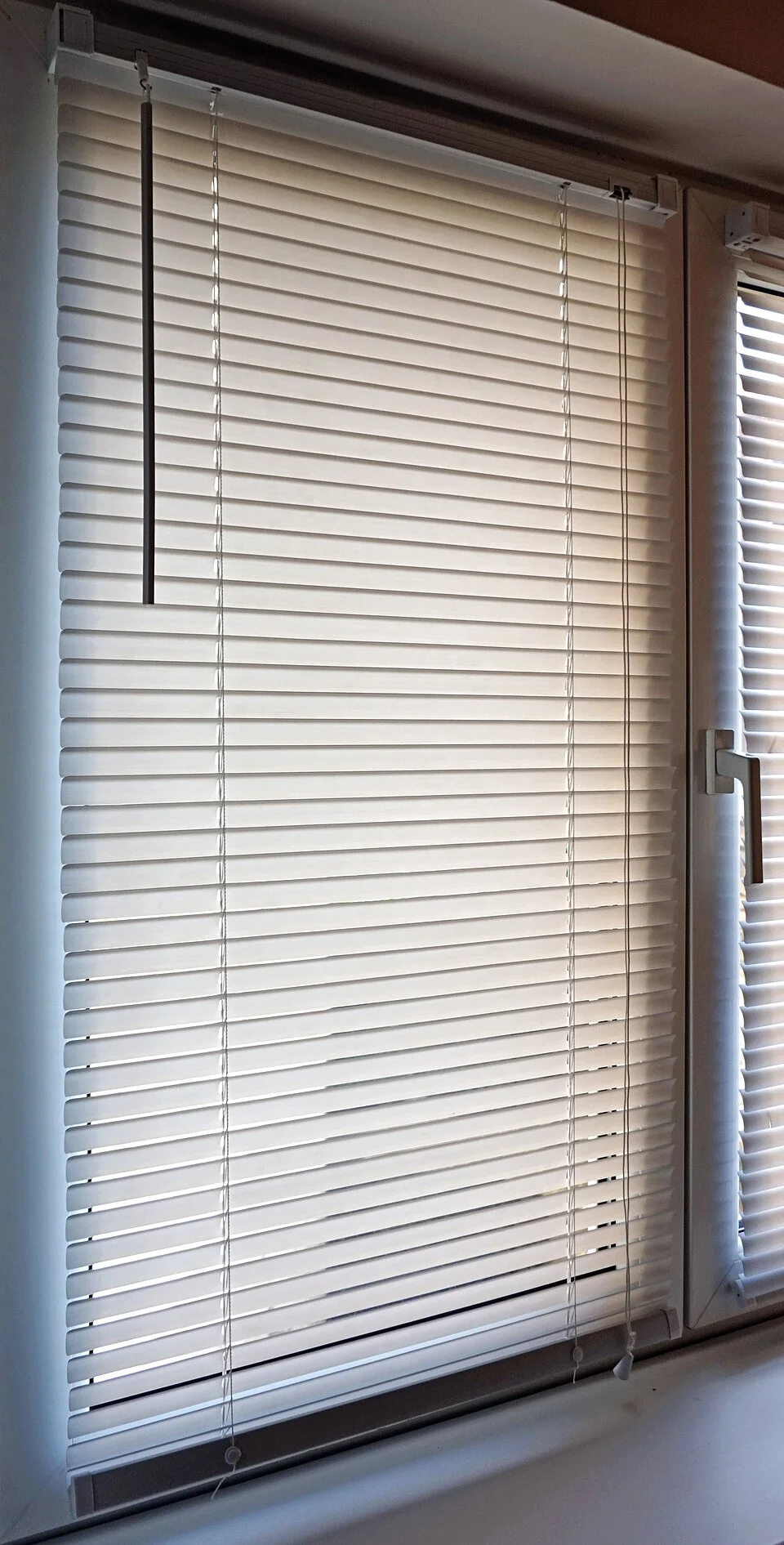
The lowered slats, tilt wand and visible window edges provide concrete reference points for a window card. Note the actual covering type and intended control state rather than writing only closed or shaded. Add date, observation time and sun visibility to your own record; neither orientation nor a repeatable numerical angle can be read from this photograph.
Photo & usage
Tiia Monto · CC BY-SA 4.0 · Source. Display copies resized and encoded as WebP; no instructional details were fabricated or removed.
Choose two or three observation times linked to real use, rather than taking hourly readings all day. For a breakfast window, the relevant period may be brief. For a work corner, morning and late afternoon may reveal different sight lines. Record clock time, date and whether the sun is visible, behind cloud or blocked by an object. Keep weather descriptions separate from the covering position.
Operate only accessible existing controls from a stable floor position. Do not lean outside to identify orientation, climb furniture to inspect an external shade or alter a fitting you are not authorized to change. A reset can be limited to ordinary indoor settings; external alterations belong to a separate practical decision.
Observe light, sun patches and local sensation separately
At each visit, note whether direct sun reaches the occupied body, the task or only an unoccupied surface. Mark the sun patch on a quick room sketch using a fixed feature as reference. A patch on the floor is not the same as sun in a person’s eyes. Look at the room and task without staring into the sun or tracing it through binoculars or other optics.
Check the normal seated view for a bright window, a reflection or insufficient light on the activity. Then note local warmth, coolness or moving air in plain language. HSE’s thermal comfort guidance makes clear that an air-temperature reading alone cannot represent all relevant influences. You do not need to convert every observation into a number before choosing a reversible shade position.
Keep optional temperature readings at a documented, settled location out of direct sun. A thermometer warming in a sun patch is a different observation from room air near the seat. If you move it between visits, mark that change and resist comparing its display as if the instrument had stayed in one position. Surface feelings and air readings belong in different columns.
Compare against a real reference rather than memory
If you have earlier notes, find a visit at the same window, similar clock time and comparable covering state. Write down the differences in cloud, occupancy and recent room use. If no earlier record exists, call this the first baseline. “The sun seems lower” can motivate observation, but it is not a measured seasonal comparison.
YourHome’s shading guidance discusses adjustable coverings and solar access. For this small reset, choose an adjustment in response to an observed conflict: a tilt that removes a reflection, a closure before a surface becomes unwelcome, or a more open setting when direct sun is absent and the task needs light. Do not claim the adjustment will save energy or work throughout the coming season.
Be alert to changes unrelated to the sun. A tree losing leaves, a newly placed mirror, a different work shift or the end of daylight-saving time can change what the household notices. Record a clock change explicitly where applicable. The reset should explain why the useful routine changed, even when the cause is schedule rather than solar geometry.
Work through an illustrative timing reset
This example is invented, with dates and times used only to explain a proposed decision. Suppose an earlier note says direct sun first reached a desk at 16:10 under a particular covering state. A later comparable visit records 15:45. The difference is twenty-five minutes earlier, found by counting from 15:45 to 16:00 and adding ten minutes. It is not a forecast for another window.
| Record | Sun reaches task | Proposed action |
|---|---|---|
| Earlier reference | 16:10 | Previous shade check at 16:00 |
| Hypothetical new visit | 15:45 | Try shade check at 15:35 |
The proposed new check keeps a ten-minute lead: 15:45 minus ten minutes is 15:35. Moving the old 16:00 check twenty-five minutes earlier gives the same answer. The arithmetic verifies the schedule translation, not the physical result. On another day the sun may be clouded out, so make the action conditional on the actual window rather than closing mechanically into an already dim room.
Trial one reset through an ordinary occupied period
Choose one window and one change first. Write the old setting, proposed setting and reason before trying it. At the relevant time, operate the covering normally and return to the occupied task. Check whether the targeted reflection, direct patch or local sensation changes, and whether a new problem appears. An adjustment can remove sun from a screen while making paper beside it hard to read.
Keep the routine reversible. Do not block intended ventilation, cover equipment or secure fabric with improvised attachments to achieve a preferred appearance. If the useful shade setting conflicts with safe normal operation, stop that trial. Document the conflict rather than seeking a more elaborate workaround during an observation exercise.
Repeat on another suitable day if the initial result depends on sun. Note unsuitable days honestly instead of forcing a comparison under unrelated weather. If the household’s occupied time changes, update the observation times as well. A seasonal setting has value only in relation to people actually using the room, not because it produces a tidy schedule on paper.
Finish with settings and a reason to revisit
Write a brief window card with the accepted setting, the event that triggers it and the condition under which it should be reopened or changed. “Tilt when direct sun reaches the desk; reopen when the task needs more daylight” is more informative than “November angle.” Keep controls accessible and make sure another occupant can understand the instruction without your demonstration.
Give unresolved windows their own status. A north-side opening behind permanent obstruction may show no useful sun change during the visits. A window with an inaccessible external blind may need help before any reset can be tried. Do not force all cards into the same conclusion merely because they belong to one monthly task.
The plan is complete when each selected window has a documented current state and a justified keep, adjust or observe decision. Choose a future check as an intention, such as after the next visible change in sun reach; do not claim that review has occurred. Retain dates so later readers can distinguish the November 1 editorial review from the household observations still to come.
THE REFERENCE FILE
Sources & scope
Documentation reviewed 1 Nov 2026. Examples are illustrative; this article does not claim hands-on product testing. Follow the instructions for your actual material, model and location.