Start with what you cannot see comfortably
A lamp can look right beside a chair and still leave half the book in shadow. At a desk, extra brightness can make paper clearer while putting a bright reflection across the screen. Choose task lighting by checking the relationship between your eyes, the material and the light, before choosing a finish or silhouette.
Gather your usual book, a handwritten note, your laptop or monitor, a tape measure and a notebook. Use the glasses you normally wear for these tasks. You can begin with an existing adjustable lamp; the aim is to discover the position and coverage a new light must provide.
Check each seat after dark and during its normal daytime use. Keep the usual room lighting on. Write a specific problem: “My writing hand shades the line,” “The glossy page has a white patch,” or “I lean forward to get the book under the shade.” These observations create a buying brief that “needs more light” cannot.
At the desk, give paper its own light
Sit as you normally work, with the keyboard and papers in their actual places. Start the lamp on the side opposite your writing hand, then check whether that reduces your hand's shadow. This is a starting position, not a rule: a monitor, shelf or shared desk may require a different angle.
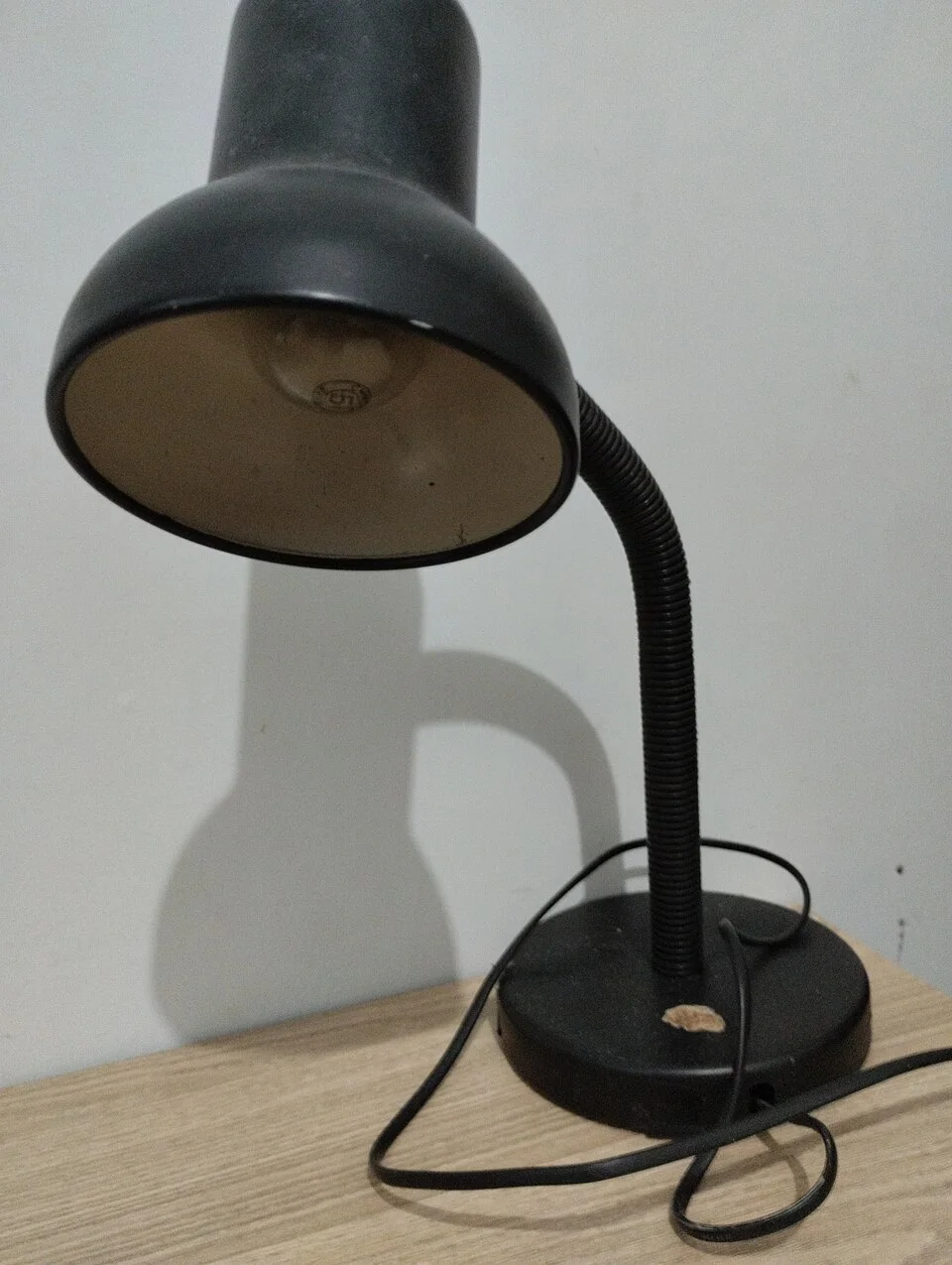
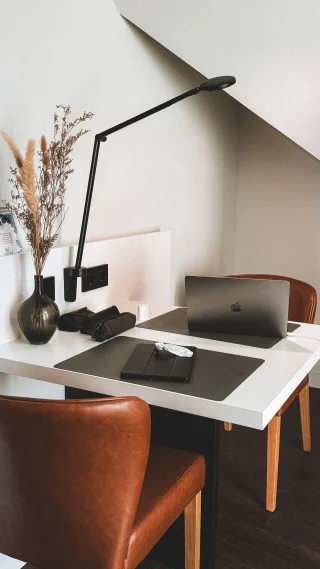
The flexible neck and downward-facing shade show the parts used to direct local light. At your desk, aim an intended adjustment across the actual notebook, then inspect the display from your seated position. No paper or screen is shown here, so this photograph does not demonstrate freedom from glare; arrange the lead clear of the working area.
Photo & usage
AirbusA330772673 · CC BY-SA 4.0 · Source. Display copies resized and encoded as WebP; no instructional details were fabricated or removed.
- With the lamp off, open your usual screen content and inspect reflections. Adjust blinds if the window is the problem.
- Turn the lamp on and aim it across the notebook. Keep the beam away from the display.
- Write several lines, including at the bottom of the sheet. Move the head until your hand no longer hides the next letters.
- Look back at the screen from your normal position. If the lamp creates a reflection, move it sideways or change its aim before increasing output.
OSHA's workstation guidance recommends positioning task lights to avoid screen reflections and using shields or shades to keep intense light out of the line of sight. Those principles are useful at home; its workplace illumination figures are not a universal household shopping target.
Once the beam works, measure the gap from the proposed base position to the paper's centre. Compare that with the lamp's usable reach, allowing for the monitor. An arm that reaches the page only when stretched across the keyboard is a poor fit. Check that its joints hold position and that the base leaves room for your actual work.
At the chair, light the book where it rests
Settle into the chair before positioning the light. Rest the open book where you naturally hold it, including against a cushion if that is your habit. Place the light beside and slightly behind one shoulder, then adjust until the beam reaches both pages without your head blocking it.
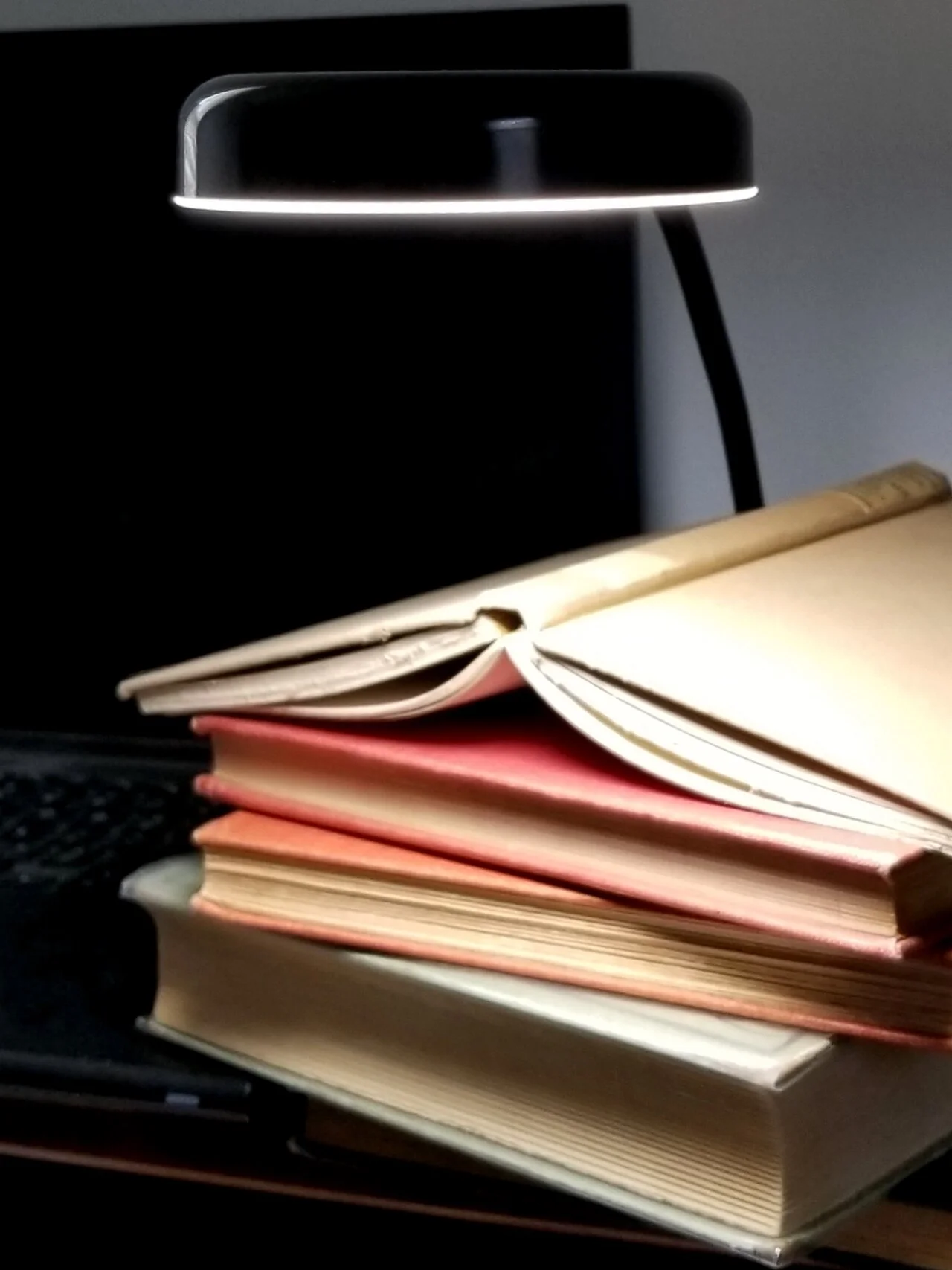
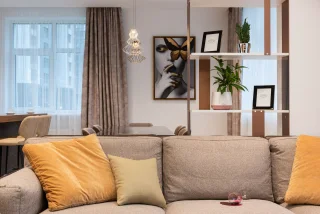
Look at where the light lands on the open pages, then repeat the check with the book at your normal reading angle. The photograph illustrates the light path; it does not prescribe a brightness or a chair position.
Photo & usage
Londonjackbooks · CC BY-SA 4.0 · Source. Display copies resized and encoded as WebP; no instructional details were fabricated or removed.
Read the top and bottom lines on each page. Turn a page, shift your elbows and lean back. If the light works only when you sit upright at the cushion's edge, its reach or beam coverage does not suit this chair. Try the other side before deciding you need more brightness.
For glossy magazines, slowly change the lamp angle while keeping the page still. Look for a position where the pale reflection moves away from the text. A visible bulb calls for a better shield or position; a reflected patch calls for a different light path. Raising brightness alone does not resolve either geometry problem.
Measure from the floor or side table to the successful head position, and from the proposed base to the book. Use these dimensions to compare adjustable floor lamps and table lamps. Check whether the switch is reachable while seated and whether another person sitting nearby would look straight into the light.
Translate those positions into a shopping brief
The Federal Trade Commission's bulb guide distinguishes lumens, which describe light output, from watts, which describe power use. Compare lumens when comparing output. An incandescent-equivalent wattage is not the LED bulb's actual electrical wattage.
Output alone cannot tell you how well a lamp lights your book. Shade design, beam spread, distance and direction all affect the result. Look for adjustable output and enough head movement to reproduce the position you found. Ask about returns if you cannot assess coverage before buying.
- Coverage
- Choose a beam that covers your open book or working sheet. A bright centre surrounded by dim page edges is a reason to try another head or beam pattern.
- Colour appearance
- The Kelvin figure describes warm or cool appearance. For a practical comparison, try a warm option around 2,700 K and a cooler option around 4,000 K, without treating either as compulsory.
- Colour accuracy
- For ordinary text, prioritise comfortable visibility. If you also compare fabric samples or illustrations, consider a stated colour rendering index, or CRI, of 90 or above.
- Controls and replacement
- Check whether dimming is built in, whether a replaceable bulb is supported, and what happens when an integrated LED module fails. Confirm compatibility with any existing dimmer.
The government-backed Energy Rating lamp guide explains Kelvin, CRI and dimmer compatibility. It also advises recording the cap type, size and voltage when replacing a bulb. Check these details alongside the fitting manufacturer's permitted bulb types and maximum actual wattage.
Two setups that lead to different purchases
Hypothetical desk: a right-handed reader uses a laptop and notebook on a desk 48 inches (122 cm) wide. The spare base position is at the left rear, but the notebook sits near the front. Measuring the base-to-page gap shows that a short fixed-neck lamp cannot reach. The useful purchase is an adjustable arm with sufficient reach and a shielded head, rather than a brighter fixed lamp.
In this example, the finish check includes writing at the notebook's lower corner and returning to the laptop. If the arm blocks the display or the beam reflects in it, the chosen model still fails, however clearly it lights the paper.
Hypothetical chair: a reader holds a paperback on their lap beside a table 18 inches (46 cm) high. A decorative table lamp lights the table well, but its shade blocks light toward the book. An adjustable floor lamp can bring the head over the shoulder without occupying the table. Its base must fit beside the chair without entering the walking route.
Here, success means both pages remain readable when the reader leans back and turns them. Copying the desk lamp's dimensions would solve the wrong problem.
Reject a layout that needs an unsafe workaround
Before buying, trace the supplied cord's route to an existing suitable outlet. Include slack for the lamp's permitted movement. If it cannot reach without crossing a walking route, choose another position or model. New outlets and alterations to fixed wiring belong with a qualified electrician.
The US Consumer Product Safety Commission's extension-cord guidance says extension cords are temporary and must not run under carpets, through doorways or under furniture. It also warns against damaged cords and makeshift repairs. A permanent reading corner should not depend on a concealed extension lead.
Follow the lamp's assembly and clearance instructions. Keep its head clear of curtains and upholstery. Before changing a user-replaceable bulb, unplug the lamp and let it cool. Use only a manufacturer-permitted bulb. If the instructions or rating label are missing, obtain them before fitting a replacement.
Stop using a lamp with visible cord damage, a damaged plug or an unstable base. Have the supplier or a qualified repairer assess it; do not open electrical housings or patch insulation.
THE WORKING FILE / COMPARISON
The same lamp can succeed at the chair and fail at the desk
In two invented layouts, one lamp illuminates an open book comfortably but appears as a bright reflection in a nearby monitor. The desk also needs space for hand movement. A single “bright enough” verdict misses these different sight lines. Compare each task in the posture in which it will actually be done.
| Check | Desk | Reading chair |
|---|---|---|
| Viewing surface | Paper plus reflective screen | Book at its normal angle |
| Failure to look for | Screen reflection or hand shadow | Lamp shining directly into eyes |
| Movement test | Write across the full page | Turn pages and change sitting position |
| Position to record | Lamp / screen / dominant hand | Lamp / shoulder / book |
Read the result
Move the lamp head or position before increasing the bulb output. If the reflection moves out of the monitor but the paper remains visible, the geometry may have solved more than a higher lumen rating would. Record a separate successful position for the chair. Lumens describe lamp output; they do not establish the illuminance at a page or a user’s visual comfort.
Your comparison record Blank worksheet
Create separate positioning briefs for a screen-and-paper desk and a seated reader.
- Task and seated position
- ________________________________
- Lamp position
- ________________________________
- Direct glare
- ________________________________
- Screen reflection
- ________________________________
- Hand shadow
- ________________________________
- Adjustment tried
- ________________________________
- Page-turn / writing result
- ________________________________
- Model electrical limits
- ________________________________
Before closing the file
- The actual task is reproduced.
- Both glare and useful page lighting are checked.
- The final setup needs no unsafe cable workaround.
Finish with a page turn and a screen check
Repeat the original tasks with the new lamp in place. The Canadian Centre for Occupational Health and Safety treats insufficient light, glare, uneven distribution and flicker as separate problems. Use that distinction when deciding what still needs adjustment.
- At the desk, write across the sheet and check the screen without moving your torso to escape a reflection.
- At the chair, turn pages and change your resting position. Confirm that the switch remains accessible.
- Check daylight and evening conditions, with some general room light as well as the task lamp.
- Check that the base stays stable, joints hold their position and cords remain clear when the chair moves.
If visible flicker appears during dimming, stop that setting and ask the supplier to confirm compatibility. If coverage or glare remains poor throughout the adjustment range, exchange the lamp. Keep a note of the successful position and setting so another household member can restore them after moving the light.
THE REFERENCE FILE
Sources & scope
Documentation reviewed 1 Nov 2026. Examples are illustrative; this article does not claim hands-on product testing. Follow the instructions for your actual material, model and location.