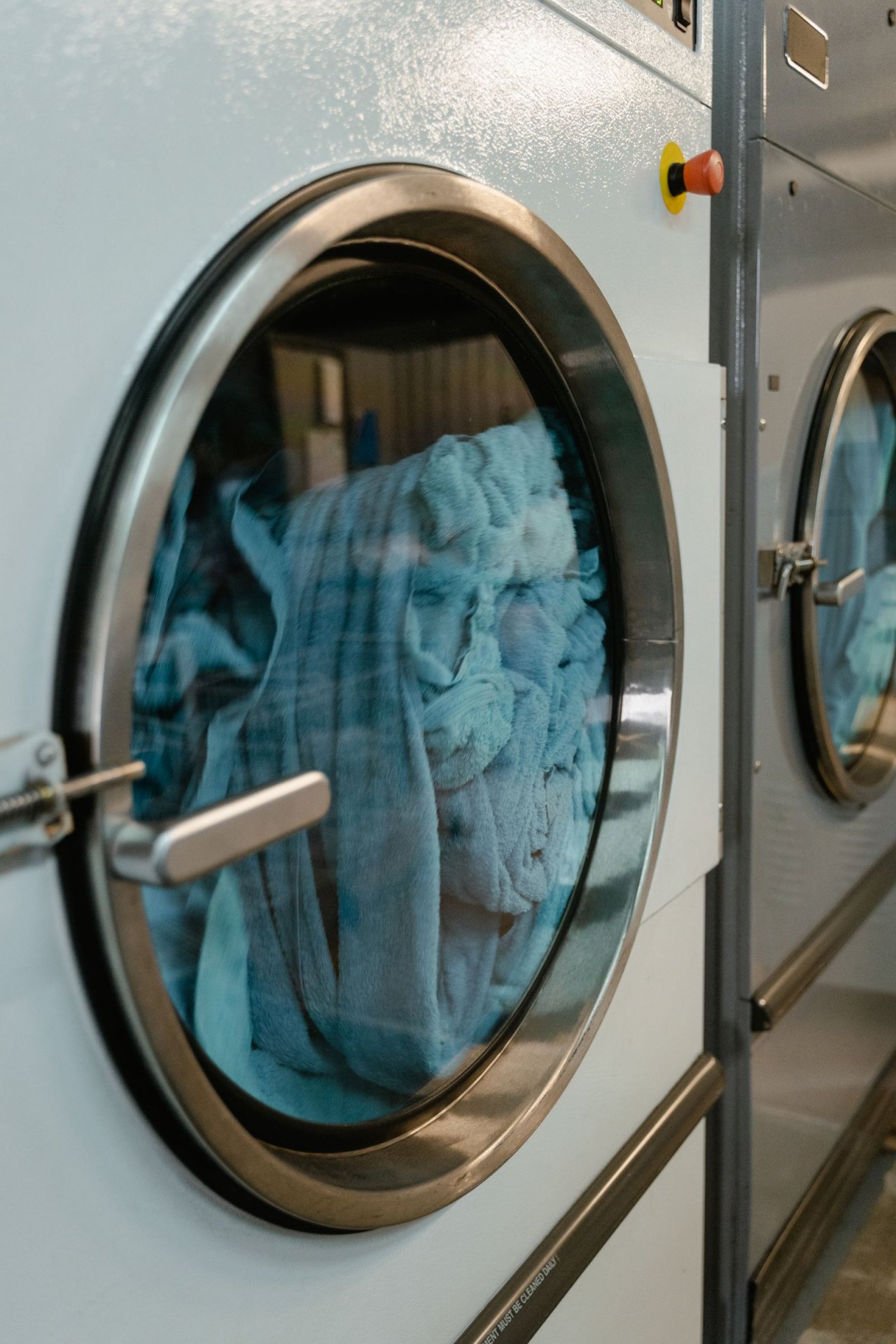
A washer with the lower energy figure can still be the more expensive choice for your household. Water charges, extra small loads and a purchase premium can change the result. Build a comparison around the laundry you actually need to finish each week, then ask what the difference is worth over a realistic ownership period.
Start with a week of laundry, not a showroom label
Before comparing machines, gather your electricity tariff, water and wastewater charging details, and the exact model numbers, manuals and energy labels for both candidates. Use documents for the country where the machine will operate. Similar model names can conceal different capacities or specifications.
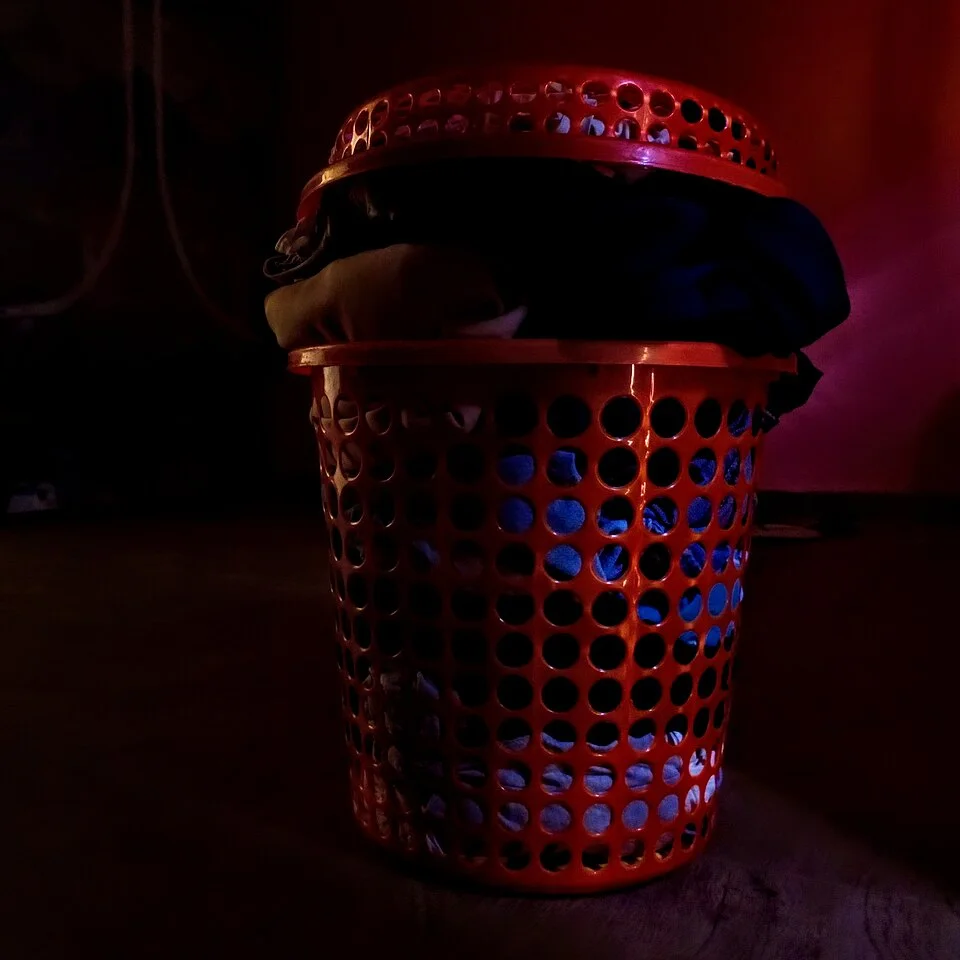
The protruding fabric shows why basket fullness should not stand in for a washer’s permitted load. Record the household’s actual wash categories, programme choices and completed cycle count over an ordinary week. This basket image cannot establish dry mass, fabric compatibility or the number of cycles needed by a particular machine.
Photo & usage
Ridzaina · CC BY-SA 4.0 · Source. Display copies resized and encoded as WebP; no instructional details were fabricated or removed.
For one ordinary week, record each completed wash: programme, temperature setting, extra rinse, approximate load fullness and whether the clothes went into a dryer. Count a repeated wash as another cycle. You do not need to weigh every sock; the aim is to identify whether your household mostly runs full cotton loads, small mixed loads or several separate fabric-care programmes.
Annualise that count with weekly cycles × 52. In the hypothetical comparison below, five cycles a week means 260 cycles a year. If holidays, work uniforms or seasonal bedding change the pattern, write a low and high estimate too. Keep the amount of finished laundry equivalent between candidates: fewer cycles only count as a saving if the larger drum can genuinely combine compatible loads.
Keep this exercise documentary. There is no need to pull out a machine, disconnect hoses, open panels or insert a power meter. If its condition makes an ordinary wash questionable, pause the observation and consult the manual or a qualified appliance technician.
Put both labels on the same basis
The European Commission’s washing-machine label guide identifies electricity consumption per 100 eco 40–60 cycles and water consumption per single cycle. Divide only the electricity figure by 100. A hypothetical 52 kWh/100 cycles becomes 0.52 kWh/cycle; 46 litres/cycle remains 46 litres/cycle. These are programme-based comparison values, not promises for every setting.
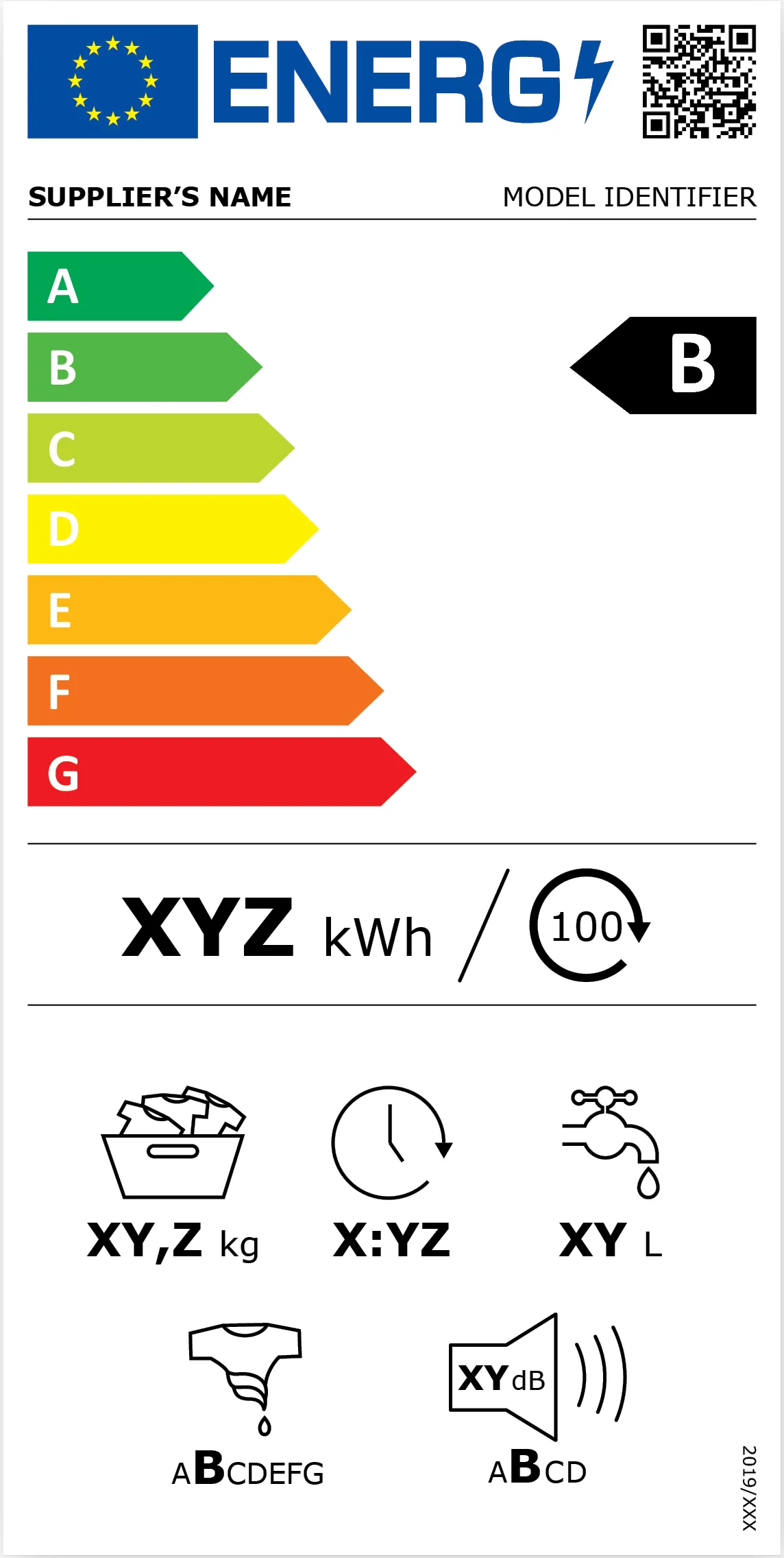
This reference explains the EU A–G washing-machine label introduced in 2021. Electricity is stated per 100 eco cycles, while water is per cycle. Read the current label for each candidate; do not use the sample values as product data.
Photo & usage
© European Union, 1998–2026 · European Commission · European Commission attribution reuse · Source. Display copies resized and encoded as WebP; no instructional details were fabricated or removed.
For US models, the FTC’s EnergyGuide guidance explains that the printed operating cost uses typical use and a national average energy price. Your bill may differ. Read the assumptions on both labels, including any water-heater distinction, before comparing their dollar figures. If the usage bases differ, obtain comparable manufacturer information rather than treating the annual numbers as equivalent.
Ask what each figure includes. Electricity recorded at the washer would not capture energy used by a separate household water heater. Conversely, adding a guessed hot-water allowance to an estimate that already includes it counts that energy twice. The worked example uses hypothetical cold-fill machines whose stated cycle electricity includes their internal water heating.
Do not mix a washer-only figure with a washer-dryer’s complete wash-and-dry figure. Also keep efficiency indices separate from consumption: ENERGY STAR’s washer guidance defines Integrated Water Factor in gallons per cycle per cubic foot of capacity. It is not simply gallons per load.
Price the units that would actually disappear
Copy the electricity price per kWh from your tariff. Include consumption-linked delivery charges and taxes where applicable; exclude fixed monthly charges that stay unchanged when you wash less. Dividing the entire bill by kWh can overstate the saving because it allocates those fixed charges to each unit.
For water, identify the variable supply charge and how wastewater is billed. Include wastewater only where reducing washer water changes that charge. A fixed sewer fee does not become a per-load saving. For tiered bills, use the rate applying to the units you expect to avoid, and ask the utility if the billing method is unclear.
Use one water unit throughout: 1 cubic metre (m³) equals 1,000 litres; 1 US gallon is approximately 3.785 litres. A rate per 1,000 US gallons therefore applies to approximately 3,785 litres, not 1,000 litres. Keep the currency unchanged throughout your worksheet.
With time-of-use electricity, calculate a second case only if you can realistically use the cheaper period. Do not credit a tariff saving to one machine while pricing the other at peak rates unless their actual schedules would differ.
Work through two candidates in dollars per year
Every model figure, tariff and price in this example is hypothetical, not a current product claim or market quote. Both candidates finish the same laundry in 260 cycles annually. Assume electricity costs $0.25/kWh and variable water plus wastewater costs $4.00/m³. Detergent and drying are initially held equal.
| Input or result | Machine A | Machine B |
|---|---|---|
| Electricity per cycle | 0.52 kWh | 0.40 kWh |
| Water per cycle | 46 litres (12.2 US gallons) | 40 litres (10.6 US gallons) |
| Annual electricity | 135.2 kWh | 104 kWh |
| Annual electricity cost | $33.80 | $26.00 |
| Annual water | 11.96 m³ | 10.40 m³ |
| Annual water and wastewater cost | $47.84 | $41.60 |
| Annual utility total | $81.64 | $67.60 |
The reusable calculation is annual cycles × [(kWh/cycle × price/kWh) + (litres/cycle ÷ 1,000 × price/m³)]. For A, that is 260 × [(0.52 × $0.25) + (46 ÷ 1,000 × $4.00)]. Carry the decimals through the calculation and round the final money amount.
B saves $14.04 annually under these assumptions: $7.80 in electricity and $6.24 in water charges. This is a utility subtotal, not the whole cost of laundry. It does not yet include detergent, drying, maintenance or repairs.
Find the assumption that could reverse the winner
Now challenge the cycle count. Suppose, hypothetically, B needs six loads weekly because its usable capacity on your chosen programme is smaller, while A still needs five. B’s 312 annual cycles would cost $81.12 at the same assumed consumption and rates. Its advantage shrinks to $0.52 annually. This is a sensitivity check, not a prediction that smaller loads use identical resources.
Check programme capacity in the manual rather than assuming the advertised maximum applies to every fabric setting. Do not combine incompatible garments or exceed programme limits to make the arithmetic work.
Drying can matter too. ENERGY STAR notes that an appropriate higher spin setting removes more moisture and can shorten subsequent drying. Record this as a possible advantage, but do not assign a dollar saving without comparable drying data. Follow garment and machine instructions when selecting spin.
For detergent, divide the price you actually pay by the number of correctly dosed loads the pack provides for your conditions. Do not assume a larger drum requires the same dose. Where reliable programme consumption is unavailable, mark that entry unknown and calculate a range instead of borrowing another model’s figure.
THE WORKING FILE / COMPARISON
How fewer weekly washes changes the purchase decision
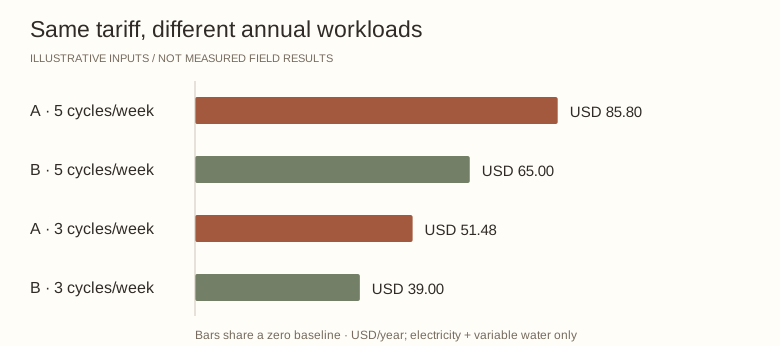
Use two hypothetical machines on a like-for-like cycle basis: A uses 0.65 kWh and 50 litres per cycle; B uses 0.45 kWh and 40 litres. Electricity is USD 0.20/kWh and combined variable water charges are USD 4 per cubic metre. These are invented inputs, not product claims or current tariffs. Both machines are assumed to complete the same washing task.
| Measure | Machine A | Machine B |
|---|---|---|
| Energy cost/cycle | USD 0.130 | USD 0.090 |
| Water cost/cycle | USD 0.200 | USD 0.160 |
| Combined cost/cycle | USD 0.330 | USD 0.250 |
| Annual cost, 5 cycles/week | USD 85.80 | USD 65.00 |
| Annual cost, 3 cycles/week | USD 51.48 | USD 39.00 |
Read the result
B saves USD 20.80 per year at five cycles a week, but only USD 12.48 at three. A USD 180 purchase premium therefore has a simple payback of about 8.7 or 14.4 years respectively. Detergent, repairs, installation, financing, discounting and dryer effects are excluded. The slower-use household should not inherit the faster-use household’s payback claim.
Your comparison record Blank worksheet
Compare two machines on the same laundry workload and tariff, then test the purchase premium.
- Candidate model
- ________________________________
- Cycle and test basis
- ________________________________
- kWh/cycle
- ________________________________
- Litres/cycle
- ________________________________
- Cycles/week
- ________________________________
- USD/kWh
- ________________________________
- USD/m³
- ________________________________
- Purchase premium USD
- ________________________________
- Excluded costs
- ________________________________
- Reason for choice
- ________________________________
Before closing the file
- Both data sets describe comparable tests.
- Annual loads reflect this household.
- The result is checked at a lower-use scenario.
Finish with an auditable decision
Before choosing, check four things:
- Both figures belong to the exact models and comparable programmes.
- Electricity, water and cycle counts use consistent units and assumptions.
- Water heating appears once, and fixed utility charges are excluded from claimed savings.
- The saving remains useful under your lower and higher annual load estimates.
Save the labels, tariff date and worksheet together. After purchase, compare your first ordinary weeks with the assumed cycle count and programme mix. A whole-house bill is only a broad cross-check because other appliances and household activity also change.
If a model’s documentation leaves water heating, programme capacity or consumption unclear, ask the manufacturer before treating its savings as established. Your finished comparison should show a defensible annual range and the purchase premium it can support, with unresolved costs plainly visible.
THE REFERENCE FILE
Sources & scope
Documentation reviewed 1 Nov 2026. Examples are illustrative; this article does not claim hands-on product testing. Follow the instructions for your actual material, model and location.