Review the reason for adding moisture
A humidifier can continue running from habit after the weather or heating routine changes. Begin by writing why it is being used and what evidence supports continued output. This is a household moisture review, not medical advice or a way to diagnose discomfort. If use was specifically advised for an individual, discuss questions about that advice with the appropriate clinician while following the equipment instructions.
Check the exact model and type. Ultrasonic, impeller, evaporative and steam devices have different mechanisms and care requirements. A setting marked comfort or automatic does not establish conditions at a cold window or behind a curtain. Record the normal room temperature and RH at a suitable independent position.
EPA: Use and Care of Home Humidifiers advises using humidifiers only when conditions require them and reducing use when condensation or nearby dampness occurs. Keep that physical evidence in the decision. A preferred number on the appliance should not override a wet tabletop, curtain or carpet.
Check where the output actually lands
Look at the surrounding surface, nearby fabrics and accessible window before the next normal use. Record droplets, a damp patch, white dust or clear surfaces without putting your face in the plume. Follow the model's placement and clearance instructions, including electrical and child-access precautions. Steam and hot-water equipment needs its own burn precautions.
Do not place the device on a vulnerable surface or beside bedding merely because a photograph shows that arrangement. Keep mist away from electrical equipment and follow manufacturer guidance for support and spill protection. A towel beneath a leaking or over-wetting unit is not a permanent solution.
If local dampness appears, reduce or stop output as the instructions and observed conditions require. Dry affected ordinary surfaces appropriately. Do not wait for a central meter to rise before responding. The air beside the outlet and the coldest nearby material can differ substantially from the air at the room's reference position.
Compare a setting change with its actual context
These observations are illustrative and invented. They describe a hypothetical review using one independent meter position. They do not establish a recommended schedule, output setting or medical benefit for any device.
| Observation period | Room reading | Local result |
|---|---|---|
| Normal output, first evening | 20°C, 48% RH | Tabletop becomes damp |
| Output stopped; surface dried | 20°C, 47% RH later | No new local wetness |
| Next evening, revised use | 21°C, 46% RH | No new droplets observed |
The first two displays differ by 1 percentage point, which may fall within meter uncertainty. The clear practical evidence is that local wetting stopped after output stopped and the surface was dried. The third period also differs in temperature, so it cannot isolate the output change as the sole explanation for the RH value.
Use the actual maintenance instructions
Unplug a portable unit before the handling and cleaning steps specified by its manual. Follow its water-quality requirements, emptying routine, cleaning method and replacement-part instructions. Do not apply a cleaning recipe from a different humidifier or mix products. Rinse and dry components as directed before reuse.
The EPA humidifier guidance discusses daily emptying and drying of portable tanks and regular cleaning, while directing users to manufacturer instructions. Treat those as care principles to apply with the actual product, not permission to wash an electrical base or heat a part that is not designed for it. Console and built-in systems have different access limits.
Do not leave old water in a tank because the device is paused during the review. A stopped machine still needs appropriate care. If a part is damaged, inaccessible or cannot be cleaned as instructed, contact the manufacturer. Household observation should not become disassembly beyond the user-access areas identified in the manual.
Record a consumable change separately
If a wick, cartridge or other user-replaceable part is changed during the review, note its identity and date. A new part can alter operation, so do not attribute every later difference to the output setting alone. Use only a compatible part and follow disposal instructions. Keeping this maintenance event visible makes the record useful when the manufacturer asks whether the concern began before or after routine service.
Keep guidance and surface evidence together
EPA: A Brief Guide to Mold, Moisture and Your Home gives general moisture-management guidance rather than a safety certificate. The humidifier-specific EPA page advises not exceeding 50% RH and responding to condensation. These are not interchangeable promises that every window will remain dry below a particular display value. Very cold surfaces can still collect water.
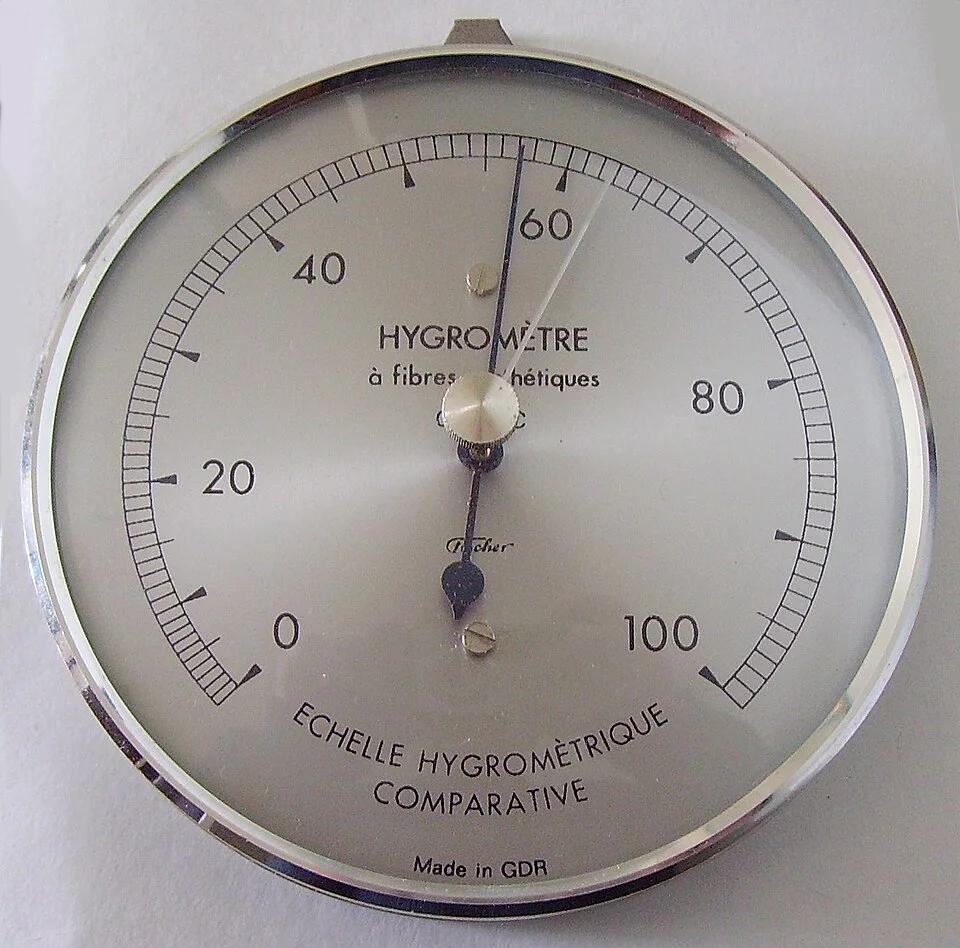
The dial supplies one humidity observation, not a certificate for the whole room. Record temperature separately and inspect the actual cool surfaces while interpreting the room record and humidifier setting. Follow the meter’s operating instructions; the photograph does not show accuracy, room placement, humidifier output or whether a particular window will stay dry.
Photo & usage
Cjp24 · CC BY-SA 4.0 · Source. Display copies resized and encoded as WebP; no instructional details were fabricated or removed.
Record temperature with RH and use the same meter position. An apparent improvement after heating starts may partly reflect warming. A meter near the humidifier's own outlet may also read differently from one elsewhere. Describe each location rather than choosing whichever number makes the setting seem correct.
If condensation or dampness persists after unnecessary humidification stops, investigate other sources and the building or ventilation conditions. Do not assume the humidifier explains every stain just because it was operating. Rain entry, plumbing and cold pockets can coexist with added moisture. The review should narrow the next question, not force one cause onto the whole home.
Do not replace the appliance with untracked evaporation
Turning off a humidifier while placing open bowls of water on radiators does not create a clear comparison. It replaces one moisture source with another and can introduce spills or unsuitable heat exposure. Keep the deliberate change identifiable. Likewise, do not add wet towels or run a hot shower to restore a preferred display during the review.
EPA: Improving Indoor Air Quality emphasizes control of individual sources. In this context, the relevant source is deliberate moisture addition and any associated material dispersed by the device. Fragrance oils and additives should be used only where the actual product permits them; a generic humidifier is not automatically an aroma diffuser.
If the household is uncertain whether continued use is needed, keep a brief room record without unnecessary output and discuss product or individual-use questions with the appropriate source. Do not use a humidity number to diagnose a symptom, promise better sleep or establish health protection. The household task is moisture management and correct equipment care.
Close with a condition-based use routine
A useful outcome may be reduced output, intermittent appropriate use or stopping for the season. Write the observed reason and the circumstances that would prompt review. If storing the device, follow the model's cleaning, drying and consumable instructions. Do not close a damp tank in a box and assume it is ready for next season.
Recheck nearby surfaces and the original window under comparable conditions. Confirm that local wetness has not returned and that affected materials received suitable drying or care. If the problem persists, seek relevant building or product advice rather than repeatedly changing the setpoint without a clear hypothesis.
Completion means moisture addition has a stated purpose, the device is cared for as instructed and surfaces are not being ignored in favour of a display. Keep the record modest about what it shows. It describes this household's observations and operating choice, not a medical result or a guarantee about the complete indoor environment.
THE REFERENCE FILE
Sources & scope
Documentation reviewed 1 Nov 2026. Examples are illustrative; this article does not claim hands-on product testing. Follow the instructions for your actual material, model and location.