Ask which sound changes with the fan
A fan can add a steady whirr while making a passing vehicle less noticeable. Those two observations can coexist. Begin with a narrow question: at the usual pillow, which audible features appear when this fan runs, and which arrive independently from outside? Do not begin by assuming the fan either solves or causes every sound you hear. Keep its airflow preference as a separate part of the decision.
Use a short daytime or early evening session when the bedroom is available and occupants can stop comfortably. You do not need to interrupt anyone’s sleep. Place the fan where it is normally used, stable and clear of curtains, bedding and traffic routes, following its instructions. Keep the same speed and direction during the first comparison. Do not open, modify or cover the appliance.
CCOHS’s noise-control guidance distinguishes sources and transmission paths. This household exercise borrows that distinction without conducting an occupational noise assessment. It cannot identify a concealed mechanical fault, certify an acceptable sound level or establish a health outcome. If the fan behaves abnormally, stop using the trial as a reason to keep it operating and follow its instructions for obtaining help.
Write descriptions before writing verdicts
From the pillow, make a short list of sounds in your own words: steady low hum, broadband rushing air, occasional click, distant engine rise or brief voices. Add a column for timing and another for uncertainty. “Rumble heard at 19:12” is an observation. “Bus outside” is an interpretation unless you actually saw the vehicle. Do not turn a guess into a source label by repeating it in later rows.
Choose a normal head position and keep the same pillow and bedding. Turning an ear into the pillow changes what you hear, so record that posture if it matters and compare it separately. Remove avoidable self-generated sounds such as handling a notebook during the interval. Write immediately afterward instead of speaking a running commentary over the very sound being compared.
Agree on simple descriptive categories: absent, faint but identifiable, prominent, and uncertain. These are ordered impressions, not equal numerical steps. One occupant’s “prominent” need not match another’s. Keep names or initials beside personal descriptions and avoid averaging them. The aim is a repeatable account of this listening position, not a contest over whose hearing is correct.
Use ordinary window positions as separate blocks
Select two window states that the household ordinarily uses and can operate safely, such as normally closed and an established opening position. Describe the actual opening with a measurement or a clear sketch if practical. Keep background ventilation in its intended condition. Do not block vents, defeat restrictors or leave an insecure opening just to obtain a larger contrast.
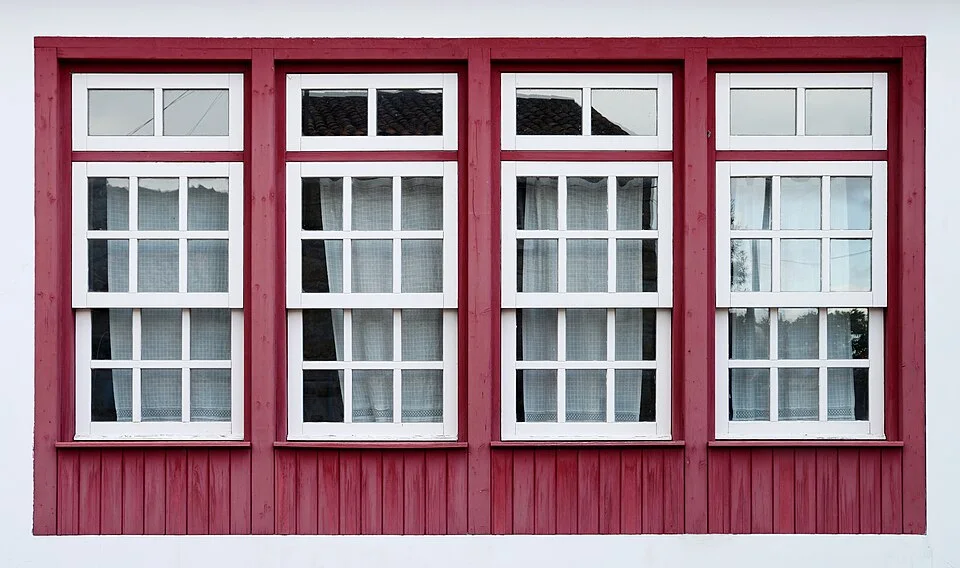
The visible sash positions illustrate why a repeatable description is more useful than writing window open. Use only your actual household’s permitted ordinary positions, keeping the curtain, door and fan settings fixed within each comparison block. This exterior view supplies no opening measurement, restrictor information, security assessment or sound result; do not reproduce an opening merely because it appears here.
Photo & usage
Alvesgaspar · CC BY-SA 4.0 · Source. Display copies resized and encoded as WebP; no instructional details were fabricated or removed.
Run the first fan comparison entirely within one window state. Keep the curtain position, door, other appliances and fan setting fixed. Then restore those details and use the other window state for a new block. Changing the fan and window together would leave you unable to tell which change accompanied the audible difference.
Note wind, rain and any external activity during each block. A window opening can change airflow and sound paths at the same time. If gusts rattle something or a sudden shower begins, stop the block and mark it interrupted. Do not call the later block a fair acoustic comparison merely because its window measurement matches your original note.
Alternate on and off without rushing
Choose a manageable listening duration, for example two minutes per interval, and record it as your household convention. Allow the fan to reach its ordinary steady operation before beginning an on interval. After switching off, wait for its blades and sound to settle before the off interval. Those transition periods are outside the timed listening period. Keep fingers and objects away from the guard.
Use an on/off pair, then reverse the order for the next pair. This reduces the temptation to attribute every later change to the chosen setting. A helper can operate accessible controls while the observer stays at the pillow, but concealment is unnecessary and should never interfere with safe operation. Record the sequence honestly; this is not a blinded experiment.
During each interval, note fan-like sound and outside events separately. If a horn occurs only during off, do not score that entire condition as inherently louder. Mark the event and consider repeating the pair later. Repeat enough to see whether the description returns, then stop before listening becomes an exhausting search for ever smaller differences.
Interpret an illustrative listening log
This invented example uses four two-minute intervals in one unchanged window state. The timing arithmetic describes observation coverage only; it does not measure noise dose. Each row records a personal impression and a count of clearly noticed outside events. An event count is not a sound-level reading and cannot show how much acoustic energy reached the pillow.
| Interval | Fan | Steady whirr | Outside events noticed |
|---|---|---|---|
| 1 | On | Prominent | 1 |
| 2 | Off | Absent | 3 |
| 3 | Off | Absent | 0 |
| 4 | On | Prominent | 1 |
Total listening time is 4 × 2 = 8 minutes, divided into four minutes on and four minutes off. The repeated whirr supports a fan-linked description. The event counts do not prove the fan removed outside sound: outside activity varied, and some events may have been less noticeable against the whirr. Do not subtract the counts to calculate a noise reduction percentage.
Keep optional sound readings subordinate
You can complete the exercise without a sound meter. If using an app for context, keep the device, microphone orientation, position and settings unchanged. Place it on a stable support near the observation location without enclosing the microphone in bedding or exposing it directly to fan airflow. Document placement before collecting numbers. A held phone that moves between conditions can create a misleading difference.
NIOSH describes its Sound Level Meter app and its device and microphone conditions. That documentation does not validate every phone, app or low-level bedroom measurement. Read the relevant limitations rather than copying a claimed accuracy into your notebook for an unrelated setup. Avoid giving small changes more authority than the equipment and method can support.
Never subtract two decibel readings and label the result the fan’s standalone sound level. Combined sound is not separated by ordinary arithmetic subtraction. For this task, the strongest evidence is repeated appearance of a distinctive sound alongside a documented fan state. Optional numbers may supplement that account, but they cannot establish which outside source operated during an unobserved interval.
Choose a combination with separate reasons
Record airflow preference after each condition using ordinary language: welcome movement, too direct, insufficient or uncertain. UC Berkeley’s fan guidebook is a reference on using fans for people; this comparison makes no promise about a particular bedroom. A quieter fan state can still feel less comfortable, and a preferred breeze can still introduce a noticeable whirr. Write both findings rather than forcing one overall winner.
Compare the completed window blocks only within their weather and outside-activity limits. If the on-linked whirr repeats in both but outside events vary unpredictably, you have separated one reliable feature from one unresolved feature. A useful next action might be trying another normal fan speed in a fresh session, while holding everything else fixed. Avoid changing speed midway through the current record.
Finish when you can describe the preferred ordinary combination, the evidence for the fan-linked sound and the uncertainty about outside events. Retain interrupted intervals with a clear mark so they cannot later become supporting evidence by accident. Restore the room to its intended operating state, and leave any unusual equipment behaviour for appropriate attention rather than an extended listening trial.
THE REFERENCE FILE
Sources & scope
Documentation reviewed 1 Nov 2026. Examples are illustrative; this article does not claim hands-on product testing. Follow the instructions for your actual material, model and location.