Begin at the pillow, with the room in use
A streetlamp can miss the curtains yet land directly on your pillow. A quiet bedroom can become noisy only when someone watches television next door. Start with the disturbance that reaches the bed, rather than buying a collection of blackout and acoustic products.
The National Heart, Lung, and Blood Institute recommends a quiet, cool, dark bedroom, allowing a dim night light when needed. That gives this project a practical aim: reduce unwanted light and sound while keeping the room comfortable and easy to move through.
You need a notebook, a tape measure, the instructions for any existing blinds or curtain hardware, and another household member if available. Begin with adjustments you can make from floor level. Before buying anything, establish whether you may change fittings, what the existing rail can support, and which windows and doors form your escape route.
Lie in your usual position during the troublesome period. Name the main interruption precisely: a bright curtain edge, a glowing clock, corridor voices, or a repeated thump. Choose one to tackle first. Leave unrelated room improvements for later.
Give each disturbance its own route
Make a short list headed source, route, and first change. It should explain what you can alter, not just record that the room feels unpleasant.
| What you notice | Likely route to investigate | Useful first move |
|---|---|---|
| A sharp line of exterior light | Beside, above, or between curtains | Reposition existing panels and inspect from the pillow |
| A pool of light on the ceiling | A display or lamp inside the room | Dim or redirect it using its normal controls |
| Recognisable television dialogue | Corridor, doorway, or shared wall | Lower or relocate the source before adding furnishings |
| A ringing quality to ordinary sounds | Reflections inside the bedroom | Try existing soft furnishings |
| Low thumps or persistent mechanical hum | Building fabric or equipment | Record the timing and seek the appropriate assessment |
Ask a helper to close the curtains or lower the television while you remain at the pillow. Change one thing at a time. A noticeable difference suggests where effort belongs; it does not establish exactly how sound travels through the building.
Use ordinary sounds already occurring. Do not create loud test noise or dismantle a fitting to trace a route. If a disturbance is intermittent, return when it normally happens rather than filling the silence with guesses.
Fix curtain coverage before replacing the fabric
With the room lights off, distinguish light passing through the fabric from light passing around it. These require different purchases. More opaque cloth will not fix a panel that leaves a bright slit beside the frame.
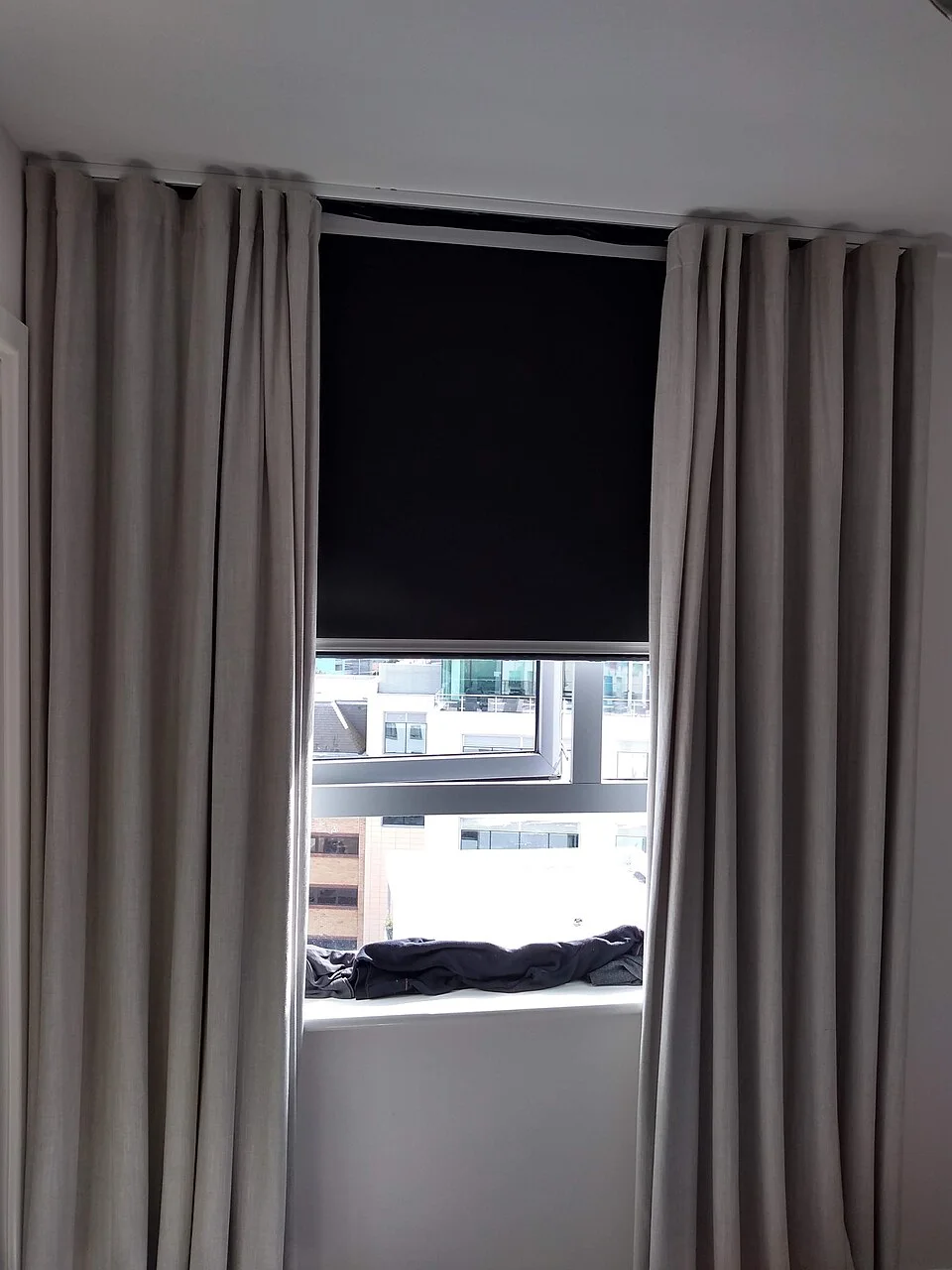
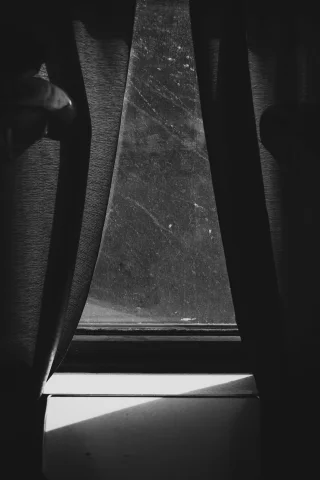
The bright uncovered lower window and darker covered upper area show two different coverage states. In the bedroom, close the intended coverings normally and inspect centre, side and top gaps from the pillow. This photograph is not a completed blackout test, and the cloth on the sill is not a recommended seal or obstruction.
Photo & usage
Cirosantilli2 · CC BY-SA 4.0 · Source. Display copies resized and encoded as WebP; no instructional details were fabricated or removed.
- Close the existing panels fully. Redistribute their folds so one panel is not using most of its width at the outer edge.
- Where the existing track permits, arrange the centre edges to overlap. Check that closing the middle has not pulled the outer edges away from the wall.
- Inspect the top and sides from the bed. Note where extra coverage would actually intercept the light.
- Open everything again. Confirm that the handles remain accessible and the covering moves freely.
If replacement is necessary, record the usable rail width, the intended drop, and space beside the window. Follow the product's fullness instructions: the fabric width needed for folds differs from the width it covers when installed. Ask whether the stated width refers to each panel or the pair.
For a hypothetical sizing example, an intended covered span of 60 inches (152 centimetres) with a maker-specified fullness factor of 2 requires 120 inches (305 centimetres) of total flat fabric width. That arithmetic does not specify side returns or guarantee darkness. Check the proposed arrangement against the actual leak before ordering.
Choose cordless coverings where young children live or visit. The CPSC's window-covering guidance identifies cords as a strangulation hazard and recommends moving beds, cribs, and climbable furniture away from windows and cords. Do not improvise hanging loops to pull curtains tighter. If heavier fabric exceeds the existing hardware's rating, arrange suitable installation rather than loading the rail experimentally.
Remove the small light sources you can control
Once the main window leak is reduced, look again from the pillow. A clock or charging device that seemed insignificant may now be the brightest object in view. Use its built-in dimming or display-off setting, or turn the display away while keeping the device in its intended operating position.
Move optional charging and entertainment equipment elsewhere if practical. Keep essential controls accessible. Leave safety equipment and its indicators unobstructed; if an essential device causes troublesome light, ask its manufacturer about an approved setting or location.
For corridor light, first adjust the source: reposition a portable lamp or ask household members to use a less intrusive light during your sleeping hours. A closed door may reduce spill without any new fitting. Keep enough light for the route you actually use at night; absolute darkness is not the only acceptable finish.
Check that route with the final lighting arrangement while fully awake. Reach the door and bathroom without moving a curtain, stepping over an object, or relying on your phone screen to find the way.
Quiet the source before treating the bedroom
For sound you control, make the agreement specific. Ask for television volume to be reduced during your sleeping hours, move a portable speaker away from the shared wall, or schedule a noisy household task earlier. Replay ordinary dialogue at the agreed setting while someone listens from the bed.
If the bed or headboard is touching the shared wall, try a position without that contact, provided the furniture remains stable. Alternatively, compare another usable bed position before committing to a room rearrangement. Treat either move as a trial, not a promise of sound isolation.
Soft furnishings address another problem. The UK Health and Safety Executive explains that absorbent materials affect reflected sound rather than its direct path. Applying that distinction at home, an existing rug or curtain may make a bare room less echoing, but should not be treated as a remedy for noise transmitted from next door.
Try what you already own before buying acoustic products. Keep rugs flat and away from the door swing. Do not stack furniture against a wall as an improvised barrier. If voices become less prominent but a low thump remains, record those as separate outcomes rather than adding more fabric indiscriminately.
Leave air routes and exits working
A bright gap beneath the bedroom door can make a draught stopper seem irresistible. First find out whether that gap has a ventilation role. Pacific Northwest National Laboratory's Building America guidance explains that door undercuts can provide a return-air path in homes with ducted heating and cooling. A visible gap alone does not tell you whether sealing it is appropriate.
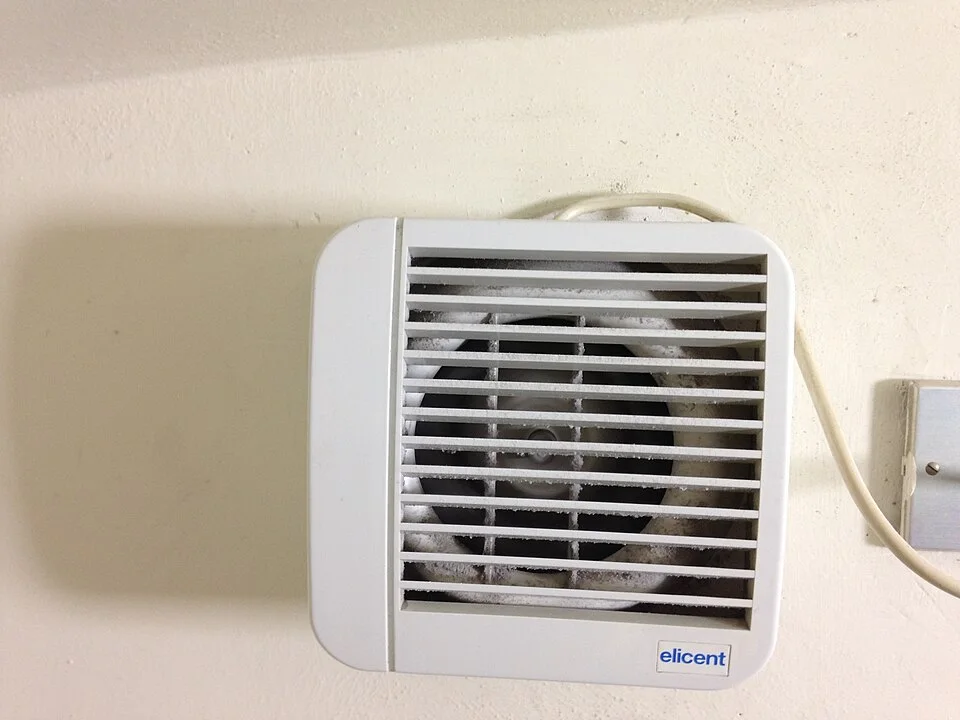
The fan and grille illustrate a ventilation opening that should not be covered to reduce bedroom light or sound. Identify the actual installation and preserve its required route, along with exits and any needed door undercut. The photograph does not show airflow, establish that maintenance is adequate or tell you that an unknown gap may safely be sealed.
Photo & usage
Antonio Mette · CC BY-SA 4.0 · Source. Display copies resized and encoded as WebP; no instructional details were fabricated or removed.
Leave the gap open if its purpose is unknown. Ask the property manager or an HVAC contractor to assess the airflow before adding a sweep or perimeter seals. Keep vents and transfer grilles unobstructed. If corridor light is the problem, changing the corridor lighting remains the simpler first option.
The US Fire Administration's escape-plan guidance calls for unblocked doors and windows. After changing curtain coverage or furniture position, confirm that doors open fully and the windows included in your escape plan remain accessible. Stop if a proposed covering requires removing an obstruction before using an exit.
THE WORKING FILE / LOG
Solve the actual disturbance, not the average room
Imagine a bedroom with a bright display visible from the pillow and a brief delivery noise around 05:30. A thicker curtain might change neither problem. A short record separates continuous light, edge leaks and timed sounds, so that the chosen intervention can be checked against the same disturbance.
| Observation point | Invented finding | One targeted comparison |
|---|---|---|
| At the pillow | A display faces the bed all night | Use its permitted dimming or repositioning option |
| Curtain edge | A narrow outdoor-light gap | Reposition the existing curtain without blocking vents |
| Early morning | A short external delivery sound | Log timing before selecting a room treatment |
Read the result
Compare from the pillow after the change, not while standing beside the window. A quieter-looking room is not an acoustic measurement. Phone recordings and uncalibrated sound apps can help identify timing but cannot certify sound isolation, occupational exposure or a product’s attenuation. If the disturbance changes between nights, record that rather than crediting every better night to the curtain.
Your log record Blank worksheet
Identify the light path or sound timing that reaches the pillow before buying room treatments.
- Date / time
- ________________________________
- Pillow position
- ________________________________
- Light source or sound event
- ________________________________
- Path / direction
- ________________________________
- Duration / recurrence
- ________________________________
- One change
- ________________________________
- Result from pillow
- ________________________________
- Unchanged safety features
- ________________________________
Before closing the file
- The observation is made where the person rests.
- Only one source is changed at a time.
- Safety devices and airflow stay functional.
Decide what is finished and what needs help
Judge the result when the original disturbance returns. Compare the same pillow position, curtain arrangement, and household activity. Note concrete outcomes: the streetlamp no longer reaches the pillow; television words are less distinct; the hallway route remains usable. One unusually quiet evening cannot establish that an intermittent problem is solved.
Keep changes that solve their assigned problem without making the room harder to use. Reconsider purchases that merely alter its appearance. If a curtain adjustment fixes the light but leaves traffic noise unchanged, the adjustment has still succeeded at its intended job.
Escalate persistent noise with a useful brief: where it is heard, when it occurs, whether it is speech, hum, or impact, and which reversible changes helped. A window specialist can assess a window that will not close normally; an HVAC contractor can investigate equipment noise and airflow; an acoustic consultant can assess recurring transmission through the building. Renters should send the observations to the property manager before changing building fittings. End the project with a targeted next step rather than another speculative purchase.
THE REFERENCE FILE
Sources & scope
Documentation reviewed 1 Nov 2026. Examples are illustrative; this article does not claim hands-on product testing. Follow the instructions for your actual material, model and location.
- NHLBI: Sleep Deprivation and Deficiency — Healthy Sleep Habits
- US Consumer Product Safety Commission: Window Covering Cords
- UK Health and Safety Executive: Workplace design — noise absorption and transmission
- Building America Solution Center, PNNL: Undercut Doors
- US Fire Administration: Home Fire Escape Plans