A newly organized room is unusually tidy because every object has just been handled and every decision is fresh. A month later, ordinary life reveals which assignments work. One box remains on a chair, a daily item has migrated closer and an attractive shelf position is never used.
Review those observations before buying more storage. This audit is a method readers can apply after their own trial; it is not a report of hands-on testing or a claim that this draft has observed a future month. Record the room as it is used, then decide which arrangements to keep, revise or remove.
Recover the original purpose of each change
List the storage changes and the specific problems they were intended to solve. A new tray may have been meant to clear a work surface, while a box under the bed was meant to hold occasional bedding. Keep the purposes separate so one successful change does not conceal another that failed.
If no baseline record exists, write down the remembered problem honestly and mark it as recollection. Do not invent precise before counts. You can still observe the current arrangement and decide whether its operation is useful, even without a formal comparison.
Include the cost in room space. A unit may organize its category while making a door harder to use or narrowing the chair's movement. The audit should assess both the stored objects and the surrounding activity. A tidy container is not a success if the room no longer supports the task it was meant to serve.
Observe exceptions rather than staging perfect use
For several ordinary days, note where items are left outside their assigned destinations. Record the object, intended home and immediate reason if known. A damp item still drying differs from a clean item whose drawer is too full. Avoid classifying every exception as carelessness.
Count recurring actions such as moving one box to reach another, searching an incorrect category or placing a lid on the floor. Keep the observation burden modest. A short factual note at the moment of failure is more reliable than a detailed reconstruction after the room has been tidied again.
Ask other users what they find awkward. Someone may quietly avoid a cupboard because its handle or approach does not suit them. The U.S. Access Board — Operable Parts guide helps distinguish the stored object's height from access over an obstruction. Use those concepts to investigate the actual failure rather than assuming the original layout was convenient for everyone.
Compare an illustrative week of exceptions
This example is illustrative and uses invented observations. In one seven-day record, a daily kit is left on a chair four times, a back-row box requires front-row movement three times and a wardrobe drawer catches clothing twice. The total is nine recorded events, but they are three different problems.
Suppose a later seven-day record contains one chair event, one front-row movement and two drawer catches. The total is four, a difference of five events. That does not establish a universal improvement or prove that the drawer is acceptable. Its two catches remain unchanged and need their own decision.
Keep the categories separate in your own record. Adding all events can help summarize workload, but it can also hide a persistent access or damage problem. A single obstructed exit or unstable unit is not made acceptable by a lower overall count. Treat essential access and product conditions as boundaries before comparing convenience.
Inspect the room's routes and operating spaces
Walk the ordinary route with doors, chair and storage in their typical states. Include the state after a hurried departure rather than only the carefully reset room. The CDC — Check for Safety: A Home Fall Prevention Checklist for Older Adults checklist emphasizes clear floors and paths. Look for boxes or bags whose assigned home is inconvenient enough that they repeatedly remain underfoot.
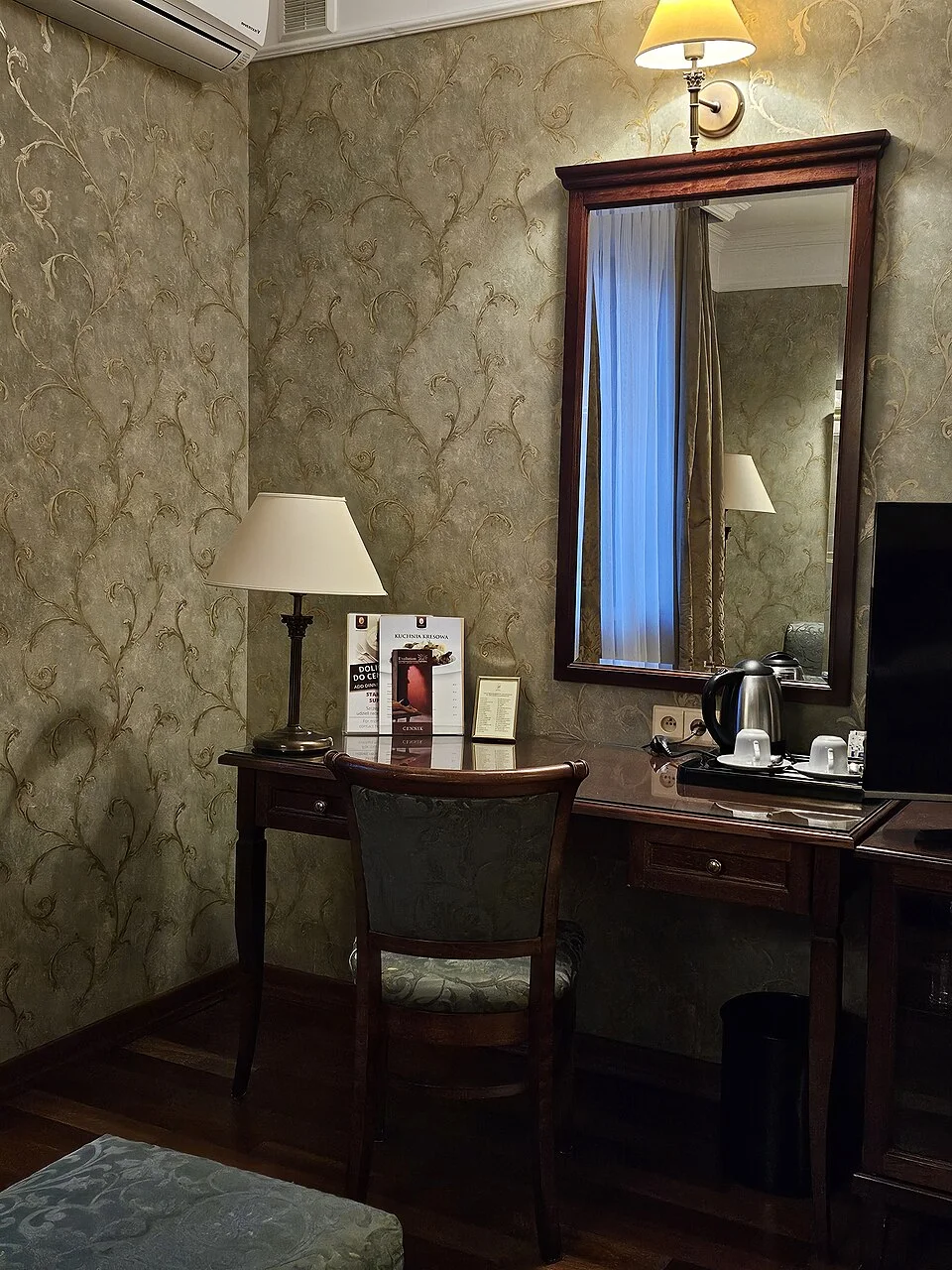
The chair, drawer fronts and neighboring stool occupy the same working corner, so a storage audit needs more than the room’s central walkway. In your own setup, observe where the chair moves and where a person stands to open the drawers and return belongings. The photograph gives no drawer projection or passage measurement and does not establish comfortable access.
Photo & usage
Tess Mattew · CC BY-SA 4.0 · Source. Display copies resized and encoded as WebP; no instructional details were fabricated or removed.
Check the places where people stand to open drawers and return clothing. A new unit can consume operating space without changing the visible central route. Identify the specific movement that has become difficult and compare it with the original purpose of the addition.
Do not conduct deliberate tipping or overload tests. Unexpected furniture movement, damaged components or uncertain restraint conditions need appropriate attention through product guidance. Pause use as necessary rather than continuing the trial to collect more observations. A month-long convenience audit cannot establish the structural performance of furniture.
Check whether the contents changed the original assumptions
Recount categories that seem to have outgrown their homes. New equipment, thicker clothing or a change in retrieval frequency may explain the failure. Compare the current collection with the accepted container envelope and category count, rather than assuming the original measurements were wrong.
The IKEA — BAGGEBO Shelf Unit, Article 504.811.72 page illustrates the need for exact product information. If a shelf's assigned load or arrangement has changed, return to the actual unit's documents. A dimensional fit and a successful first week do not authorize later overloading or a modified configuration.
Notice containers that now hold unrelated overflow. Their labels may still describe the original category while the contents have become mixed. Decide whether the new objects belong there and update the inventory, or give them another suitable home. Restoring honest categories is often more useful than adding another organizer around the expanded mixture.
Change one cause at a time
Choose the most specific practical response. Move a daily kit closer if approach is the problem, reduce a category if capacity is the problem, or change a closure if operation is the problem. Avoid a complete reorganization that makes it impossible to tell which change resolved the observed failure.
Retain suitable existing containers where they still work. A new purchase should solve a named mismatch with measured dimensions and known product conditions. Do not buy a larger unit simply because the audit uncovered several unrelated exceptions; some may be decision or return-routine problems rather than missing volume.
Give each revision a short ordinary-use check. State what evidence would justify keeping it: fewer repeated chair piles, independent box retrieval or a drawer that closes without catching fabric. Do not promise that the change will produce health benefits, time savings or approval from a landlord or professional.
Use a return failure to choose the next change
If the same kit repeatedly stays on a chair, follow its last successful action. Was the shelf occupied, was the box too heavy, or did the user need both hands to close it? Record that specific stopping point before changing the category’s location. A new label cannot repair a lid that is difficult to operate.
Keep one example of the failed sequence in the audit note. After a revision, repeat that sequence under ordinary conditions and check whether the kit returns. This gives the next decision a concrete completion test. Avoid declaring the entire room improved because one shelf looks neater while the original chair pile remains.
Close with keep, revise and unresolved decisions
Record each arrangement as keep, revise or unresolved, with a plain reason. Keep means its task works and the surrounding room remains usable. Revise means a specific cause and next change are identified. Unresolved means information, a suitable destination or individualized advice is still needed.
Return trial objects and temporary materials to suitable places so the audit itself does not leave floor piles. Save the current category map and accepted dimensions. Keep sensitive inventory information private where appropriate, especially if the record names valuables or personal documents.
Completion means the room's storage reflects ordinary use rather than the memory of its first tidy day. Revisit only when a meaningful change occurs, such as a new user, new equipment or recurring overflow. A dependable small-room plan can evolve without becoming a continuous cycle of buying containers and starting over.
THE REFERENCE FILE
Sources & scope
Documentation reviewed 1 Nov 2026. Examples are illustrative; this article does not claim hands-on product testing. Follow the instructions for your actual material, model and location.