Give the record a question it can answer
A hood-filter record should help the household decide what maintenance is due and describe a persistent problem clearly. It should not become a calendar that orders a new filter every time a reminder appears. Inspection, cleaning, replacement and any authorized regeneration are different events. Keeping those categories separate makes the record more useful and prevents a routine glance from being mistaken for completed maintenance.
Start with one question: “What happened to this identified filter between the last permitted care task and today?” Useful answers include visible grease accumulation, an unchanged stain, a damaged catch or no significant visible change. None of these answers certifies extraction rate, fire compliance or indoor air quality. The record captures accessible observations and the care decisions they support.
Keep the sheet short enough to use while planning ordinary household maintenance. A dated line with clear conditions is better than a complex rating scale that nobody applies consistently. Include a place for uncertainty, because not seeing the back of a component or not knowing an accessory number is useful information rather than a blank to fill by guessing.
1. Establish identity, permissions and the baseline date
Record the full hood model and suffix, region, manual revision and installed filter accessory identity where known. Separate the metal grease filter from any carbon or charcoal component. The same hood may have more than one care route, and a change of accessory can invalidate an old reminder. Do not carry a replacement interval forward without checking that it belongs to the installed part.
Use the exact model and accessory instructions to enter the required maintenance intervals and condition triggers. Bosch’s US and UK hood pages offer general care context, while its regional manual finder helps locate model documentation. Do not convert a general support interval into a universal deadline for every carbon system. Regenerable and replaceable accessories need their own documented rules.
Write the baseline date as what it actually means: installed, inspected, cleaned, replaced or date unknown. If a previous owner cannot establish the filter’s history, write “history unknown.” Today’s inspection cannot reset a documented service life that began at an unknown date. That gap may require manufacturer clarification rather than a neat but invented start date.
2. Record the cooking pattern at a useful level
For a manageable period, note cooking sessions that used the hob and the broad method: for example simmering with lids, shallow frying or a longer uncovered cook. Record whether the hood was used at its ordinary setting and whether an unusual event occurred, such as a spill or exceptionally smoky food. Use plain descriptions rather than attempting to calculate grease loading from recipes.
Agree what counts as one session before counting. Breakfast and dinner can be separate sessions, while several pans used for one meal can remain one session if that is the household rule. Keep that definition stable. A session count is context for comparing your own records, not a standardized measure that can be compared confidently with another home.
Do not deliberately fry more food, generate smoke or obstruct ventilation to test the filter. Ordinary cooking supplies enough context. If the household changes its routine substantially, mark the change instead of treating the next inspection as directly comparable with the previous one. Different food, pan coverage and operating settings can all weaken a simple before-and-after comparison.
3. Make a consistent observation within permitted access
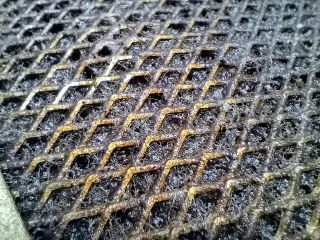
At each inspection, use the same accessible viewpoint and similar lighting where practical. Record visible deposits as location and character: sticky film at the front edge, residue within visible mesh, or a stain that remains after documented cleaning. Do not label dark material “carbon failure” or “mould” from colour alone. Photographs can document appearance but cannot identify every substance.
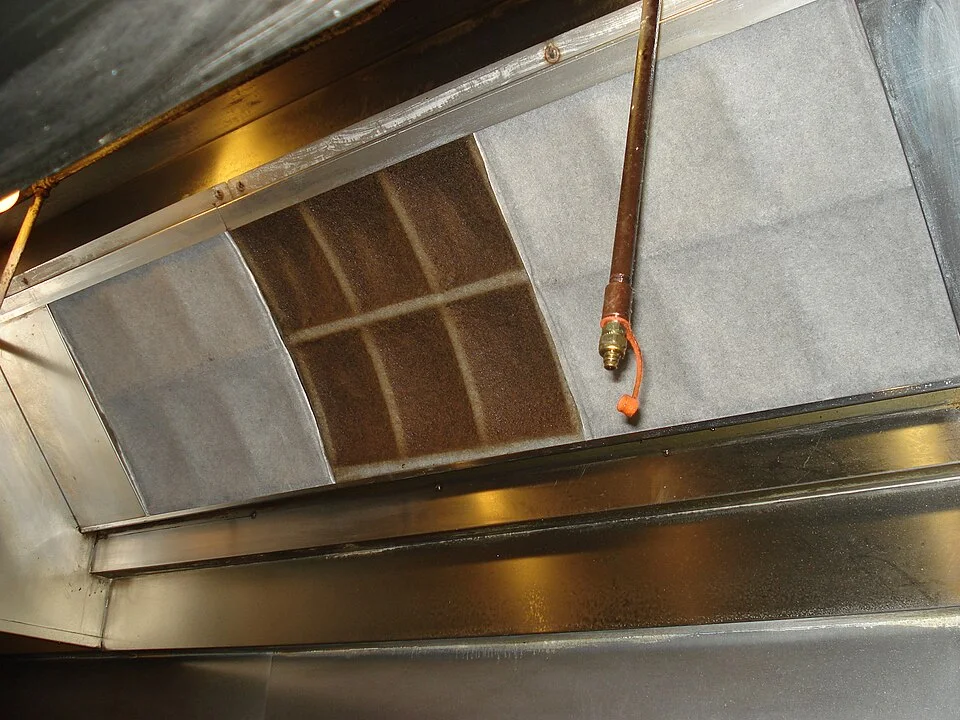
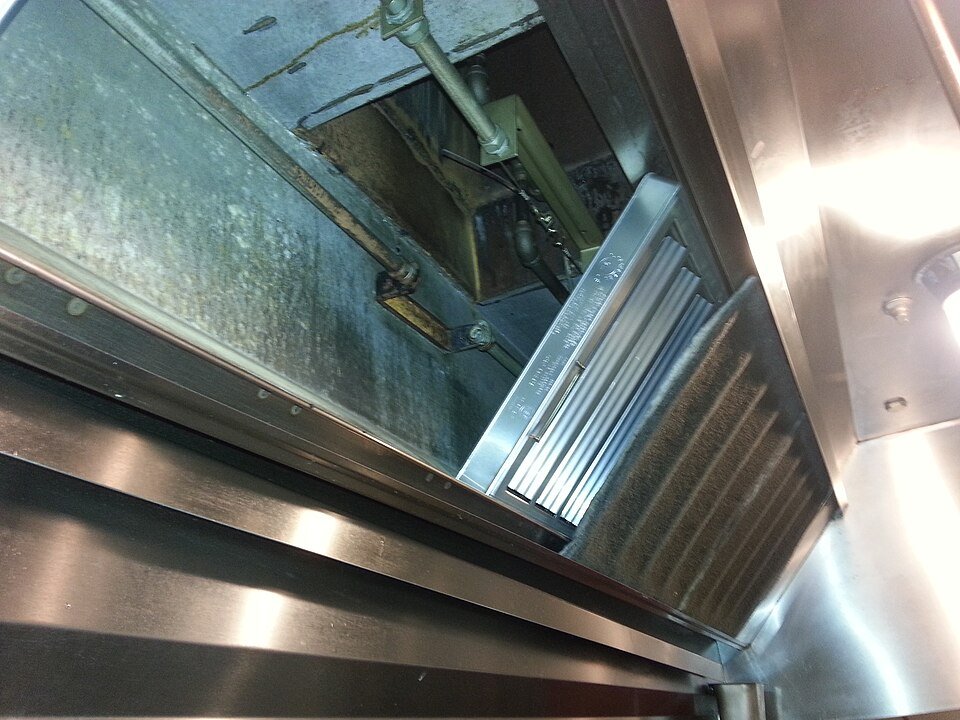
The central panel has a noticeably darker surface than the adjacent panels, providing a clear location and appearance to record. Describe that observation without diagnosing the material from colour alone. This commercial reference does not set a domestic cleaning interval; use the exact filter identity, manual permissions and comparable observations in the household record.
Photo & usage
GreaseLock · CC BY-SA 3.0 · Source. Display copies resized and encoded as WebP; no instructional details were fabricated or removed.
Any removal must remain within the exact manual’s user permissions, power isolation and cooling instructions. A calendar reminder does not authorize access. If the panel is difficult to reach, the latch is damaged or the illustrated movement does not match the installation, stop. Inspection can remain external until a safe, model-specific route is established. Do not reach into a running hood or open a housing.
Check condition separately from soil. A torn mesh, distorted frame or latch that will not engage belongs in a damage field. Add a separate symptom field for recurring odour, noise or apparent weak capture reported during normal use. Damage can require action even when the panel looks clean, while a symptom can persist after the visible grease has been removed.
4. Compare exposure without inventing a replacement formula
The following figures are invented to demonstrate record interpretation. In one 14-day period, a household records 12 cooking sessions, of which 4 involve frying. In the next 14 days it records 18 sessions, of which 9 involve frying. Total sessions rise by 6, and the second count is 18 ÷ 12 = 1.5 times the first. Frying counts rise by 5.
The frying shares are 4 ÷ 12 = one third, approximately 33%, and 9 ÷ 18 = one half, or 50%. These calculations show that the periods differ in both frequency and broad cooking pattern. They do not prove a proportional increase in grease, establish a cleaning interval or predict carbon exhaustion. No quantity of grease or airflow was measured.
If visible deposits also increased, an earlier inspection reminder may be useful within the manual’s rules. It would be unjustified to conclude that the filter must now be replaced 1.5 times as often. Keep the numbers in a context column and let the documented care requirements and actual condition govern the maintenance decision. Small records are useful precisely when their conclusions remain small.
5. Give each reminder its own meaning
Use different labels for “inspect condition,” “clean by manual interval,” “replace by documented limit” and “review an unresolved symptom.” An inspection reminder opens a decision; it does not automatically close it with an order for a new part. Conversely, a mandatory documented replacement or regeneration requirement should not be postponed merely because the surface looks acceptable.
For each reminder, record the basis beside the date: exact manual instruction, accessory requirement or household observation review. If the document expresses an interval in operating hours rather than calendar months, preserve that distinction. Do not convert between hours and months using a guessed average. If reliable hours are unavailable, seek a suitable tracking method or advice for that model.
When an authorized care task is completed, add its actual date and the condition afterward. Do not overwrite the original reminder or delete a missed date. A record that shows a delay and its resolution is more informative than a perfectly tidy calendar with lost history. Never reset a counter unless the manual says the completed task is the appropriate reason to do so.
Finish with a maintenance decision or a clear handover
At the end of each entry, choose a specific outcome: continue within the documented schedule, perform permitted cleaning, obtain a compatible replacement, follow the exact regeneration procedure or seek advice. Add a reason grounded in the record. “Visible grease at the documented inspection” is useful; “air seems unhealthy” is a concern to describe, not a result the sheet can establish.
Escalate a filter that cannot be secured, unexplained damage or a persistent symptom after permitted care. Record the ordinary operating setting and timeline without diagnosing a motor or duct problem. Do not keep repeating cleaning because it is the only familiar action. A service professional may need information or measurements beyond household access, and the record should make that transition easier.
The system is working when someone can read the latest line and understand both the next due task and any unresolved concern. Keep the manual reference with the sheet, and revise the baseline when the accessory changes. Close each inspection honestly, including “not removed” or “history unknown” where applicable. A disciplined record supports maintenance decisions while leaving performance assessment to evidence it does not possess.
THE REFERENCE FILE
Sources & scope
Documentation reviewed 1 Nov 2026. Examples are illustrative; this article does not claim hands-on product testing. Follow the instructions for your actual material, model and location.