A vacuum shortlist becomes easier to defend when it starts with the floors you own. A powerful machine can still have an unsuitable head for a delicate rug or a finish that requires a different setting. Build a small compatibility record before comparing prices. The record should show why a candidate remains eligible, which questions need answers and what ownership will require.
Inventory the surfaces rather than the rooms
List carpet styles, loose rugs and hard-floor finishes separately. Include the flooring maker and product identifier where available. “Bedroom floor” is not enough if that room contains both fitted carpet and a delicate bedside rug. Photograph labels on rug undersides without moving heavy furniture unsafely.
Find each surface's care instructions and note restrictions on rotating brushes, head materials, suction or wet methods. NWFA recommends a bare-floor vacuum setting for routine wood-floor debris removal and prohibits wet and steam mopping in its general maintenance guidance. Your particular flooring documentation may supply further limits.
Keep unidentified floors as unresolved entries. Ask the installer, owner or manufacturer rather than inferring the finish from appearance. Do not let an unknown surface disappear from the list because most rooms are easy to classify. One unsuitable area can change whether a single-machine purchase is practical.
Turn instructions into exclusion questions
For every candidate, ask whether it has an approved configuration for every required surface. Record the exact included head and controls. A brand may sell several bundles under similar names, and an optional hard-floor head may not be included in the advertised price.
Check whether a rotating brush can genuinely be stopped and whether the manufacturer permits that configuration on the floor. Do not assume reducing power stops the brush. For delicate rugs, resolve any conflict between the rug and appliance instructions before purchase. “Suitable for most floors” is not a specific answer.
The Carpet and Rug Institute's care guide explains its vacuum assessment categories, including soil removal, dust containment and carpet appearance. A certification can be useful evidence for the stated purpose, but verify the exact model and current listing. It does not replace your carpet's instructions or certify every accessory for every surface.
Record dust handling without inventing health claims
Compare how the machine contains and disposes of collected material. Note bags or bins, filter types, replacement access and the emptying process. EPA notes that HEPA filtration can help retain some vacuumed dust. That is a limited general point, not proof that a particular household will experience a health benefit.
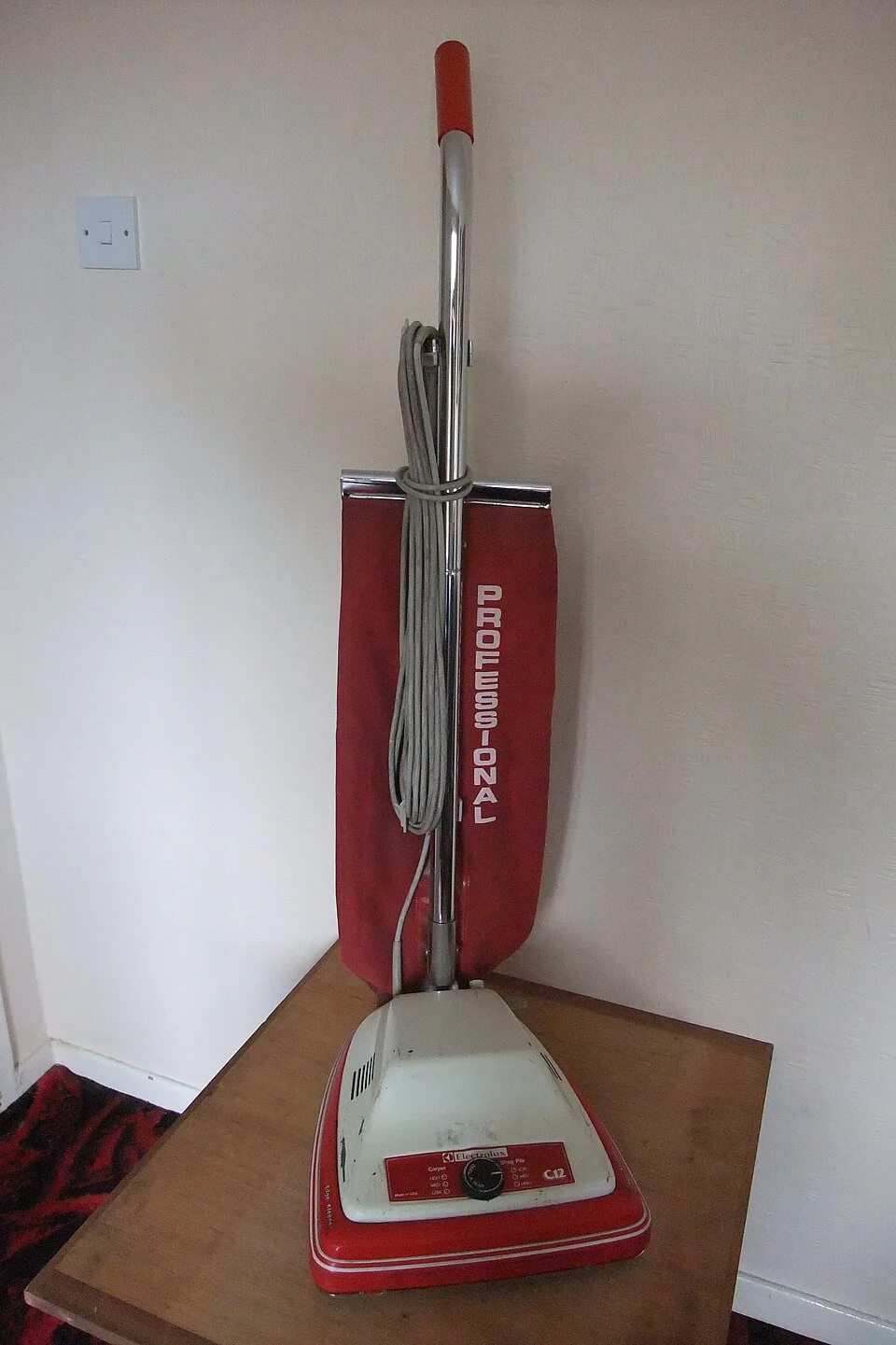
The upright’s external fabric collection bag shows a dust-handling arrangement to record when comparing machines. Locate the candidate model’s disposal and filtration instructions, including what must be removed and replaced. This photograph does not show an internal filter, a sealed system or a HEPA rating, and the word on the bag does not establish a health benefit or a maintenance method.
Photo & usage
Lankyrider · CC BY-SA 4.0 · Source. Display copies resized and encoded as WebP; no instructional details were fabricated or removed.
Check the whole appliance description rather than treating a filter word as a complete system claim. Ask the maker what is sealed, which filter comes in the purchased version and how it is maintained. Record any unresolved marketing term as a question instead of converting it into a fact.
Consider where emptying will happen and whether the user can handle the latch, bag collar or filter without difficulty. Do not release collected dust in a food preparation area. The practical question is whether the household can consistently complete the disposal and care process described in the manual.
Compare eligible options with an illustrative cost record
All figures below are invented and illustrative, expressed in USD. They compare two already compatible candidates, not real products. Candidate A costs USD 240, with expected consumables of USD 24 per year. Candidate B costs USD 300, with expected consumables of USD 12 per year. Assume three years and no repairs, electricity or financing costs.
| Candidate | Calculation | Total |
|---|---|---|
| A | 240 + (3 × 24) | USD 312 |
| B | 300 + (3 × 12) | USD 336 |
The arithmetic is 3 × 24 = 72 and 3 × 12 = 36, making B USD 24 higher over this assumed period. This is not a lifecycle prediction. Consumable use, repairs and changing prices can alter the result. A lower calculated total cannot rescue a candidate excluded by floor compatibility. Keep assumptions visible beside the totals.
Check reach, controls and ordinary handling
Measure the narrowest useful gaps, storage position and route between floors. Compare those measurements with published dimensions or a permitted demonstration. A slim-looking photograph does not establish that a head reaches beneath your sofa. Record whether clearance includes the neck and attached wand, not only the head's front edge.
Check cord reach or stated battery conditions in the exact manual. An “up to” runtime may use a particular mode and attachment. Do not apply it automatically to the household's required powered head. Where published information is insufficient, ask for clarification rather than inventing a whole-home runtime.
If trying a demonstration unit, record what you actually observed: control access, steering effort, carrying grip or storage fit. Do not claim cleaning performance from a brief shop-floor pass. Separate measured dimensions from subjective handling notes so the shortlist remains understandable to another household member.
Make service requirements part of the decision
Locate the manual before buying and identify bags, filters, belts and wear parts where applicable. Check whether replacement items are available through an appropriate supplier. Record exact part identifiers and whether cleaning requires drying downtime. Avoid assuming every filter is washable or every brush roll removable.
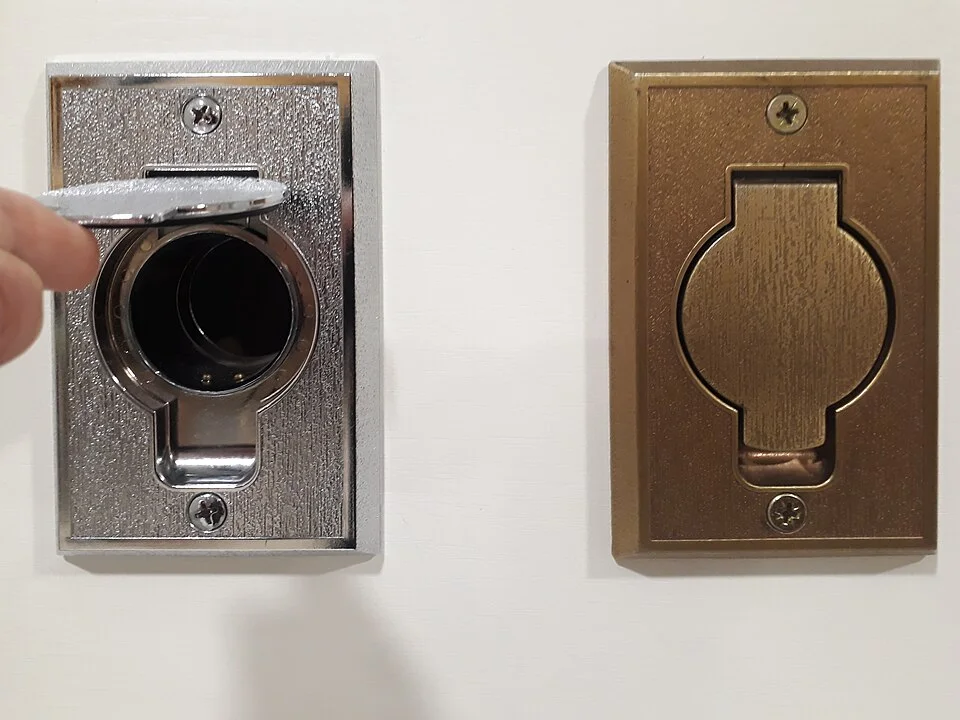
The open inlet exposes its rim, hinged lid and mounting arrangement, features to record when checking a replacement part. Compare those observations with the exact system model and maker’s part identifier before ordering service items. These central-vacuum fittings do not identify a portable cleaner’s bags or filters, and similar-looking openings alone do not prove interchangeable connections.
Photo & usage
Chico1996 · CC BY-SA 4.0 · Source. Display copies resized and encoded as WebP; no instructional details were fabricated or removed.
Compare the steps the household will actually perform. A candidate needing tools for routine access may still suit you, but it belongs in the decision. Note who will empty it, where it will be stored and whether a spare consumable is needed to keep it available.
Read the seller's return conditions and warranty terms directly rather than relying on a general consumer article. Keep legal interpretations outside this practical record. The useful entry is the actual document, purchase route and unresolved question. Do not promise that a particular floor or vacuum warranty will accept any unverified combination.
Resolve bundle differences before comparing prices
A bundle comparison needs its own line in the record. Two listings can share a model family while supplying different floor heads, batteries or storage fittings. Copy the exact seller identifier and included accessories, then check each against the manufacturer’s description. Do not count a pictured accessory as included unless the listing says so.
If a necessary compatible head is optional, add its actual quoted price and any required adapter to the purchase comparison. Keep that verified amount separate from the illustrative cost example above. Ask whether the accessory is approved for the exact model and whether it changes the permitted operating mode. A cheaper bundle that needs unavailable parts is not an equivalent candidate.
On delivery, photograph the contents before setup and compare them with this record. Resolve a missing or substituted component before using the appliance on a floor whose care depends on it. This final contents check closes the gap between a good shortlist and the machine actually supplied.
Close the shortlist with explicit reasons
Keep only candidates that meet required surface permissions and practical handling needs. For each, write one short reason for inclusion and any remaining question that must be answered before purchase. A machine missing permission for a required rug belongs on hold, even if its other features are attractive.
Store the selected model, bundle contents, receipt and floor-care references together after purchase. On arrival, verify that the supplied heads and filters match the order before ordinary use. Read setup instructions and inspect for transit damage. Do not discover a missing accessory after discarding the packaging you need for a return.
The record is complete when the household can explain its choice in concrete terms: compatible surfaces, usable controls, manageable dust handling and known care costs. It remains a decision record, not an independent performance test or a ranking of all vacuums on the market.
THE REFERENCE FILE
Sources & scope
Documentation reviewed 1 Nov 2026. Examples are illustrative; this article does not claim hands-on product testing. Follow the instructions for your actual material, model and location.