Give the food and the appliance separate decisions
A refrigerator that feels cool can still be too warm for food. Start by deciding what needs protected storage, then investigate why the appliance is struggling. Turning the dial and leaving everything overnight merges those decisions into one risky guess.
The FDA's refrigerator thermometer guidance sets the refrigerator limit at 40°F (4.4°C), with the freezer at 0°F (−18°C). Use appliance thermometers rather than touch. Discard refrigerated perishables known to have been above 40°F for more than two hours; discard them if the duration is unknown. Smell and appearance cannot establish safety.
Transfer still-safe perishables to another refrigerator confirmed within that limit. An ice-filled cooler is an alternative only while a thermometer confirms the same cold storage temperature. If neither is available, arrange food storage before continuing. A manufacturer's cooling recovery period is never permission to keep food warm.
Prepare a notebook, appliance thermometers suitable for each compartment, and the exact model's owner manual. Photograph the accessible model label during your next opening. This investigation uses ordinary controls and visible checks; component access belongs with an appliance technician.
Make a record that distinguishes a setting from a reading
Write down when you noticed the problem and the last time you actually measured a satisfactory temperature. “Milk seemed fine yesterday” is an observation, not a temperature record. Note recent power loss, grocery loading, a door left ajar, installation or servicing. These details give the readings context without pretending to identify a failed part.
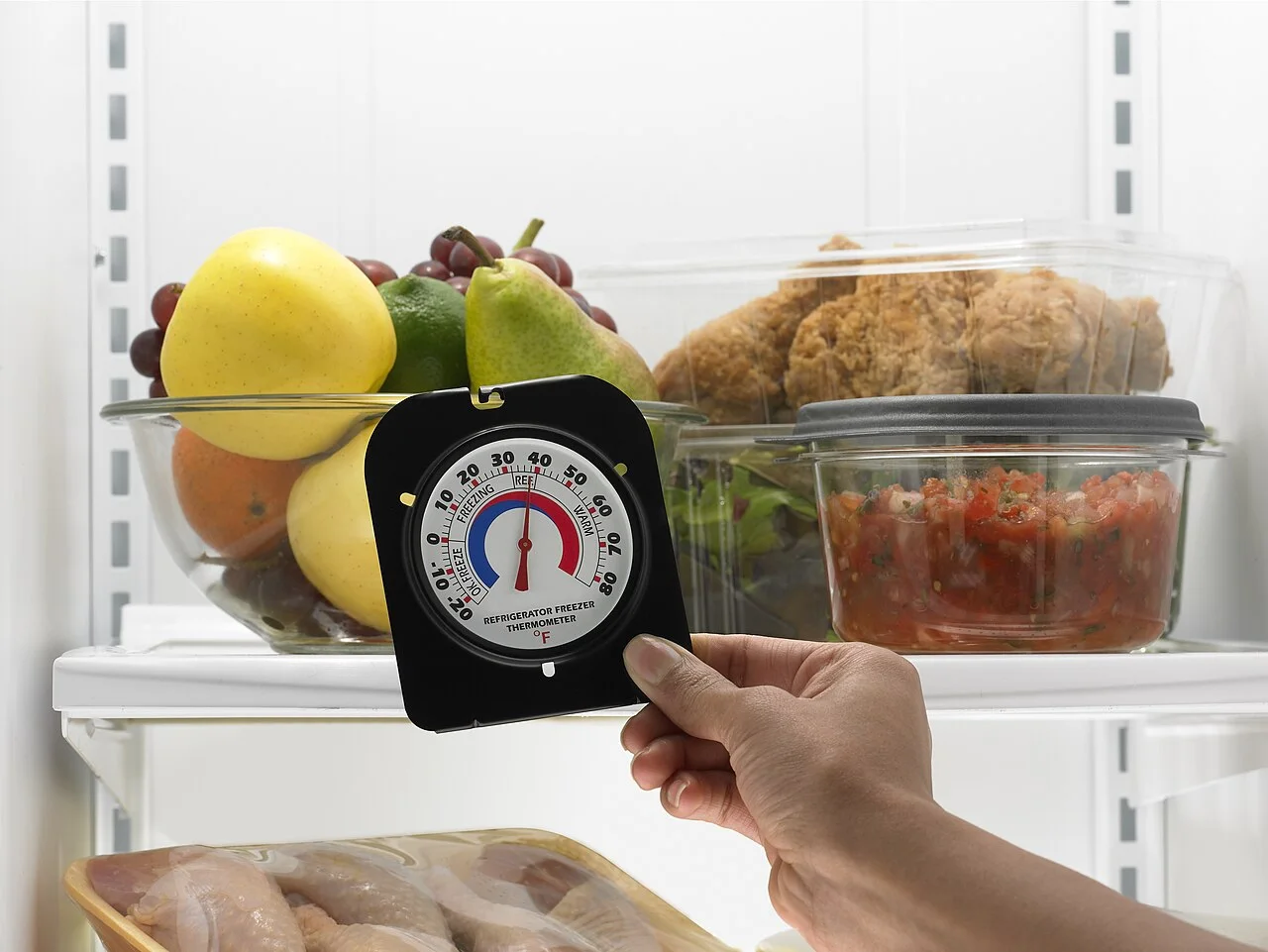
The USDA photograph shows a freestanding thermometer inside a refrigerator. Record a reading, time and location using your instrument’s instructions; a thermostat setting alone does not establish the storage temperature.
Photo & usage
USDAgov · Public domain · Source. Display copies resized and encoded as WebP; no instructional details were fabricated or removed.
Place each thermometer according to its instructions. Choose a repeatable location among the stored contents rather than pressing it against a wall or directly into an air outlet. Allow its specified settling time with the door closed. Record its location so the next reading is comparable. If using one thermometer sequentially, label the times clearly: those are not simultaneous compartment readings.
Copy the control setting separately. A numbered dial is not a temperature scale, and a display may show a requested setting. Consult the manual to identify what yours shows. The Whirlpool troubleshooting guide also flags cooling-off and showroom modes; check only the procedure specified for your model.
| Time | Measured temperatures | What happened |
|---|---|---|
| Initial check | Fridge and freezer, with units | Settings, thermometer positions, recent events |
| After a change | Same positions, after settling | Exact change and door use |
| Follow-up | Repeat readings | Improved, unchanged or rising |
Gather observations in one brief opening, then close the doors. Repeatedly opening them to feel the air makes the record harder to interpret.
Use the two compartments to choose your next check
Treat these patterns as directions for observation, not diagnoses or shopping lists for replacement parts. A freezer's ice tray is less informative than its measured temperature.
- Both compartments are warm
- Check the documented operating mode and recent power history first. Note whether the display and interior light work, but do not treat either as proof that cooling operates. If the appliance appears dead, stop this investigation and arrange help with the supply or appliance rather than opening electrical covers.
- The freezer measures correctly; the refrigerator is warm
- Prioritize visible vents, loading and refrigerator-door closure. Record both readings for service if these checks change nothing.
- One area is warm while another freezes food
- Record where the thermometer was located. Inspect the loading layout before making the whole appliance colder. Later, repeat the measurement at the affected storage position.
A useful service description is “the freezer measured its target, while the refrigerator remained warm after I cleared the visible vents.” “The fan has failed” skips over evidence you cannot establish from outside the covers.
Trace the visible air route and the closing door
Find the interior vents in the manual, including return openings. Move packages away from them in both compartments. Avoid substituting an arbitrary spacing rule: the opening must remain unobstructed, and shelves and bins should stay in their intended positions. Whirlpool's Not Cooling guidance identifies blocked vents, large warm loads and frequent openings as factors affecting temperature.
Next, watch what happens as you gently close each door or drawer. Look for a projecting tray, a drawer not seated fully, or a package trapped behind a freezer basket. Reposition the obstruction and close again. A hypothetical pizza box can cause two separate problems: its edge prevents closure while its broad base covers a vent. Removing only one obstruction leaves an incomplete check.
Inspect the gasket around the entire accessible perimeter for a split, folded section or visible gap. Photograph damage rather than trying to reshape the seal with heat. GE's frost guidance connects repeated frost with door and gasket problems and recommends service when the basic checks do not resolve it.
Record visible frost before doing anything else. Leave packed ice, internal panels and concealed air passages to service; this check does not include chipping ice or applying heat. A photo with the door location identified is more useful than a partly dismantled compartment.
Check the installation without pulling the appliance apart
Compare accessible clearances and the room's measured temperature with the exact manual. A refrigerator installed in a garage or boxed into new cabinetry needs that comparison even if the kitchen model beside it works well. Move loose objects blocking an accessible external grille. If measuring behind the unit requires moving it or straining connected lines, leave that part for the installer or technician.
Do not assume every refrigerator needs exposed-coil cleaning. GE's Not Cooling Enough document explains that many models have condensers that need no routine cleaning; requirements and clearances vary. It specifies disconnecting power before maintenance. For this non-invasive investigation, record any manual-listed maintenance that is overdue and arrange it separately if access is awkward or requires dismantling.
Write the installation finding precisely: “manual clearance cannot be confirmed behind cabinet” gives an installer something to check. “Needs more ventilation” without a model requirement is only a guess.
Make one controlled change and judge the result
Once obvious obstructions are corrected, use the manual's recommended control setting. If adjustment is needed, change one increment in the documented colder direction and record it. Whirlpool advises at least 24 hours between temperature adjustments. Keep protected food elsewhere throughout an unresolved cooling problem; do not restart a food-safety clock each time you turn the control.
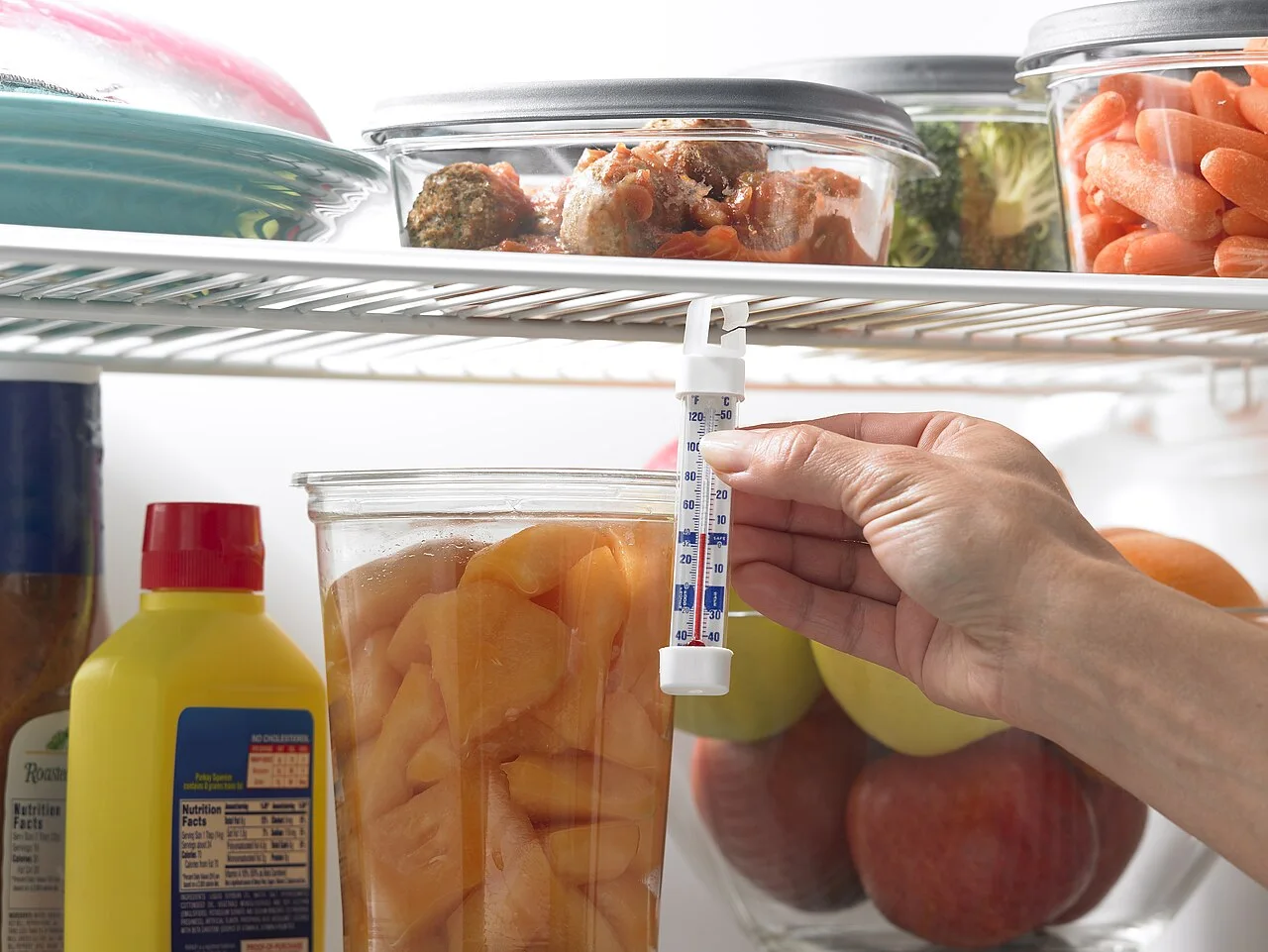
Use the same suitable measurement location and record the time of the next check. The second USDA reference shows a thermometer being checked at a shelf; do not treat its displayed value as a result for your refrigerator.
Photo & usage
USDAgov · Public domain · Source. Display copies resized and encoded as WebP; no instructional details were fabricated or removed.
Consider this hypothetical log: at 8 a.m., the refrigerator reads 46°F (7.8°C) and the freezer 0°F (−18°C). You relocate a carton covering a vent and leave the setting unchanged. A later refrigerator reading of 43°F (6.1°C) shows a downward trend, but it has not met the refrigerator limit. It does not justify reloading perishables.
Check progress after the thermometer has settled, then at the manual's stabilization interval. Do not spend a full observation period waiting if cooling appears absent, readings keep rising, or the door cannot close. Arrange service promptly. If the appliance remains warm after the specified interval, stop making successive adjustments.
THE WORKING FILE / DECISION
A display setting is not a food-temperature history
A hypothetical fridge display is set to 37°F, but an appliance thermometer records 46°F at 09:00. The overnight history is unknown. A reassuring setting does not establish that stored food stayed cold; the unknown interval cannot be replaced with the time someone first noticed the problem.
Set point: 37°F
- What it tells you
- The requested control setting
- What it cannot tell you
- The achieved storage temperature
Reading: 46°F at 09:00
- What it tells you
- The indicated condition at that place and time
- What it cannot tell you
- How long perishable food was warm
Later reading improves
- What it tells you
- Cooling may be recovering
- What it cannot tell you
- Previously mishandled food has become safe
Read the result
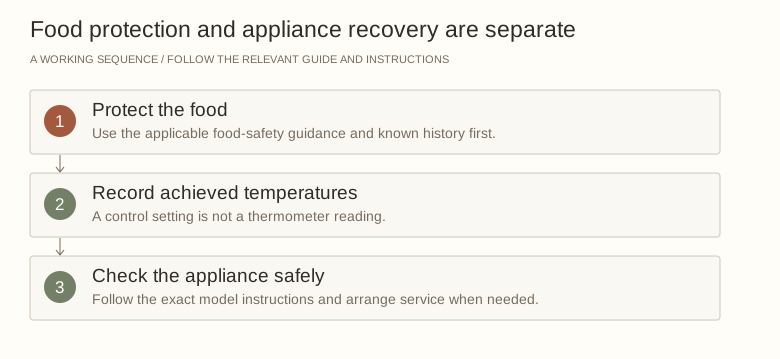
FDA guidance keeps a refrigerator at 40°F or below and addresses time outside safe cold storage separately. Make the food decision using the applicable guidance; do not delay it for an appliance experiment. Then log both compartments, door use, room conditions and the one documented adjustment made. Keep food protection and cooling recovery as two distinct outcomes.
Your decision record Blank worksheet
Protect perishable food promptly and give appliance service a useful temperature history.
- Model
- ________________________________
- Time first noticed
- ________________________________
- Known temperature history
- ________________________________
- Fridge thermometer / location
- ________________________________
- Freezer reading
- ________________________________
- Food protection action
- ________________________________
- Door / airflow observation
- ________________________________
- Documented change
- ________________________________
- Service record
- ________________________________
Before closing the file
- Food safety is decided before troubleshooting delays.
- Actual readings are separate from settings.
- Cooling recovery does not retrospectively clear food.
Require a finish check or hand over a useful record
Before returning still-safe food, confirm the refrigerator meets the temperature limit and the freezer reaches its target. Repeat readings after a further closed-door period, including the previously warm storage area. Restore ordinary use and check again the next day. Recovery of the appliance cannot establish the safety of food whose earlier storage history was unknown.
If warmth or frost returns, book qualified appliance service. Supply the model, dated readings, thermometer positions, settings, photographs, recent events and changes already made. Ask the technician how long to observe temperatures after repair before relying on the appliance again.
Keep the log with the manual. A completed investigation ends with repeatable cold readings and doors that close properly, or a documented handover while food remains in dependable storage.
THE REFERENCE FILE
Sources & scope
Documentation reviewed 1 Nov 2026. Examples are illustrative; this article does not claim hands-on product testing. Follow the instructions for your actual material, model and location.