A pantry can look orderly while the same half-used packet keeps slipping behind new shopping. To prevent that, give food a route from delivery to dinner: unopened reserve stock waits behind the active packet, and ingredients needing attention move into a small, visible next-meal area.
Start with the cupboard you actually cook from. You need a clear work surface, removable labels, a pen, your shopping list and a shallow tray or space at the shelf front. Keep foods in their existing packaging during the first sort. Buy containers only after you know what needs containing.
Check what belongs on the shelf before organising it
Unload one shelf at a time, keeping packets upright and labels attached. Check behind food for damp patches, evidence of insects and shelf damage. If a shelf sags or its supports look loose, leave it unloaded and arrange repair before returning heavy jars. Do not climb on shelving or alter cupboard fixings during this job.
Read storage instructions, including those on cans and cartons. A familiar package shape does not prove that its contents belong at room temperature. USDA's Shelf-Stable Food Safety explains that some canned products require refrigeration and recommends cool, dry storage away from the stove and sink.
If an opened product should have been refrigerated and its storage history is uncertain, do not put it in the next-meal tray. Follow product-specific official guidance; the FDA's storage advice says neglected refrigeration usually means discarding the food. Keep household chemicals elsewhere.
Stop the sort around leaking or swollen cans, badly damaged packaging or extensive rust. Do not open suspect cans to investigate. Discard damaged food following official guidance rather than trying to rescue it through faster meal planning.
Give each date its proper job
Read the words beside a date before deciding what it means. A best-before date concerns quality; it is not automatically the day an intact, correctly stored dry food becomes unsafe. Conversely, a date still in the future cannot compensate for unsuitable storage or damaged packaging.

The close reference reads “best before” on a historical package. Its printed 2004 date is not a recommendation about food in your pantry. Use the wording, storage directions and applicable rules for the actual product in front of you.
Photo & usage
CambridgeBayWeather · CC BY-SA 3.0 · Source. Display copies resized and encoded as WebP; no instructional details were fabricated or removed.
Terminology varies by country. In the UK, GOV.UK distinguishes safety-related use-by dates from quality-related best-before dates. Do not apply a blanket claim that every use-by date is merely about freshness. Follow the product's instructions and the official guidance where you live. Infant formula must be used within its labelled use-by date, as the FDA explains.
- Printed date
- Leave the manufacturer's wording visible. If you repeat it on a shelf-facing label, copy the wording as well as the date.
- Opened date
- Write when you broke the seal, particularly where instructions specify a period after opening. This records an event; it does not establish a new shelf life.
- Meal reminder
- Write an intended meal or shopping reminder separately. A planning note must never look like a replacement safety deadline.
Do not use smelling or tasting as proof that questionable food is safe. The FDA warns that harmful bacteria need not cause obvious spoilage.
Turn the oldest usable ingredients into meal decisions
Choose a small shelf-front space and label it “Plan meals from here”. Admit only food you have already checked and can store there appropriately. Refrigerated ingredients stay refrigerated; put a written reminder in the pantry instead. This prevents an organisation habit from overriding storage instructions.
For every ingredient moved forward, name a realistic use. “Cook something with lentils” is easy to postpone. “Lentil soup on the next evening we cook at home” connects the ingredient with an actual opportunity. Check that you have the other ingredients and equipment before putting missing items on the shopping list.
In a hypothetical household, the tray might hold an opened packet of couscous, an intact tin of chickpeas approaching its best-before date and a small remainder of dried apricots. The plan could be couscous with chickpeas for dinner and chopped apricots in the usual breakfast. These are meal ideas, not storage-life recommendations; follow each packet's directions.
When an ingredient has no plausible use, ask whether you still want to buy it. A shelf of aspirational baking supplies can remain untouched despite perfect labels. Stop replacing the products that repeatedly stall here.
Give every staple a working packet and a reserve position
Group by how you look for food while cooking: breakfast, meal bases, tins, baking or another arrangement that fits your household. Within each group, place the active packet at the front and unopened replacements behind it. Compare dates when restocking; a new purchase can have an earlier date than existing stock.
- Bring all packets of the same product together, including those stored in another cupboard.
- Choose the checked, opened packet to finish first, subject to its instructions. Place other opened packets beside it so they remain visible.
- Arrange unopened stock by the earliest relevant date first. Keep different foods distinct rather than treating all grains or all sauces as interchangeable.
- Leave enough room to remove and return the working packet without unloading its neighbours.
For deep shelves, use a light tray that brings a whole group forward. Test it with the door open and closed before filling it. Put heavy reserves where you can lift them comfortably, and keep labels facing the normal viewing position. A handwritten list of hidden reserve packets on the shelf edge can work better than buying another organiser.
Decant only when you can preserve the information
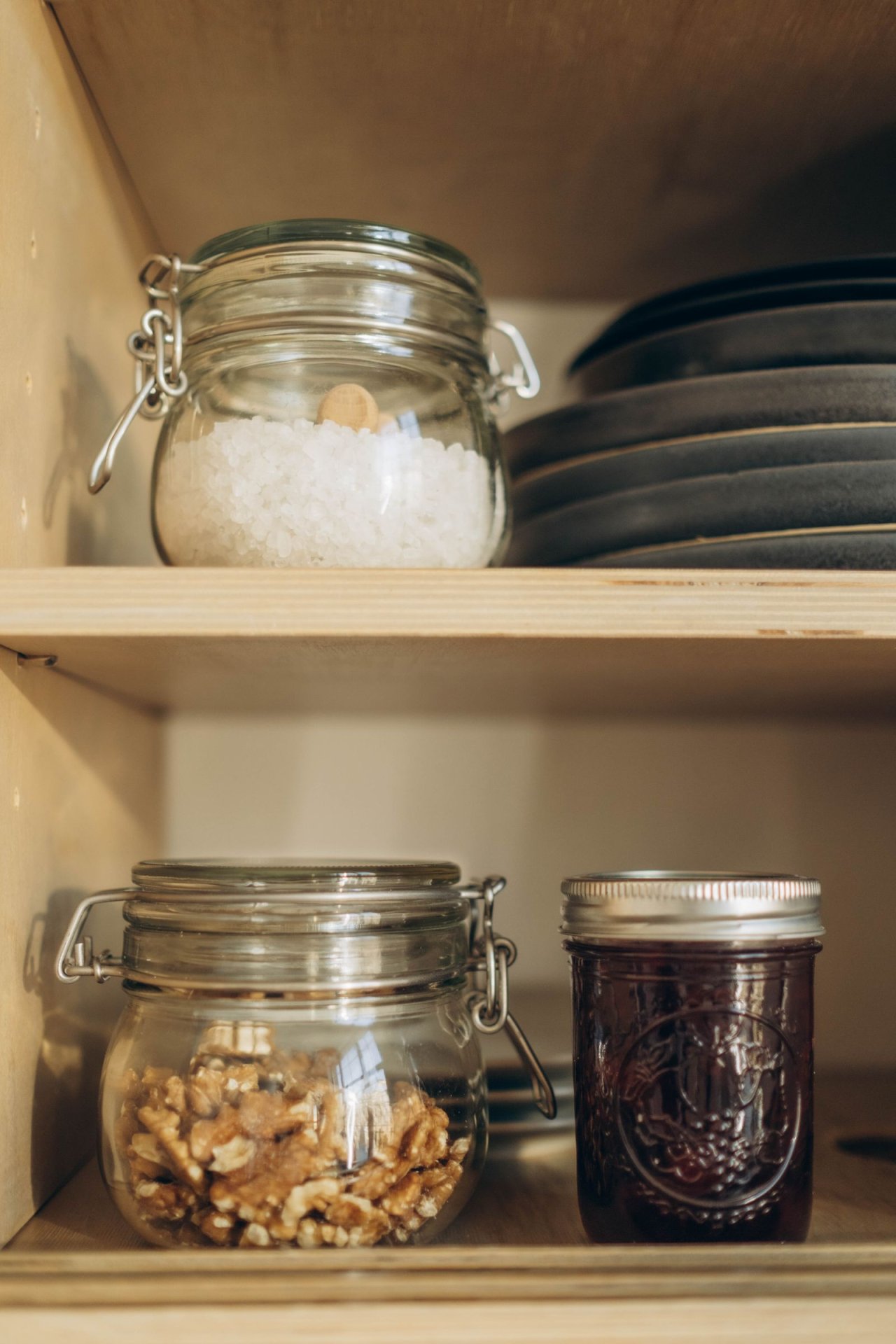
Containers are useful when a packet will not reseal or when awkward bags obscure their neighbours. They also create extra work: information must move with the food. University of Minnesota Extension recommends tightly closed glass, metal or heavy plastic containers to protect insect-free dry foods.

The shelf photograph shows why clear containers alone are insufficient: identity, allergens, preparation and date information still need a reliable link to each ingredient. Do not copy an unlabelled display as a complete pantry system.
Photo & usage
Pexels contributor · Pexels License · Source. Display copies resized and encoded as WebP; no instructional details were fabricated or removed.
Choose containers intended for food storage. Keep the original packet, or retain its complete readable label, including ingredients, allergen information, cooking instructions, dates and batch details. Attach the information to the outside or store it in a clearly identified nearby envelope. A decorative “flour” label alone cannot distinguish products or identify a recalled batch.
Finish the old contents before refilling. Avoid pouring new stock onto an unidentified remainder: you lose the ability to tell which batch you are using. Wash the empty container according to its manufacturer's instructions and let it dry completely before adding dry food. Do not combine similar-looking products or remove the identifying packaging from specialist dietary foods.
Set buying limits from meals you actually make
Choose a stock limit for each frequently purchased staple. Base it on how often you use it, the pack size and the interval between shops. Leave occasional ingredients off the automatic replenishment list until a planned meal needs them.
Here is a hypothetical calculation: a household uses 250 g (about 8.8 oz) of dry pasta per pasta dinner and expects two such dinners before its next shop. It needs 500 g (about 17.6 oz) available for that plan. If it already has that amount, another packet adds reserve stock rather than filling a gap. These quantities illustrate stock arithmetic, not recommended portions.
Put “check reserve” beside staples on the shopping list. Before buying a larger pack, ask whether it will fit its allocated space and whether your normal meals will finish it within the product's storage guidance. A lower cost per unit offers little benefit if the surplus repeatedly becomes waste.
THE WORKING FILE / LEDGER
Four rice packets, one useful buying decision
A hypothetical pantry contains four unopened 500 g rice packets and an open packet holding 200 g. A household usually cooks 150 g dry rice for one planned meal. Total stock is 2,200 g: enough for fourteen complete meals at that portion assumption, with 100 g remaining. This measures planned use, not a universal serving size.
| Stock decision | Working | Practical consequence |
|---|---|---|
| Total dry stock | 4 × 500 g + 200 g | 2,200 g |
| Complete meals at 150 g | 2,200 ÷ 150 | 14, with 100 g left |
| At two such meals per week | 14 ÷ 2 | About seven weeks of planned meals |
| Next shopping trip | Compare stock with actual meal plan | Do not buy automatically because one packet is low |
Read the result
Place the open packet and the earliest suitable reserve where the next meal is assembled. Keep original identity, allergen and preparation information with any decanted stock. If the household changes its menu, the seven-week estimate changes too; it is not a storage-life promise. The useful result is fewer duplicate purchases and an ingredient assigned to a meal, not an attractively uniform row of containers.
Your ledger record Blank worksheet
Turn surplus stock into a next-meal plan and a defensible shopping limit.
- Food and package ID
- ________________________________
- Opened date if known
- ________________________________
- Date wording
- ________________________________
- Required storage
- ________________________________
- Usable quantity g
- ________________________________
- Next meal
- ________________________________
- Planned quantity per meal
- ________________________________
- Reserve already owned
- ________________________________
- Buy / do not buy
- ________________________________
Before closing the file
- Original instructions remain identifiable.
- Unsuitable food is removed from ordinary stock.
- Shopping quantity follows a meal plan.
Finish with a retrieval check and a pest stop point
Ask another household member to find a dinner ingredient, identify which packet to open next and locate any reserve. If they must move unrelated food or decode your labels, simplify the arrangement. Check that doors close, containers reseal and storage instructions remain readable.
Before each shopping trip, review the next-meal space, check reserves and remove crossed-off reminders. If the same item survives repeated reviews, change the meal plan or the future buying decision. Do not keep moving it between attractive baskets.
If you find insects or webbing in food, pause restocking. Minnesota Extension advises discarding infested food, inspecting other susceptible products and vacuuming cupboard cracks; empty the vacuum afterwards. It does not recommend insecticides inside stored-food cupboards. Persistent activity or uncertain insect identification warrants advice from an extension service or qualified pest professional. Resume the shelf arrangement once you have addressed the source.
THE REFERENCE FILE
Sources & scope
Documentation reviewed 1 Nov 2026. Examples are illustrative; this article does not claim hands-on product testing. Follow the instructions for your actual material, model and location.