Read what makes the selected cycle stop
A dryer countdown can look like a timer even when the programme is responding to the load. Start by identifying the stopping rule in the exact manual. An automatic or sensor programme may adjust according to sensed conditions and selected dryness. Timed drying runs for a chosen interval under its defined settings. Neither label removes fabric-care requirements.
Whirlpool: Using Auto Dry, Timed Dry and EcoBoost distinguishes automatic and timed drying for covered Whirlpool products. It describes sensor-based stopping and notes particular uses for timed drying. Treat those as product-family guidance, not proof that every dryer senses in the same place or responds identically. A heat-pump model, vented model and washer-dryer combination may differ.
Write the practical need: an ordinary compatible load, a small residual damp item or a permitted rack-drying task. Do not choose timed high heat simply because a previous automatic run ended with one seam still damp. The load and the manual need to explain that choice first.
Check whether the load suits the sensing programme
Read care labels and select only a programme allowed for the fabrics. Separate items with substantially different drying needs where practical. A mixed load of thin synthetic pieces and thick cotton can reach uneven endpoints. Sensor behavior may also be less useful for particular very small loads, depending on the model; check its guidance rather than assuming a fault.
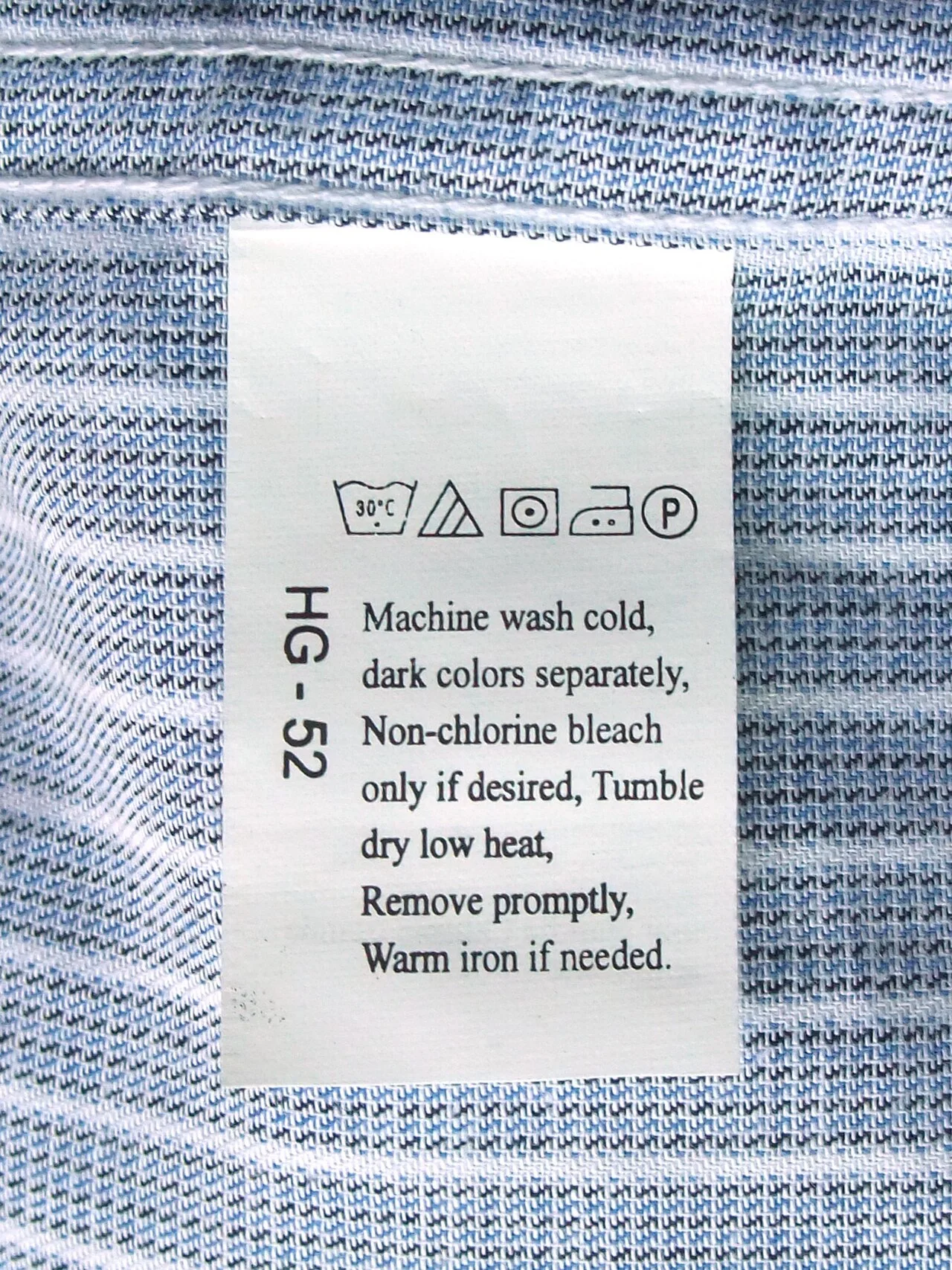
A sewn-in shirt care label is shown. The reference supports checking tumble-drying permission; it does not depict a dryer sensor, control or approved temperature.
Photo & usage
Mk2010 · CC BY-SA 3.0 · Source. Display copies resized and encoded as WebP; no instructional details were fabricated or removed.
Use the permitted load capacity and allow normal tumbling. Do not pack the drum so tightly that items remain folded into a mass. Check that the washer completed its intended extraction before transferring the load, because unusually wet starting fabric changes the drying task. Record that history if it differs from normal.
Whirlpool: Auto Dry or Timed Dry on a HybridCare Electric Dryer provides separate guidance for covered HybridCare electric dryers. Its existence is a useful boundary: similar Auto Dry and Timed Dry names can sit within a different drying system. Use the exact model document for programme compatibility, rack use, dryness adjustments and any cooldown requirements.
Capture dryness, heat and options as distinct fields
Write the programme, selected dryness, heat setting where available and any energy or extended-tumble option. Some settings are defaults, some are unavailable and some may be remembered. Check the final accepted combination. A programme name alone is not enough to reproduce the run later.
Complete the model's normal user maintenance before operation, including the specified lint-screen routine. Do not operate without required screens or filters. Keep installation and service access limits intact; this article does not authorize opening a heater compartment, disconnecting a gas line or moving a stacked dryer.
Record the initial estimate as an estimate. Whirlpool: Dry Time Keeps Going Up explains that automatic-cycle time can change with sensed conditions. A rising display is not itself a diagnosis. Keep the actual elapsed time and fabric outcome separate so a shorter countdown is not automatically treated as a better run.
Compare two stopping choices by what remains
The following observations and timings are illustrative and invented. They are not tests of a dryer or recommendations for heat settings. Assume all selections are permitted by the hypothetical appliance and fabrics.
| Route | Time | Observed endpoint |
|---|---|---|
| Compatible sensor load | 54 minutes elapsed | Most items ready; one thick seam damp |
| Whole load given an extra timed interval | 15 additional minutes | Already-dry items receive more drying too |
| Permitted targeted follow-up | Outcome assessed under actual instructions | Only items needing further care continue |
The whole-load route totals 54 plus 15, or 69 minutes. The arithmetic does not prove a particular energy cost or damage outcome. It shows why a residual damp item deserves inspection before adding time to everything. A targeted route is appropriate only where the actual load size, programme and care instructions permit it.
Check hidden damp areas without skipping cooldown
Let the programme complete its normal stages and follow unloading instructions, including any cooldown precautions. Do not interrupt heat repeatedly to check fabric or leave hot laundry piled tightly. Inspect thicker seams, waistbands and folds after safe unloading, keeping care requirements in mind.
Record which items are ready for their next use or storage and which need further permitted drying. Warmth can affect a quick touch impression, so avoid calling the whole load dry after checking one exposed sleeve. The observation is ordinary care, not a laboratory moisture measurement.
If the same programme repeatedly stops with an unsuitable endpoint, consult the model's user adjustments and troubleshooting. A dryness-level change may be available, but it is not universal. Do not access a service calibration or scrape internal sensors using an unrelated guide. Manufacturer support can interpret the repeated load and settings record.
Record a small residual group precisely
When only a few pieces need more care, list them and the damp feature before choosing follow-up. One heavy seam, a rolled cuff and an entire wet towel are different endpoints. Check whether the model's automatic programme is suitable for the resulting small group; removing ready items can change the sensing task. If the instructions provide a timed or other route for that situation, use its permitted heat and load limits.
Keep both stages in the final record. The first programme may have handled the majority appropriately while the residual group needed a different permitted finish. That is more informative than calling the whole run a failure or hiding the second stage. It also prevents a remembered extra-time setting from being applied to the next ordinary full load without a specific reason.
Do not make maximum time the automatic remedy
For a small residual damp group, use the follow-up route the manual permits. Some models specify timed drying for certain situations; others provide a suitable automatic adjustment or rack programme. Keep the fabric's heat and action limits controlling. A short time does not make an otherwise unsuitable heat level acceptable.
If every item remains much wetter than expected, review the load, starting extraction, programme and user-maintenance status. Stop for overheating signs, burning smell, error conditions or water leakage, and seek appropriate help. Do not run a succession of timed cycles to compensate for a recurring airflow or equipment concern.
Record the follow-up and its outcome. That makes the total task visible rather than reporting only the first automatic run. Avoid energy-savings or fabric-life percentages from this log: it measures neither standardized energy consumption nor long-term textile effects. The useful comparison is whether a permitted programme reaches a practical endpoint without unnecessary repetition.
Finish with a load-specific drying decision
Write a short rule for the ordinary load that actually worked: programme, dryness selection, compatible item types and what to inspect afterward. Include exceptions such as a single thick item or a rack task, with a reference to the exact manual. Do not generalize one successful run to all fabrics.
Keep the next drying handoff practical. The person unloading should know which items need a seam check and where any residual damp pieces can receive appropriate follow-up. A load should not be folded into closed storage simply to meet a schedule while known damp areas remain.
Completion means the initial stopping rule is understood, the observed endpoint is recorded and extra drying has a defined purpose. The machine's countdown remains useful, but it no longer substitutes for load suitability or fabric inspection. A good routine ends the actual care task rather than treating more timed minutes as the universal answer.
THE REFERENCE FILE
Sources & scope
Documentation reviewed 1 Nov 2026. Examples are illustrative; this article does not claim hands-on product testing. Follow the instructions for your actual material, model and location.