Decide which air you want to describe
A hygrometer beside a wet window may tell a convincing story about that window while giving a poor account of the room. Before moving the instrument, write the question you want answered. Are you tracking the air near your usual chair, a cupboard that smells damp, or the background conditions between showers? Those are different sampling positions. One number cannot represent all three without qualification.
For an ordinary room record, choose an accessible shelf or table away from direct sunlight, a radiator, an air-conditioning outlet and a visible moisture plume. Keep the sensor openings clear. Do not hide the display behind books merely to keep it tidy. A photograph or simple sketch of its position is more useful than calling the spot the usual place.
This is a household observation method, not a calibration procedure. EPA: Low-Cost Air Pollution Monitors and Indoor Air Quality explains that consumer monitors describe only the factors they measure. A humidity display cannot establish that indoor air is safe or that concealed materials are dry.
Give the position a short identity
Label your chosen position A in the notebook. Record the room, supporting surface, approximate height, distance from the nearest window and whether heating or cooling air reaches it directly. Exact surveying is unnecessary; the description should let another household member return the instrument to the same place after dusting. Include which way its sensor openings face if nearby objects might obstruct them.
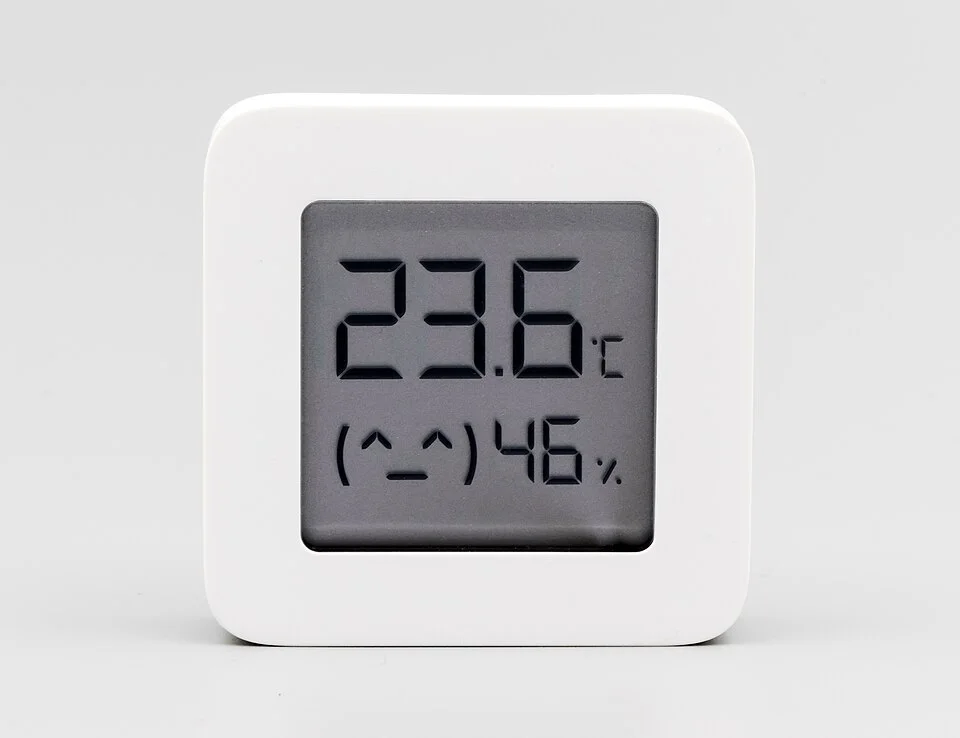
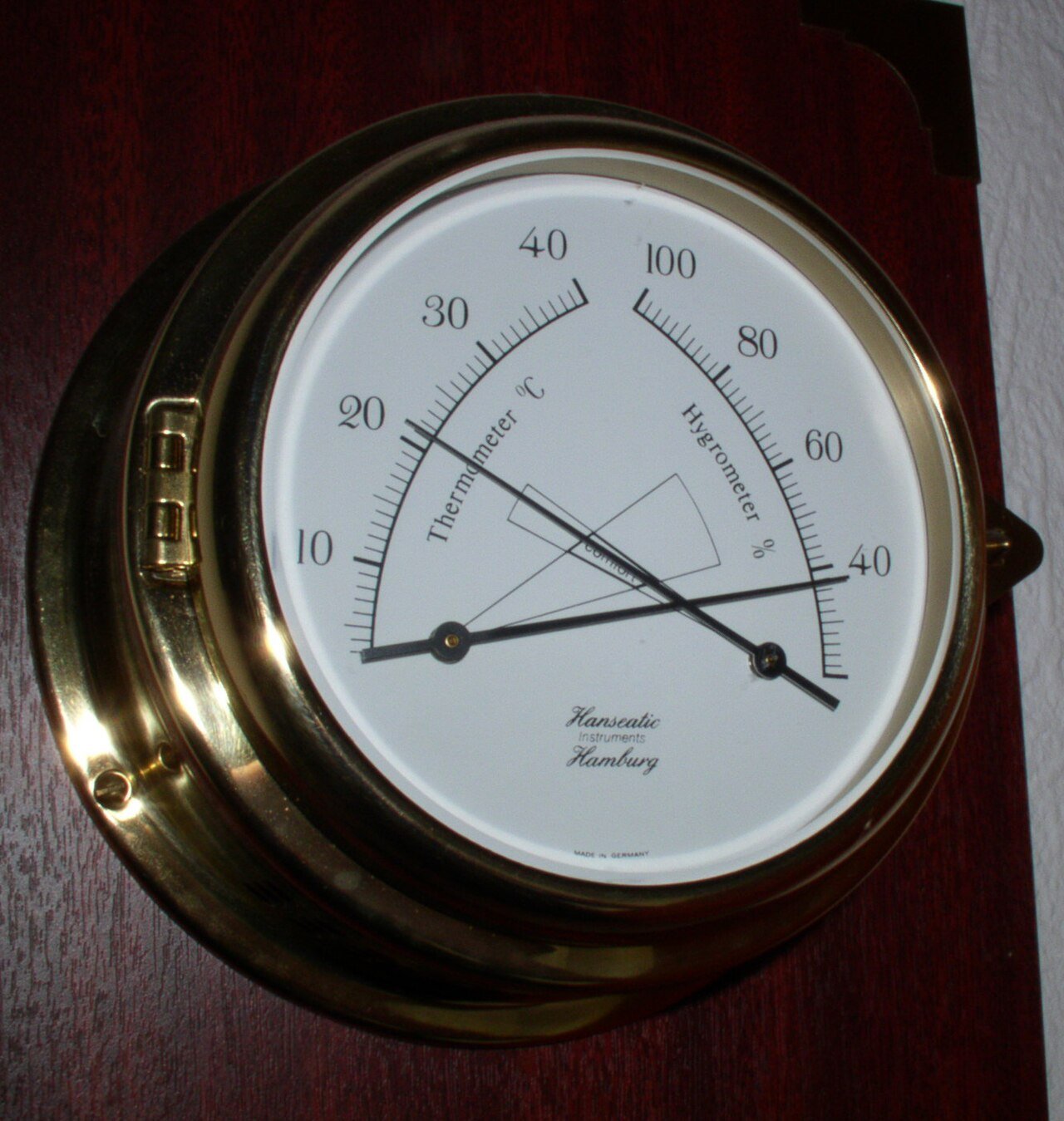
The separate temperature and humidity figures show what belongs beside each dated observation. Record the supporting surface, approximate height and nearby window or heat source on a position card so the meter can return to the same place. This product view supplies no room distances or mounting permission; follow its instructions for sensor clearance and settling time.
Photo & usage
Jacek Halicki · CC BY-SA 4.0 · Source. Display copies resized and encoded as WebP; no instructional details were fabricated or removed.
Read the instrument instructions for its operating range and response or settling guidance. After moving it, leave it undisturbed for the specified time before accepting a reading. If no settling time is supplied, record a short sequence until the display stops making a consistent directional change, and note that this is your practical convention rather than the manufacturer's specification.
Avoid carrying the meter around while reading it. Hands, breath and the previous room's conditions can affect the transition. Write a timestamp next to every accepted temperature and RH pair, including the time you first placed it.
Keep a damp-pocket reading separate
You may also need a position B near a suspect corner. Choose an accessible place that does not touch wet material or require moving heavy furniture. Describe it as a local investigation position, not a better measurement of the whole room. A cold wall and restricted circulation can make conditions there differ from the central shelf.
With one instrument, observe A, move to B and allow it to settle, then return to A later. That sequence cannot show simultaneous differences. Cooking, weather or a heating cycle may change the room between visits. With two instruments, compare them side by side first so a device difference is not mistaken for a corner effect.
Health Canada: Guide to addressing moisture and mould indoors includes checking condensation, moisture damage and restricted circulation in household investigations. Use that physical evidence alongside the display. If the corner is visibly wet, photograph its location and arrange prompt drying or repair; do not wait for an elaborate measurement sequence to validate the water.
Work through a misleading shelf comparison
Consider this illustrative record, invented to demonstrate positioning rather than describe a tested room. The same meter spends the morning in three places. Each figure is accepted only after the display settles under the household's recorded convention. The heater operates during the second visit, so the observations are not a controlled experiment.
| Position and time | Temperature | RH | Nearby influence |
|---|---|---|---|
| A, open shelf, 08:00 | 20°C | 55% | No direct supply air |
| B, beside radiator, 09:00 | 24°C | 44% | Heating active |
| A, open shelf, 10:00 | 20°C | 54% | Original position restored |
The difference between 55% and 44% is 11 percentage points. It does not demonstrate removal of moisture. The instrument warmed beside the radiator, and RH depends on temperature. Returning to A produces only a one-point difference from the first reading. Position and temperature explain why selecting the lowest number would produce a misleading success story.
Add the events that could explain a change
Use a small number of repeatable observation times that match the question. A bedroom might need bedtime and waking readings; a workroom might need an arrival reading before equipment starts. Add brief event notes: laundry brought in, door closed, window opened, people visiting or heating starting. Record an event even when it seems inconvenient to your preferred explanation.
Do not turn the notebook into a minute-by-minute burden unless a short event genuinely needs that detail. Two well-positioned observations and an honest activity note can be more useful than a dense graph with an unknown sensor location. If an automatic logger moves, mark the move in its exported record rather than treating the whole trace as continuous room evidence.
Choose a written way to describe visible surfaces as well. Clear, scattered droplets and running water are intelligible categories. They are observations rather than measured water volumes. Keep them in a separate column so a dry-looking window cannot erase an elevated room trend.
Know when a small difference is inconclusive
Check the meter's stated accuracy before treating a slight rise as a household problem. Display resolution and accuracy are different: a device showing whole percentages is not necessarily accurate to one percentage point. A side-by-side agreement with another inexpensive meter is encouraging, but it does not supply traceable calibration.
EPA: A Brief Guide to Mold, Moisture and Your Home gives a general moisture-management reference of below 60% RH, ideally 30–50%. That guidance does not turn a single shelf reading into a verdict on every surface. Very cold material can collect condensation while the room reading appears ordinary. Conversely, a brief local steam plume should not become the room's permanent humidity label.
Do not keep moving the meter until it reports a preferred value. If readings at A stay unexpectedly high, check ordinary sources and existing ventilation. If only B is persistently damp, investigate that location's circulation, cold surface or possible water entry. Both patterns can justify action without pretending the meter identifies the cause.
Finish with a position another person can repeat
The placement task is complete when the meter has a documented home, its instructions are available and the record explains any temporary move. Revisit A during a normal occupied period and confirm that books, curtains or furniture have not newly enclosed it. A shelf that worked before rearranging the room may no longer represent the same conditions.
Keep the first useful page as a position card: location sketch, device identity, temperature units, settling convention and regular observation times. Add a short note saying what the station cannot describe, such as the space behind a wardrobe or moisture inside a wall. That limitation prevents later readers from giving the number more authority than it has.
Close with a practical decision, not just a folder of readings. Continue routine observation if conditions are consistent and surfaces remain dry. Investigate recurring wetness or material damage promptly. The point of repeatable placement is to support a clearer next action, not to make a household earn permission to address obvious dampness.
THE REFERENCE FILE
Sources & scope
Documentation reviewed 1 Nov 2026. Examples are illustrative; this article does not claim hands-on product testing. Follow the instructions for your actual material, model and location.