Do not use spin speed as a cleaning-intensity label
A washer panel can place soil, temperature and spin controls together, encouraging the assumption that every higher setting means a stronger wash. Separate the decisions. Soil settings may change wash time or related programme behavior; spin settings affect the permitted extraction stage; temperature has its own role and fabric limits. The actual functions depend on the model.
Begin with the exact machine guide and one ordinary load. Read the labels on its items before choosing the base programme. Do not use a higher spin setting for a delicate fabric merely because it is heavily soiled. Soil and fabric construction are separate considerations, and a machine accepting a setting does not override garment care.
Whirlpool top-loading washer quick reference W11197737B shows separate soil and spin modifiers on the covered top-loading washer. Use it as an example of distinct controls, not a universal list of speeds. Your machine may offer different names, defaults or restrictions for each programme.
Choose soil from the load description
Describe whether the load is lightly worn, ordinarily soiled or carrying heavier visible soil, using the machine guide's categories. Note a few specific problem areas. That gives the result something to refer back to. A laundry basket that smells strong is not automatically a heavy-soil load in the programme's technical sense.
Whirlpool: Cycles, Options, and Modifiers on a Top Load HE Washer describes soil modifiers for the covered top-load family, including more wash time for heavier soil. Check the actual manual before assuming a setting raises water temperature or adds water. Do not convert a named setting into a hidden mechanical claim that the documentation does not support.
Use compatible detergent and dosing guidance. A programme choice cannot compensate reliably for an unsuitable formulation or an excessive dose. If items need pretreatment, follow their care and product instructions without mixing chemicals or extending soaking beyond permitted use. Keep that pretreatment event in the record so it is not silently credited to the washer setting.
Choose spin within fabric and programme limits
Check which spin options are available for the selected programme and allowed by the items. A lower extraction setting may leave more water for later drying, while a higher permitted setting may affect creasing or handling. Do not promise a specific drying-time reduction without measuring the relevant conditions.

The label displays a wash-temperature instruction and several separate care restrictions. Read the actual item’s full guidance before selecting extraction, then check which spin options the chosen washer programme accepts. This label view supplies no spin speed; do not infer an rpm limit or drying-time benefit from a wash-temperature symbol.
Photo & usage
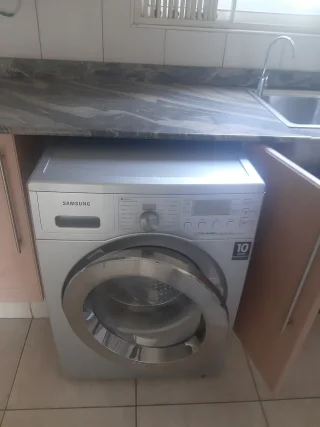
Gozitano · CC BY-SA 4.0 · Source. Display copies resized and encoded as WebP; no instructional details were fabricated or removed.
Record the setting by its displayed name or stated speed, not by an invented equivalent. Some panels show slow, medium and fast rather than revolutions per minute. If the manual does not give a speed, keep the name. A nominal speed also does not prove the machine reached that speed through a particular unbalanced load.
Whirlpool front-loading washer use and care guide W11339488A provides a cycle matrix with different allowed settings for the covered washer. Read rows and options together. A setting available on Normal may not be available on Delicates. Never bypass a restriction or use an unrelated service menu to force an extraction speed the programme does not offer.
Compare two loads without ranking every setting
This comparison is illustrative and invented. It assumes the hypothetical appliance and fabric instructions permit the stated selections. It is not a recommended settings chart for an actual machine.
| Load | Cleaning question | Extraction question | Record |
|---|---|---|---|
| Lightly worn crease-sensitive items | Light soil setting appropriate to guide | Permitted gentler spin | Check ordinary soil removal and creasing separately |
| Sturdy compatible items with heavier soil | Permitted heavier-soil programme or modifier | Permitted extraction setting for those items | Check original soil areas and remaining wetness separately |
Neither row says to maximize all controls. If the first load comes out wetter but appropriately cared for, that does not show poor cleaning. If the second comes out well-spun but visibly dirty, extraction did not solve the wash question. The matrix keeps the household from using a dry-feeling result as a substitute for checking cleaning.
Observe after the machine finishes normally
After normal completion and unlocking, inspect the noted soil areas and the load's ordinary handling condition. Write cleaning and extraction outcomes in separate fields. Useful wording includes mark remains at cuff, no obvious residue, several items unusually wet or more creasing than the household finds manageable.
If the load is unexpectedly wet, check the manual's user-level guidance for distribution, permitted load and any displayed error. Do not automatically add maximum spin. A heavy single item, restricted programme or incomplete cycle can require different actions. Stop for leakage, violent movement or other abnormal behavior and seek appropriate support.
Do not open a drain pump area or remove panels as part of this programme comparison unless the actual manual explicitly identifies a user procedure and its precautions. This article concerns choosing controls and recording outcomes. It does not diagnose suspension, motor, drainage or sensor faults from the appearance of wet clothing.
Separate a setting request from a completed stage
If the appliance reports an unbalanced load or ends without the expected extraction, record the selected spin and the actual status separately. The selected value is a request within the programme, not evidence that the machine sustained it. Do not estimate achieved speed from sound or a phone video. Use the model's ordinary instructions for the reported condition and stop if movement is abnormal.
This distinction also helps when comparing later drying. A longer drying task after an incomplete extraction should not be attributed automatically to the chosen soil level. Add the interruption or balancing event to the laundry handoff so the person using the dryer knows the starting condition differed. That preserves a useful causal boundary without attempting to diagnose the washer's suspension or control system.
Do not change soil, dose and spin together
For a useful ordinary-use comparison, choose the control relevant to the problem and hold other practical conditions broadly consistent. If visible soil remains, investigate the appropriate wash choice and permitted treatment. If cleaning is satisfactory but drying is difficult, review the extraction and drying arrangement within care limits.
Record unavoidable differences in load composition, weather or subsequent drying. Do not treat two different fabric baskets as identical because their dry masses match. If you weigh retained water, use a suitable scale and an explicit method; this guide does not require or infer such a measurement.
A single improved result supports a practical routine but does not prove the control caused every difference. Keep the raw observations. If an appropriate load repeatedly produces poor results despite following the instructions, contact manufacturer support with the exact programme, accepted settings, load description and symptom. That evidence is more useful than saying the washer is weak.
Leave each control with a clear household purpose
Make a concise control map from the actual manual: base programme for the load, soil modifier for the documented soil category, temperature within care limits and spin within both fabric and programme permissions. Include which options are unavailable rather than leaving someone to discover them during a rushed wash.
Check the panel before the next run because remembered settings can carry over on some models. Do not assume returning to the same programme name restores every factory default. Capture the final accepted combination and any additional rinse. If a household member changes a setting, the record should make that visible.
Completion means the household can explain why each selected control fits this load and can judge cleaning separately from extraction. The result is a repeatable appliance-use decision, not a contest to choose the highest values. Keep promises proportionate: no cleaning, fabric-life, health or energy percentage has been established by this ordinary-use record.
THE REFERENCE FILE
Sources & scope
Documentation reviewed 1 Nov 2026. Examples are illustrative; this article does not claim hands-on product testing. Follow the instructions for your actual material, model and location.