Ask what job the object will have next
Decluttering before a move often starts with the question “Do I like this?” A more useful first question is where the object will work at the destination. A well-liked cabinet can be a poor moving choice if no wall can accommodate it, while an unfashionable folding table may be essential during the first weeks.
Write a specific next use beside each difficult object. Include the room, the function and the date it becomes useful. “Might be useful someday” is a different category from “holds the printer in the study next month.” Neither requires an immediate disposal decision, but the distinction makes the uncertainty visible.
Gather destination evidence before making irreversible choices. Use a measured plan, existing furniture dimensions and known storage. If access to the next property is unavailable, mark estimates as unconfirmed. Do not release an expensive, difficult-to-replace item solely because an online room photograph makes the space look small.
Compare with usable capacity
Measure the relevant shelf, wall or cupboard, including obstructions and opening doors. Do not compare the combined outer dimensions of furniture with the entire floor area. An object needs a usable position, access and any manufacturer-required clearances. A cabinet that blocks a socket or prevents a door opening has not passed the test.

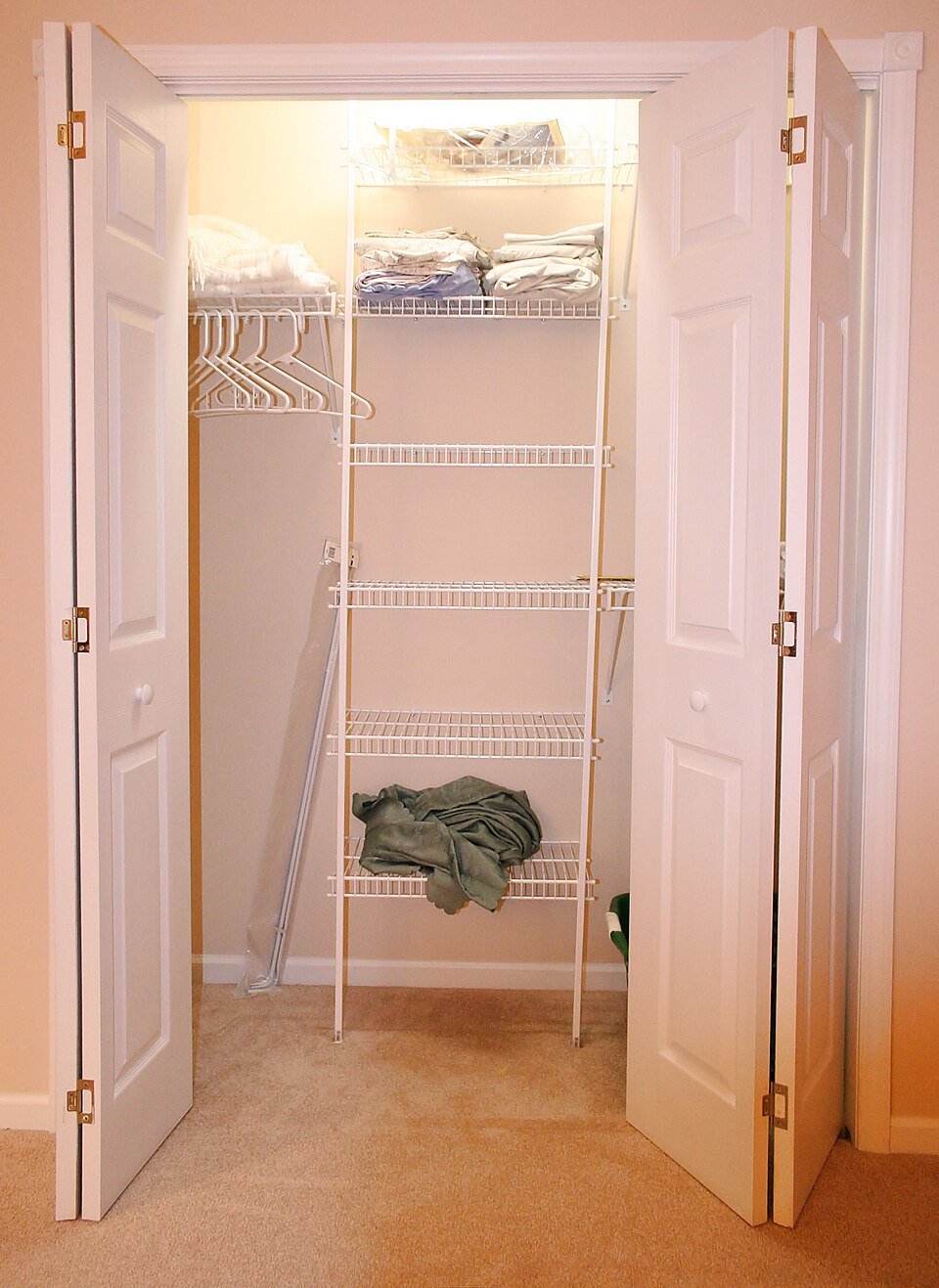
The wardrobe’s closed doors and the stool in front identify separate furniture and access footprints. At the destination, include the open doors and surrounding objects before measuring the actual interior. The outer cabinet photograph cannot establish usable shelf or rail capacity, dimensions or whether a particular collection will fit.
Photo & usage
Richard Avery · CC BY-SA 4.0 · Source. Display copies resized and encoded as WebP; no instructional details were fabricated or removed.
For collections, compare the space the usable selection requires rather than keeping everything because the category matters. Count the plates actually needed for the household's ordinary meals and planned gatherings. Distinguish frequently used equipment from duplicates kept only because they arrived in a set.
Use temporary floor markers or a paper layout for uncertain positions, selecting a method suitable for the surface. If two objects compete for the same location, record that conflict explicitly. A destination plan should not promise the same corner to a desk, a bookcase and an overflow wardrobe.
Treat transport cost as one input
Ask the mover whether removing a particular object would change the actual quotation. A smaller load does not always produce a proportional price reduction, especially where minimum charges or a fixed service apply. Do not divide the total bill by the number of objects and describe that as the saving from discarding one.
Compare repairability, replacement availability and the cost of an appropriate replacement if the function is still needed. Include delivery and assembly when relevant. Use current written prices for a real decision, and keep resale expectations separate until a buyer has committed and paid through an agreed safe method.
A cherished or specialised object may justify transport despite being used infrequently. Conversely, a cheap replacement is not a reason to discard something that already works and fits. EPA Ireland's circular economy guidance supports considering repair and reuse before buying; apply that order to the object's actual condition.
Work through competing storage choices
In this illustrative comparison, a household has 180 cm of usable wall for book storage. Cabinet A is 110 cm wide and cabinet B is 95 cm wide. Together they require 205 cm before any additional allowances, exceeding the available wall by 25 cm.
The household's selected books occupy 3.6 linear metres of shelf. Cabinet A provides four usable shelves of 0.95 m, or 3.8 m total. Cabinet B provides four usable shelves of 0.80 m, or 3.2 m. On these invented measurements, A holds the selection with 0.2 m spare; B is short by 0.4 m.
This supports reviewing B for release, provided A also passes access, condition and installation checks. It does not prove A's shelves can support the books: load limits and anchoring instructions remain separate. Reducing the collection or choosing another arrangement could change the conclusion. Record which assumption led to the decision.
Confirm an exit route before calling it gone
Contact the proposed recipient or donation service with accurate dimensions and condition photographs. Habitat for Humanity's ReStore FAQ explains that acceptance varies by location. A general statement that a charity takes furniture is not confirmation that this branch will collect this cabinet from this floor.
Ask about collection timing, access, disassembly and exclusions. Keep the object on the moving decision list until a realistic handoff exists. If a sale or donation falls through, you need time to choose another route without blocking packing or leaving furniture in a communal corridor.
Separate ordinary reuse from hazardous waste. EPA's household hazardous waste guidance directs residents to local management options and warns against mixing leftovers. Paint, chemicals and certain other products need their own acceptance checks. Do not put them in a donation box simply because the box already contains useful household items.
Limit the unresolved group
Create a small holding area for objects whose destination depends on missing evidence. Give each one a question, a person responsible for answering it and a decision date. “Measure study wall by Thursday” is actionable; “think about desk” tends to persist until the vehicle arrives.
Keep the holding area within a chosen physical limit that does not obstruct everyday use. When it fills, resolve an existing question before adding another large object. The limit is a household management choice, not a rule about how many possessions someone should own.
For shared belongings, agree who can authorise release. Photographing an object or packing it into a giveaway pile does not establish consent. If family members disagree, separate the space and transport facts from the emotional decision, and allow the actual owners to decide within the moving constraints.
Close decisions with evidence and a fallback
Mark each reviewed object keep, confirmed release or unresolved. For retained objects, identify the destination position and any installation task. For releases, record the recipient or accepted disposal route and the handoff date. Save only the personal information necessary for that transaction.
Recheck the list when the move quotation or destination plan changes. If a previously retained cabinet no longer fits, reopen that specific decision instead of restarting the whole decluttering exercise. If a donation appointment is cancelled, activate the fallback early enough to avoid an emergency clearance.
The edit is complete when retained objects have credible uses, released objects have actually left through suitable routes, and remaining uncertainty is bounded and named. A dramatic reduction in the number of possessions is not the measure of success; a workable destination and an accountable moving load are.
Distinguish genuine duplicates from parallel uses
Put apparently duplicate items beside the tasks they support. Two laundry baskets may both be used at once in separate rooms; two large serving dishes may serve an annual gathering that the household intends to keep hosting. The relevant question is simultaneous demand, not whether two objects share a product name.
Observe a normal week before releasing equipment whose use is disputed. Note when each item was taken out and whether an alternative was already occupied. An unused item during an unusual holiday week is weak evidence about ordinary demand. For seasonal objects, use the planned season and available storage instead of pretending a short observation settles the matter.
Where a duplicate is retained as a backup, name the failure it covers and the time needed to obtain a replacement. A spare essential component with a long lead time is a different decision from a third decorative container. Keep the rationale with the destination position so a useful reserve does not later become another unexplained object in an overflow pile.
THE REFERENCE FILE
Sources & scope
Documentation reviewed 1 Nov 2026. Examples are illustrative; this article does not claim hands-on product testing. Follow the instructions for your actual material, model and location.