An electricity review can produce several useful numbers and still leave a confusing file. Bills sit in one folder, appliance measurements in another and a tariff screenshot has no date. Months later, nobody can explain which rate supported the claimed saving or whether the reading was actual.
Close the review with a compact evidence file. This procedure describes a review readers can perform; it does not claim this scheduled article has already observed a future billing period. Keep the source-review date distinct from publication timing and use dated household records for the actual decision.
Start with the question and the accounting boundary
Write the question in one sentence: why daily use changed, what a device costs under defined conditions or whether a purchase premium is justified. A file without a question tends to collect unrelated documents and produce a vague conclusion that the bill seems high.
State the boundary: whole-home imported electricity, one appliance, a group of devices or a standardized label comparison. Keep export, generation and storage flows separate where they exist. A figure cannot be audited unless its meaning is clear before arithmetic begins.
List what the review excludes. This might include fixed charges, taxes, repair costs or seasonal extrapolation. Exclusions are not necessarily defects when the question is narrow, but they must remain visible. Do not label an energy-only scenario as a complete ownership-cost assessment simply because the spreadsheet displays a USD total.
Gather original records without losing their versions
Retain relevant bills, reading histories, interval downloads, official tariff documents and appliance information. Name them with the service period or observation date, not just the download date. Keep corrected statements distinguishable from originals so a later reader does not count both as new consumption.
Portland General Electric — Understanding My Bill provides examples of separate charge categories and account adjustments. Use the applicable supplier's own information to interpret the file. A copied glossary from another utility can help frame a question but cannot establish the terms of your account.
Keep account identifiers and personal schedules appropriately private. A summary for another household member can reference documents without exposing unnecessary details. Do not publish meter identifiers, service addresses or private bills merely to make the review appear well evidenced. Traceability within a suitable private file is enough for an ordinary household decision.
Create a short evidence index
For each important input, record the value, unit, source and applicable period. Include whether it is measured, estimated, published or illustrative. A spreadsheet cell should not silently change from one kind of evidence to another when an updated number is copied in.
The index can remain simple: billed kWh from final statement, elapsed hours from meter log, rate from dated tariff and annual energy from official model label. Add the exact document reference or page where useful. Avoid creating a filing system more complex than the review itself.
PSE&G — Meter Reading explains its distinction between estimated and actual meter information. Preserve that status in your evidence index even when the number has several decimal places. Precision of display and reliability of origin are separate issues. A highly precise estimate remains an estimate, and a later actual reading may change the interval interpretation.
- Index every decisive input by value, unit, applicable period and source document.
- Preserve original and corrected versions while counting final energy allocations only once.
- Attach each unresolved question to the conclusion it limits and record the next meaningful review trigger.
Reconcile one illustrative energy-and-cost file
All figures here are illustrative. A reliable interval contains 320 kWh. The file assigns 200 kWh to one price period and 120 kWh to another. The allocation reconciles because 200 + 120 = 320. At USD 0.16 and USD 0.25 per kWh, the modeled energy charges are USD 32 and USD 30, totaling USD 62.
A separate USD 15 fixed charge makes the simplified total USD 77 before other items. Dividing USD 77 by 320 gives an average account cost of USD 0.240625 per kWh, but that is not automatically the avoidable price of a device's energy.
Suppose a proposed change removes 10 kWh entirely from the USD 0.25 period. Its modeled energy-charge difference is USD 2.50, not 10 times the average account cost. This check connects the allocation, tariff and decision boundary. The figures are invented and do not reproduce a real account or promise a future saving.
Link appliance records to the right comparison basis
For a measured appliance record, retain device identity, mode, instrument, endpoints and elapsed time. For a label comparison, retain the exact official model information and test basis. Do not merge them into one column without marking their different conditions.
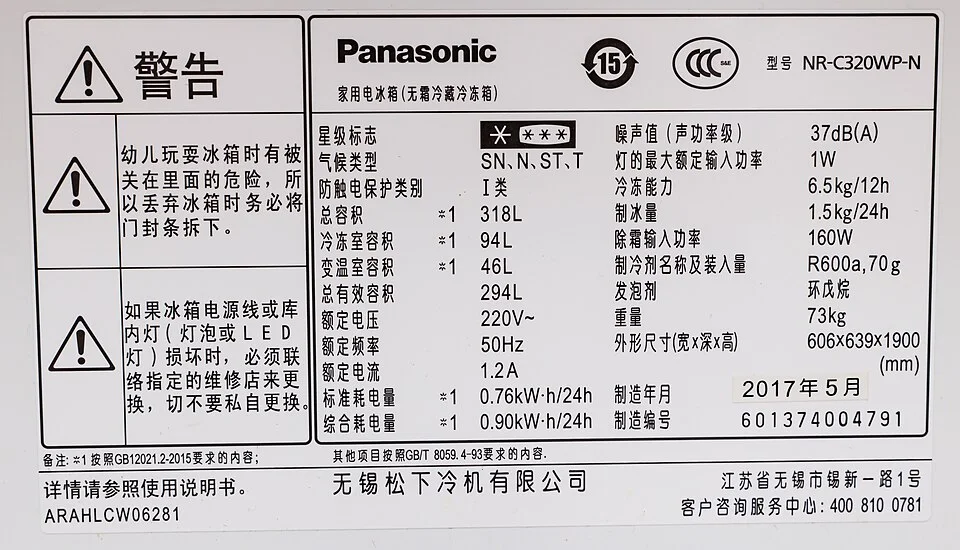
The plate includes energy figures expressed per 24 hours alongside model identity and other ratings. Preserve the complete label, its unit and official test basis when filing comparison evidence. A standardized daily figure and a measured household interval describe different conditions; keep the usage schedule and any annualization assumption separately identified.
Photo & usage
Dinkun Chen · CC BY-SA 4.0 · Source. Display copies resized and encoded as WebP; no instructional details were fabricated or removed.
FTC — How to Use the EnergyGuide Label to Shop for Home Appliances explains that label operating costs are estimates affected by use and local prices. A file comparing a measured week with a standardized annual label must state that limitation. It should not claim a manufacturer error merely because the two figures differ.
Keep the usage schedule separate from the energy evidence. A measured session multiplied by an assumed annual frequency produces an annual scenario, not an annual measurement. Record both inputs so the next reader can change the schedule without accidentally changing the original observation. Preserve units throughout the calculation and avoid copying rounded display totals into intermediate steps unnecessarily.
Record unresolved issues as questions with evidence
Name the specific uncertainty: a missing register definition, an unexplained charge, a low-power reading near instrument resolution or a tariff allocation that cannot be reproduced. Attach the relevant documents and write the question another person or the supplier needs to answer.
Do not hide uncertainty behind a broad disclaimer at the bottom. Place it beside the affected conclusion. A review may support the total interval energy while leaving monthly allocation uncertain, or support an energy difference while leaving the purchase decision unresolved. Different parts of the file can reach different levels of completion.
Use the supplier's official contact or dispute process for account questions. The file does not establish legal rights, guarantee a correction or authorize ignoring payment requirements. Its purpose is to make a concrete, answerable question possible and to preserve the response with the original evidence.
Write a conclusion that can survive reopening
State the result, conditions and next decision in plain language. For example, period length explains the raw increase, the mode comparison remains below useful measurement resolution, or a purchase premium is not supported by the selected energy-only scenarios. Avoid generic verdicts about the household's efficiency.
Include a date and a trigger for revisiting the file: a corrected bill, new tariff, changed equipment or material occupancy change. Do not schedule repeated analysis when nothing relevant has changed. The record should reduce repeated searching, not create a permanent administrative task.
Ask whether another household member can follow one key calculation from the original input to the conclusion. If they cannot identify the unit, period or rate, improve the index. A concise file with traceable inputs is more useful than a large folder containing every screenshot from the investigation.
Complete the review with a final consistency check
Confirm that energy allocations add to their totals, hours belong to the same interval as measured kWh and monetary scenarios use the stated rates. Check document versions and remove duplicate counted inputs without deleting the original evidence. Retain corrections with clear explanations.
Mark the review complete only for the questions actually answered. Keep unresolved items visible and avoid promising professional approval or future financial outcomes. A completed record can honestly conclude that better evidence is needed before a purchase or operational change.
Completion means the file explains what was known, how it was calculated and what decision followed. The practical outcome is a service record that remains understandable after the original conversation and the immediate concern about the bill have faded.
THE REFERENCE FILE
Sources & scope
Documentation reviewed 1 Nov 2026. Examples are illustrative; this article does not claim hands-on product testing. Follow the instructions for your actual material, model and location.