Ask a question the log can actually answer
Repeatedly returning to the refrigerator can make meal preparation feel disjointed. A small event log can show whether the interruptions come from forgotten ingredients, hidden containers or necessary returns of perishable food. Choose a narrow question: does reading the recipe and checking a written location list before retrieval reduce searching compared with the household's ordinary sequence?
Use two real meals that were already planned. Do not stage extra openings, hold the door open to produce a longer reading, or remove food simply to make the experiment symmetrical. This is an observation of normal work. A lower opening count is not a goal worth delaying refrigeration, keeping raw food beside ready-to-eat food or carrying more containers than you can safely handle.
Check food suitability first. If temperature history is uncertain, make the food decision before running a comparison. The FDA's cold-storage guidance provides the relevant safety framework. Use a refrigerator already operating dependably; this log does not diagnose cooling or establish the earlier history of its contents.
Define an opening before you start counting
Step 1 is a consistent definition. Count an event when the refrigerator door opens and end it when that door closes. For a pair of doors, decide in advance whether your record follows each leaf or the period during which either refrigerator door is open. Write the choice down. Keep freezer access separate rather than mixing two compartments into an ambiguous total.
Set the observation window around the same type of activity, such as first ingredient retrieval through final return of refrigerated ingredients. Record the window's start and finish times. Include necessary returns within it, since leaving an ingredient on the counter to improve the count would distort the workflow and may compromise safe handling.
Prepare columns for event number, duration in seconds, purpose and brief context. A second person can time ordinary events without distracting the cook. If working alone, record counts and a short reason after closing the door; do not juggle a phone timer while carrying food. If duration cannot be measured reliably, mark it missing. An approximate memory should not be presented as an exact timed result.
Observe the usual sequence without correcting it mid-meal
Step 2 records workflow A during an ordinary meal. Note each purpose in simple language: ingredients, missed condiment, return milk, retrieve prepared dish. Do not leave the door open while explaining the event to the recorder. Close it as soon as the ordinary retrieval is complete and expand the note afterwards.
Record factors that could change the comparison. Was a second person preparing lunch? Did groceries arrive? Was the recipe unfamiliar? Did an unrelated drink retrieval occur within the window? Keep such events visible and identify them consistently rather than dropping whichever entries make the preferred workflow look worse.
If an unsafe situation or a closure problem appears, interrupt the observation and address it. An item wedged against the door is not an opportunity to time an unusually long event. The official Whirlpool manual finder, or the matching manufacturer resource for another brand, can establish permitted storage and closure instructions. Recording must remain secondary to normal safe use.
Change the planning step for the second meal
Step 3 prepares workflow B while the refrigerator is closed. Read the recipe, write a short ingredient list and consult known container locations. Arrange clean work space for the immediate preparation task. Retrieve only what the task requires, keeping raw ingredients contained and separated. Return perishables promptly when they are no longer needed, even if that creates another event.
Do not translate “group retrieval” into “take every cold ingredient out at once.” The useful change may be knowing where the next ingredient is before opening the door. Another household may benefit from a readable label or moving a suitable frequently used item within the model's permitted arrangement. Choose one specific planning change so the record can describe what differed.
Whirlpool product guidance discusses frequent openings among factors relevant to refrigerator conditions. It does not provide an energy conversion for your event log. Keep the measurement claim limited to the openings you observed, and leave settings, sensors and appliance components alone throughout this exercise.
Calculate total duration as well as opening count
Step 4 adds the observations. These invented times demonstrate the arithmetic; they are not measured household results or performance targets. Assume the same event definition and preparation window were used for both meals, with no missing durations.
| Workflow | Recorded durations in seconds | Count | Total open time |
|---|---|---|---|
| A: ordinary sequence | 12, 18, 9, 15, 11, 13 | 6 | 78 seconds |
| B: written retrieval plan | 16, 14, 12, 10 | 4 | 52 seconds |
For A, 12 + 18 + 9 + 15 + 11 + 13 = 78 seconds. For B, 16 + 14 + 12 + 10 = 52 seconds. The count difference is 6 − 4 = 2 fewer events; the duration difference is 78 − 52 = 26 seconds. Relative to A, each reduction is one third: 2 ÷ 6 and 26 ÷ 78 are both approximately 33.3%.
Mean event duration is unchanged: 78 ÷ 6 = 13 seconds and 52 ÷ 4 = 13 seconds. The example therefore suggests fewer events, not faster individual retrievals. A real record could show fewer openings but longer total duration. Report both measures instead of selecting only the more flattering number.
Use event reasons to choose a practical change
Step 5 reads the purpose column beside the totals. If three openings were forgotten ingredients, the recipe list may help. If the longest opening was a search behind opaque containers, a label or better permitted location may be more relevant. If the openings were prompt returns of milk or raw ingredients, preserving that handling matters more than reducing the number.
One pair of meals cannot isolate every cause. Different menus, cooks, quantities and interruptions affect retrieval. Write a bounded conclusion such as “the planned meal used two fewer recorded events during this window; the missing-condiment entry disappeared.” Avoid claiming that the plan caused a lasting percentage improvement from a single comparison.
Open time is not kWh. Room conditions, appliance design, cooling cycles, load and many other factors are absent from this log. Do not multiply seconds by an assumed power rating or turn the illustrative percentage into an electricity saving. No energy result has been measured. The useful evidence here concerns household sequence and where searching occurs.
Keep the useful habit and end the observation
Step 6 chooses whether the planning change is worth keeping. Use it when it makes retrieval simpler without delaying chilling, increasing spills or making someone carry an unstable load. If recording distracts the cook, stop timing and retain only the helpful list or label. There is no requirement to keep collecting data after the practical question is answered.
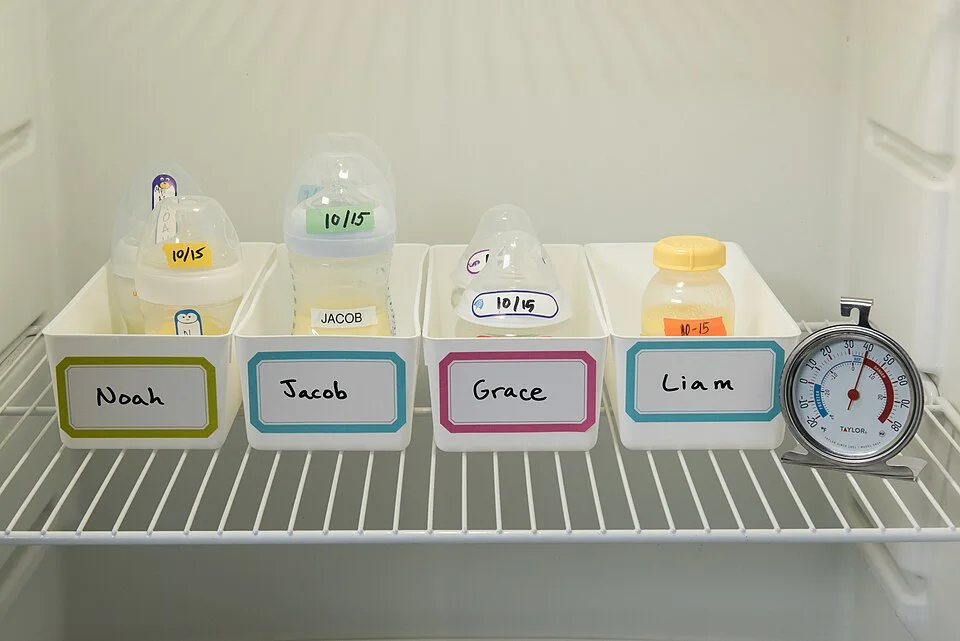
The thermometer sits beside the named containers with its dial exposed, providing an access-planning reference. Keep the household’s actual monitoring point reachable when retaining a retrieval habit. This photograph shows no door-event timing or energy saving, and the displayed storage arrangement is not a transferable rule for unrelated foods.
Photo & usage
USDAgov · Public domain · Source. Display copies resized and encoded as WebP; no instructional details were fabricated or removed.
The reference thermometer photograph shows routine access to a dial instrument inside a refrigerator. It is a reminder that monitoring access should remain possible; it is not a timer, a depiction of either workflow or evidence of an energy saving. Keep ordinary food-temperature checks distinct from the door-event worksheet.
File the event definition, both logs, arithmetic and a short decision together. Mark any missing durations and unusual events. Completion is a defensible choice about the next meal's retrieval sequence, with food promptly stored and doors closing normally. If you repeat the comparison later, do so during another genuinely needed meal preparation using the same definitions, not by manufacturing additional door openings.
THE REFERENCE FILE
Sources & scope
Documentation reviewed 1 Nov 2026. Examples are illustrative; this article does not claim hands-on product testing. Follow the instructions for your actual material, model and location.