A narrow gap beside a wardrobe or desk can feel like wasted room. Yet it may already provide space for a plug, a door movement or a hand reaching a control. Filling it can create more difficulty than the new container solves. Start by identifying what the gap does before measuring what could occupy it.
This guide helps decide whether the space merits storage at all. It covers movable containers and existing furniture, without alterations or structural installation. Leaving a gap empty is a completed decision when access, maintenance or everyday movement needs that space.
Identify every existing claim on the gap
Inspect the full height and depth in good light. Note sockets, plugs, ventilation openings, heating equipment, window controls and furniture hardware. Include the need to see or reach them. A container placed in front of an outlet can make an ordinary plug inaccessible even if the lead emerges neatly at the side.
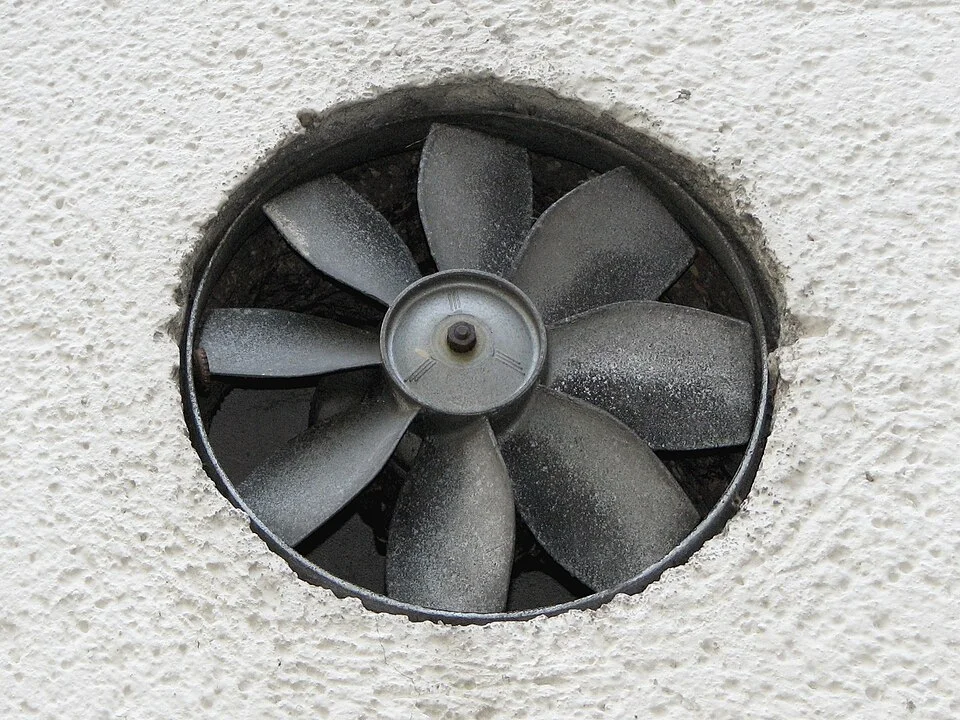
This wall opening illustrates a function that a storage proposal must not obscure. When assessing a narrow gap, identify ventilation equipment and preserve the access and clearances required for the actual installation. The exposed blades here do not demonstrate a safe operating arrangement or suitable guarding, and the photograph provides no airflow or clearance measurement.
Photo & usage
Adamantios · CC BY-SA 3.0 · Source. Display copies resized and encoded as WebP; no instructional details were fabricated or removed.
Open neighboring drawers and doors through their normal movement. Check whether the gap is part of their operating area or the place a person stands to use them. Measure from the farthest projecting edge, not simply from one flat furniture side to another.
Use U.S. Fire Administration — Home Fire Escape Plans to retain the household's clear exit arrangements. Do not treat a strip beside an escape door as an opportunity for temporary bags or a tall rolling unit. If the gap contributes to a required route or access to a window in the escape plan, preserve that function and reject storage that would obstruct it.
Measure the gap at several points
Record width at the floor, middle and top, and depth from the accessible edge to the rear obstruction. Skirting, furniture feet and slightly uneven placement can produce different values. Use the smallest dimension relevant to the container's path rather than averaging them into a misleading generous opening.
Also measure height if the gap is under another surface. A projecting underside, brace or handle can catch a container after it has entered. For a tall narrow object, check whether it can remain stable in its intended configuration; the surrounding furniture does not automatically provide safe support.
Keep the room furniture in its ordinary position while measuring. Pulling a wardrobe forward to gain width changes the route and may affect its intended restraint arrangement. If the proposed storage depends on moving or modifying existing furniture, evaluate those changes separately through the exact product requirements before counting the new capacity.
Assign a specific category before buying a container
Name the objects that would live there and how often they are needed. A slim document case, a small portable kit and an awkward long object require different access. A vague intention to store miscellaneous things is likely to create a hidden pile with no reliable retrieval method.
Measure the complete category in a suitable container, including handles and lid. Avoid selecting a tall narrow tower merely because its advertised width matches the gap. Check the product's intended placement, stability and any securing requirements. If the intended safe setup cannot be provided, choose another product or destination.
Think about the destination when the container is removed. If it has to sit in the room's only passage while open, the gap may be unsuitable for that category. Infrequent access can tolerate a deliberate setup, but it still needs a clear and safe operating position rather than an improvised floor obstruction.
Work through an illustrative usable-width calculation
This example is illustrative. A gap measures 24 cm between the furniture sides. A plug projects 4 cm into the gap along the planned container path, leaving 20 cm at that point. A proposed container is 19 cm wide including its lid, so only 1 cm remains across the width.
The closed container may fit numerically, but side handles that need 2 cm of finger access each would require 4 cm of total hand space. The available 1 cm does not provide it. A front handle might change the operation, but its projection and pulling path would need their own measurements.
A second container is 15 cm wide. It leaves 5 cm at the narrow point, although cable protection and access to the plug still need checking. Do not interpret that remainder as permission to press a box against wiring. The calculation is a screening tool; the control access and retrieval method determine whether the gap should be used at all.
Test the approach from the user's normal position
Stand or sit where the container would normally be retrieved. Check label visibility, grip and the need to bend or reach around furniture. The U.S. Access Board — Operable Parts guide explains why an obstruction changes practical access. A narrow front opening can make a shallow item difficult if your body cannot approach it.
Use a light representative trial where suitable, and stop if the movement is awkward. Do not pull on an unstable shelf or furniture edge to reach the gap. If the category needs frequent access, give it a more convenient location rather than accepting a difficult reach as inevitable in a small room.
Notice whether retrieving the container requires moving another object first. That dependency may be acceptable for an occasional spare item but poor for a daily kit. Record the complete sequence. A gap that can only be used after moving the desk chair and a bedside table offers much less useful capacity than its dimensions imply.
Keep electrical and service access separate
The CPSC — Safety for Older Consumers: Home Safety Checklist checklist identifies pinched wiring as a household problem. Keep containers from crushing leads against the wall or forcing sharp bends at connectors. Do not wrap excess cable tightly around the new storage just to hide it. Follow device and electrical accessory instructions.
If access to a socket, valve or other service point would be lost, leave the needed area available. A removable container is not automatically adequate access if it is heavy, jammed or concealed behind other furniture. Consider the ordinary person who may need to reach the point, not just the person who installed the storage.
Unexplained warmth, damaged cords or a defective socket require appropriate attention rather than a tighter storage fit. In a rental, use the property's normal reporting process and qualified help for electrical work. Do not open covers or modify wiring as part of making a gap useful.
Close the decision with an explicit yes or no
Approve storage only when the assigned category fits, can be removed and returned comfortably, and leaves existing functions available. Record the accepted exterior dimensions and the destination for the removed container. Keep the category narrow enough that future additions do not change the arrangement silently.
Reject the gap if it is needed for a route, control, safe equipment placement or service access. You can note the reason on your room inventory so it is not repeatedly reconsidered as wasted space. An empty strip serving a necessary function is already working.
Check the arrangement after normal use, especially if furniture can move. A container creeping outward or a lead becoming trapped is evidence to revise it. Completion means a deliberate storage assignment or a deliberate preserved gap, both based on observed use rather than the urge to fill every visible opening.
THE REFERENCE FILE
Sources & scope
Documentation reviewed 1 Nov 2026. Examples are illustrative; this article does not claim hands-on product testing. Follow the instructions for your actual material, model and location.