A pale deposit on dark clothes is a reason to inspect the wash process, not immediately add more detergent. Undissolved product, loose lint and a changed fabric surface can look similar at a glance. Keep the load history available and examine a representative garment before choosing a rinse, rewash or different finishing step. The next action should answer a specific question.
Describe what you can actually see
Spread the garment under consistent light and look at the deposit without aggressive rubbing. Note whether it consists of loose fibres, chalky clumps, streaks along folds or a broad faded area. Check the reverse and seams. A surface deposit and colour loss require different decisions.
Compare other garments from the same load. If only a dark smooth top shows the problem, it may simply reveal material that is less visible on pale fabric. If every garment has similar clumps, a shared process question becomes more relevant. Photograph the deposit before trying to remove it.
Do not identify an unknown substance by tasting it, inhaling it closely or mixing it with household chemicals. This workflow concerns ordinary laundry with known products. If an item has unusual chemical contamination, keep it separate and follow guidance for that substance rather than testing it as detergent residue.
Reconstruct the product and dose
Find the exact detergent container and record whether it was liquid, powder, a unit dose or another format. Check concentration and the measured quantity. A remembered capful is not a precise dose when cap markings or product concentrations differ. Include any pretreatment or booster used in the load.
Whirlpool notes that excess detergent can leave residue and that powder may dissolve less well in cold water. These are plausible process questions, not a diagnosis of your garment. Compare your actual product instructions with the machine requirements and the selected programme.
For an automatic dispenser, verify the reservoir contents and concentration setting using the appliance manual. Do not assume the machine knows a new product's concentration. If someone changed detergent recently, record that event. A dose copied from the previous bottle can be inappropriate even when the packaging looks familiar.
Check whether the load could move properly
List bulky items and the amount loaded, using the washer's programme-specific guidance. A drum that accepts the textiles through its opening may still be too full for the selected cycle. Inspect for tightly rolled sleeves or folded pieces that could have held concentrated product.
Check sorting as well. ACI distinguishes soil levels, care compatibility and lint donors. A new towel in a dark load can produce a lint complaint that more detergent will not solve. Keep that question separate from dissolution and dosing so the next action remains targeted.
Do not automatically increase temperature or choose a harsher programme. The garment's instructions remain binding. If the product needs conditions that the garment cannot tolerate, choose a compatible product or another supported route rather than exceeding the care limit. Consult the appliance instructions for permitted cycle adjustments.
Compare three illustrative residue records
The observations below are invented and illustrative, with no washing trials implied. They compare histories that could produce superficially similar pale material. Each row points to a useful check rather than proving a cause.
| Observed material | Known history | First check |
|---|---|---|
| Chalky clumps in folds | Powder; crowded cold wash | Product dissolution and load guidance |
| Loose fine fibres | New pale towel included | Lint-donor sorting |
| Broad pale patch | Several direct pretreatments | Residue versus colour damage |
Keep more than one possibility open where the evidence overlaps. A crowded load can contain both towel lint and detergent residue. The table helps choose an order of investigation, not a universal cure. If the surface looks abraded or bleached rather than coated, stop stain treatment and assess the material condition before another cycle.
Choose a permitted rinse or rewash
Read the garment, detergent and washer instructions before repeating care. A rinse may be appropriate for some ordinary residue situations; a full rewash may be recommended for others. Follow the supported route and do not automatically add a second full detergent dose to an item already suspected of carrying excess product.
Separate bulky or incompatible pieces where needed so the new load follows the programme's guidance. Resolve a unit-dose placement or dispensing error through the product and appliance instructions rather than moving the product to an improvised location. Keep concentrated detergent off fabric unless direct pretreatment is explicitly permitted.
Make one relevant adjustment and record it. For example, correct a verified dose error while keeping other compatible conditions stable. Changing product, temperature, load size and programme simultaneously may produce a cleaner result but gives little evidence about which issue mattered. Do not present such a change as a controlled test.
Inspect after the appropriate drying route
Check the item at unloading and after complete permitted drying. Damp dark fabric can hide a pale film. Look at the same area photographed earlier, including folded seams. Use the garment's approved finishing route rather than tumble drying solely to conceal or dislodge an unexplained deposit.
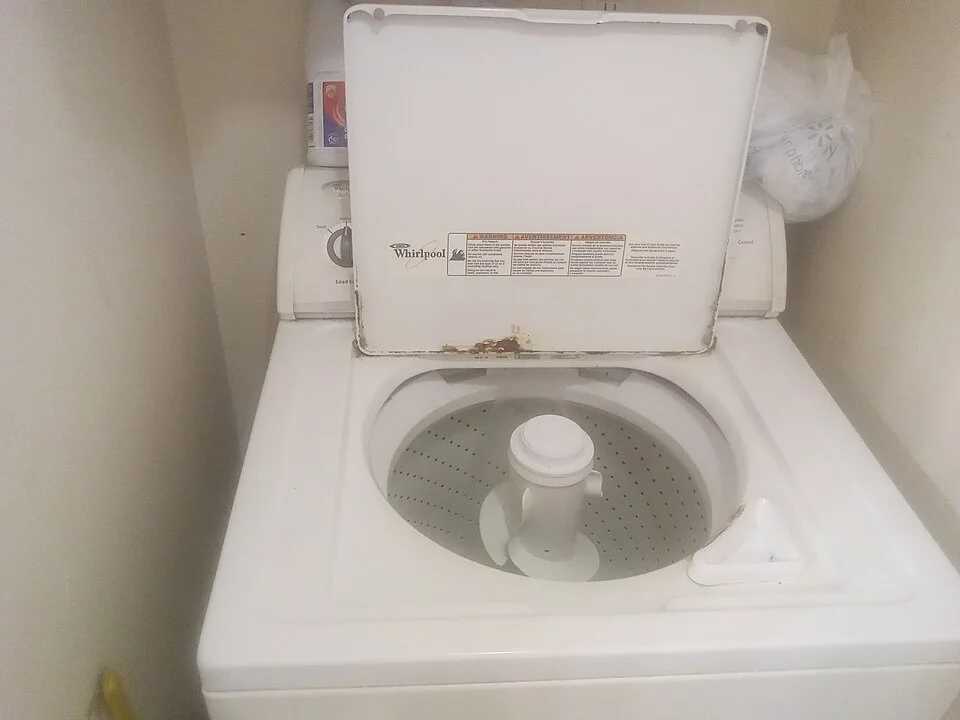
The open lid exposes the basket rim, agitator and reachable upper surfaces that can be checked after unloading. Follow the actual washer manual and inspect only permitted accessible areas; do not dismantle parts or reach around powered mechanisms. The visible lid-edge discolouration is a condition to record, not proof of the cause of residue on clothing.
Photo & usage
Corn cheese · CC0 · Source. Display copies resized and encoded as WebP; no instructional details were fabricated or removed.
Observe whether the material has disappeared, reduced or changed appearance. If it is gone and the fabric remains unchanged, the corrective route may be useful for future similar loads. If it remains, review the original identification instead of adding progressively more detergent or an unapproved household rinse.
If residue recurs across correctly prepared compatible loads, follow the washer's cleaning and troubleshooting instructions. Record model, programme, detergent and observations for support. Avoid claiming a pump, heater or sensor is faulty from clothing appearance alone. Household process evidence can support a service enquiry without becoming an unsupported appliance diagnosis.
Prevent the next dosing mistake
Keep the current detergent's measuring tool with its original container and make the relevant mark readable. Replace a damaged or unmarked measure rather than estimating by eye. Store detergent securely and keep any transfer container clearly labelled only where the product instructions support that handling.
If automatic dispensing is used, update the setting whenever a formulation change requires it. Leave a short household note identifying the exact concentration or manual reference. Do not write a universal “use less” instruction that could underdose a different product or a genuinely heavily soiled load.
Review the next compatible wash under similar inspection conditions. A useful routine follows the product and load rather than memorising a capful forever. Once the problem is resolved, keep only the exception that would otherwise be forgotten, such as a powder requiring a particular supported dispensing method.
Close with a garment and a process decision
Put the garment away fully dry only after appearance and feel are acceptable. If a mark remains, identify whether it is being held for further assessment or accepted as a cosmetic limitation. Keep it out of an automatic cycle of repeated washing by several household members.
Clean any measuring or dispensing parts according to the appliance instructions. Do not dismantle inaccessible components or mix chemicals while cleaning a reservoir. Return the laundry area to a state where the next load starts with known products and clear settings.
The task ends with two outcomes: the garment has a clear status, and the next wash has a specific supported adjustment. That is more informative than calling every pale patch detergent and repeatedly redosing a load that may need a different sorting, dispensing or material-care decision.
Keep the corrected dose measurable during the next wash. Read the tool at the product’s specified mark rather than comparing a new amount with the height of the previous capful. If the household changes containers or concentration again, review the instructions afresh. The successful correction belongs to a product and load combination, not an indefinitely reusable volume for every detergent.
THE REFERENCE FILE
Sources & scope
Documentation reviewed 1 Nov 2026. Examples are illustrative; this article does not claim hands-on product testing. Follow the instructions for your actual material, model and location.