Do not turn one suspect box into a roomful of items
A box brought from a basement can release an unpleasant smell when opened, but spreading every object across the living-room floor makes source tracking and care harder. Pause before unpacking. Note the storage location, whether the container sat on a floor or external wall, and any known leak or flood history. Observe visible wetness or damage without putting your face into the opening.
If water was contaminated, contents are visibly mouldy or the box is breaking apart, seek appropriate assessment and handling advice rather than proceeding with ordinary sorting. Keep children and pets away. Do not shake textiles, brush paper or use a household vacuum to remove suspect growth.
EPA: A Brief Guide to Mold, Moisture and Your Home distinguishes material types and emphasizes correcting the water source. This guide is a limited observation and decision routine. It does not establish a cleanup method for every object and does not make a closed plastic box a substitute for dry storage conditions.
Record container, contents and shelf separately
Give the container its own description: cardboard, plastic, fabric luggage or another material. Note staining, distortion, pooled water or a damaged closure. Then record only the accessible condition of the contents. Finally describe the supporting shelf or floor. These three records can point toward different work even when they share an odour.
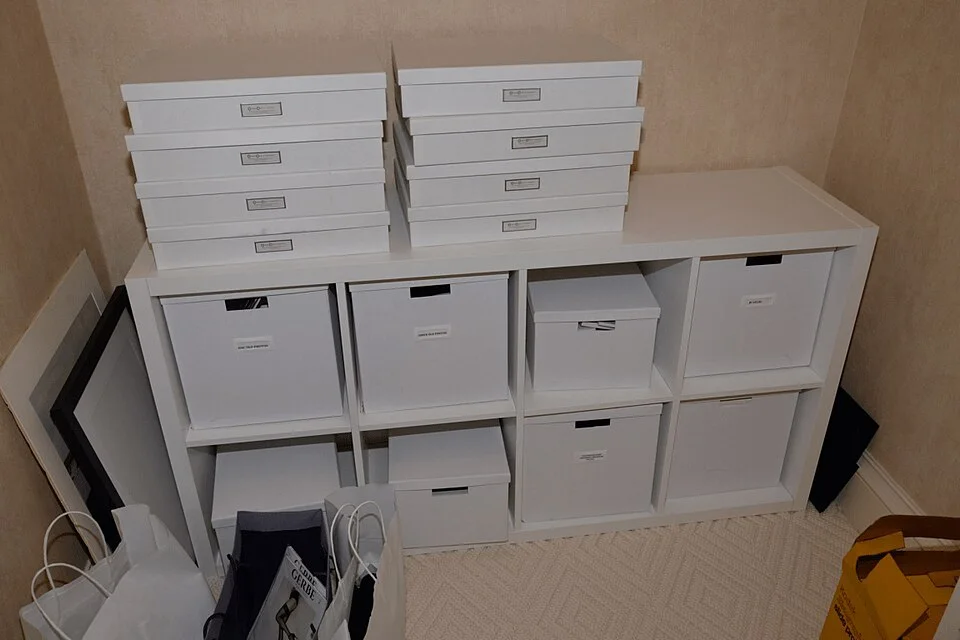
The closed bins, stacked lids and shelving make the outer containers and their placement visible. Record those separately from whatever the contents are known to be, without opening a suspect box merely to complete the record. These closed containers reveal no condition of their contents, no musty source and no permission to disturb suspected growth.
Photo & usage
Federal Bureau of Investigation · Public domain · Source. Display copies resized and encoded as WebP; no instructional details were fabricated or removed.
A dry plastic exterior does not establish that cloth packed inside was dry. A damp cardboard base can reflect floor contact or a wider storage problem. Do not infer the entry route from the darkest patch alone; water can move through materials and pool at the lowest point.
Photograph from a normal position if useful, keeping the box in a suitable contained area rather than moving it repeatedly for better light. For valuable papers, photographs, leather or other sensitive objects, consult the relevant specialist before cleaning or applying heat. An apparently convenient general method may damage the item more than the original moisture did.
Look where the box used to sit
Inspect the accessible original storage position for damp surfaces, staining, condensation and nearby plumbing. Work from a safe floor level. Do not enter a crawl space or move a heavy shelving unit to complete the record. If several boxes show a similar base pattern, record their positions rather than assuming each was packed wet independently.
Health Canada: Guide to addressing moisture and mould indoors advises against placing cardboard directly on basement floors. Apply the practical lesson by choosing suitable elevated storage after the source is addressed, not by lifting a wet box onto a new shelf and declaring it solved. Keep intended ventilation openings and service access clear.
A local temperature and RH record can add context, but it does not determine whether objects inside a box are dry. If the location gets wetter during warm-weather window airing or after rain, note that association for assessment. Do not use the room's central humidity display as permission to ignore damaged stored materials.
Compare patterns across containers
The following observations are illustrative and invented. They demonstrate a source-tracking comparison rather than an inspection of actual belongings. The appropriate care response still depends on the material and extent of damage.
| Container | Location and condition | Useful question |
|---|---|---|
| A: cardboard carton | On floor; base damp and distorted | Is floor contact or water entry involved? |
| B: plastic bin | Same room, elevated; damp cloth inside | Was the cloth packed before drying? |
| C: fabric case | Against cool wall; affected outer corner | Is local wall moisture contributing? |
Three affected containers do not necessarily have one source. Conversely, a shared damp corner may indicate a wider location problem. Preserve the sequence and material differences. Replacing every container with a sealed bin could trap moisture in contents that were already damp, while leaving the floor or wall source unresolved.
Do not use odour as the only acceptance test
An item may smell less after airing and still have material damage or unresolved contamination. Another may retain a historical odour after appropriate care. Use the item's condition, source history and specialist advice where needed rather than treating smell alone as a pass-or-fail test. Avoid repeated close sniffing.
Canadian Conservation Institute: Incorrect relative humidity explains that different materials respond differently to humidity and its fluctuations. For household storage, this means a book, metal tool and leather bag should not receive one improvised drying treatment. Direct heat, strong sun, water cleaning or sealed storage may be unsuitable for a particular object.
Separate ordinary dry, unaffected belongings from items needing care without dragging suspect material through the home. Where disposal is appropriate, use suitable local handling guidance. Do not donate an unresolved damp or mould-affected item merely to clear the shelf. The container audit should make the care decision clearer rather than transfer the problem to another household.
Make the new location inspectable
After any required source repair and item care, choose a dry, suitable location with practical access. Keep storage off vulnerable floor contact where appropriate and avoid pressing cases tightly against a known cold or damp wall. The exact arrangement depends on the shelving, container and room; no universal gap guarantees preservation.
Label containers with their contents and the date they were checked, without claiming they were professionally cleared unless that happened. Avoid overfilling so a future inspection does not require emptying an entire room. Keep the items' care notes with valuable or sensitive belongings. If a container is replaced, record why rather than treating new packaging as proof of a solved source.
Do not put a wet cloth inside a sealed bin as an odour-control trial. Do not add desiccant without understanding its capacity, handling and replacement requirements. Passive collection products may have a limited role, but they cannot establish dryness throughout a large mixed box or correct recurring water entry.
Finish when the storage system survives normal conditions
Recheck the new arrangement after an ordinary closed-storage period and during the weather that previously caused trouble. Inspect the supporting surface as well as the container. A clean box can conceal a recurring wet shelf, and an elevated shelf can still sit beside a leaking wall.
Completion means the moisture source has been addressed or clearly assigned for assessment, affected items have an appropriate care outcome and storage remains accessible for follow-up. Keep one concise record of the old location, material findings and final arrangement. A normal room RH reading is supporting context, not a certificate for every object.
If mustiness or wetness returns, stop cycling the same contents through new boxes. Share the location history with the appropriate building or conservation specialist. The useful outcome is a storage plan that keeps dry items dry and reveals recurrence early, without scattering a suspect container's contents through the rest of the home.
THE REFERENCE FILE
Sources & scope
Documentation reviewed 1 Nov 2026. Examples are illustrative; this article does not claim hands-on product testing. Follow the instructions for your actual material, model and location.