A shared cupboard often gives the central shelves to whoever arranged it first. Other users then stretch, move containers or leave items outside because the assigned positions do not suit them. A shared room needs shared access, which may mean different heights, smaller groups or duplicate low-cost everyday items.
Begin with the people and their tasks. This is an observation-based household arrangement, not a formal accessibility assessment. Preserve existing aids and necessary access space, and seek individualized advice if changing furniture affects supported movement or transfers.
List who uses each category
Write the storage categories and name their actual users. A shared stationery group may be used by everyone, while a hobby kit belongs to one person. Note frequency and whether each person retrieves the whole container or individual items. Those differences affect both location and container choice.
Ask users directly about the current arrangement. A person may avoid a shelf rather than complain about it, making the category look less frequently used. Record workarounds such as asking someone else to fetch an item, leaving a box on the floor or keeping a second unofficial supply elsewhere.
Separate necessary restricted storage from ordinary shared items. A convenient low shelf is not automatically appropriate for hazardous products or objects that children must not access. Keep the relevant storage requirements intact, and focus the access exercise on categories that can properly be shared in the proposed location.
Observe each person's ordinary approach
Ask each user to show a normal retrieval from a comfortable supported position, using manageable items. Keep the route clear and do not encourage reaching beyond what feels suitable. Notice where they stand or sit and whether the furniture permits that approach.

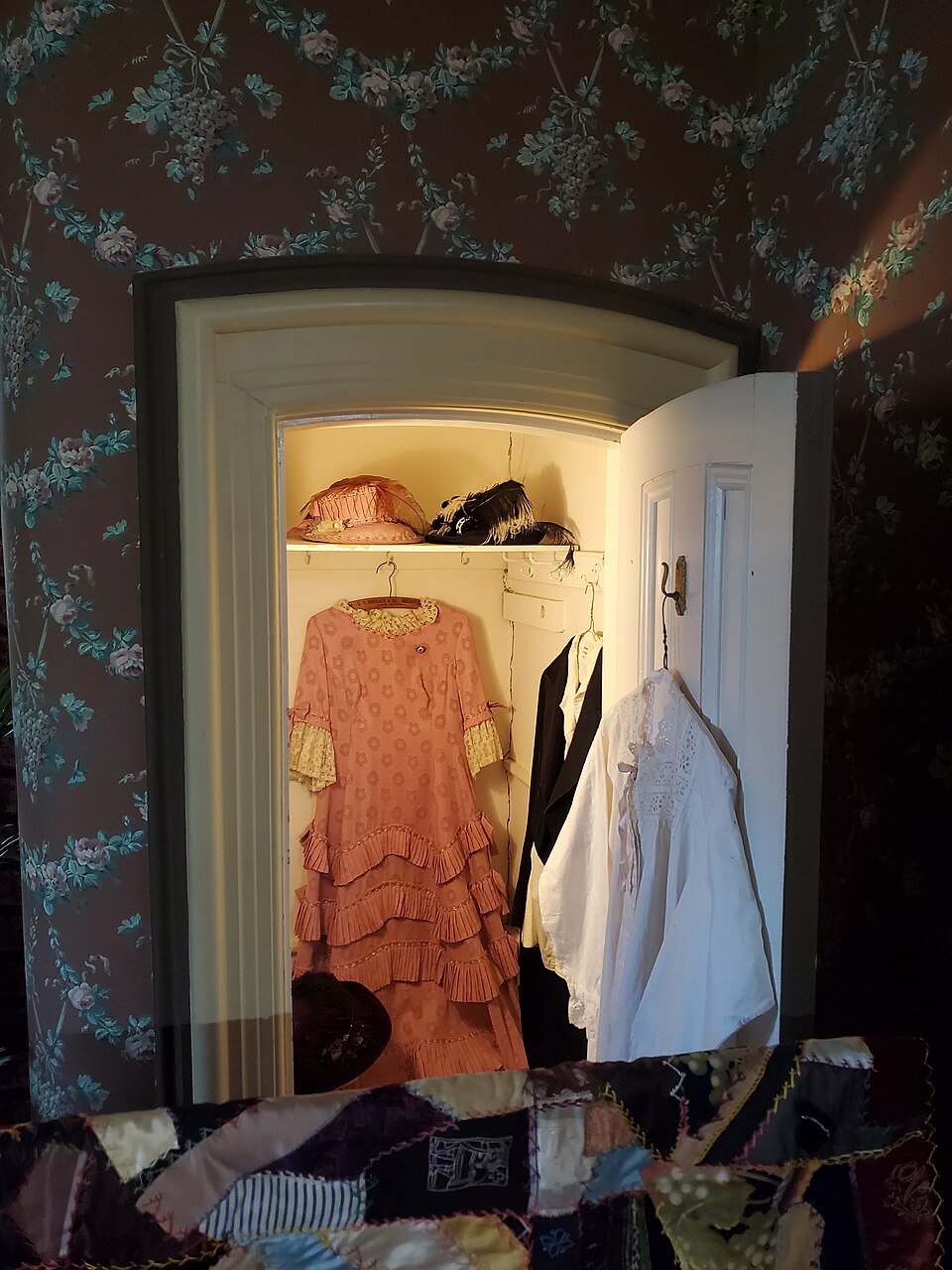
The open wardrobe exposes a hanging rail and garments, while a trunk occupies space beside it. Before assigning shared storage, watch each person approach and retrieve an ordinary item using their usual posture and equipment. The scene identifies a rail and surrounding furniture; it supplies no reach measurements or proof of independent access.
Photo & usage
Tim Evanson · CC BY-SA 2.0 · Source. Display copies resized and encoded as WebP; no instructional details were fabricated or removed.
The U.S. Access Board — Clear Floor or Ground Space and Turning Space guide distinguishes clear approach and turning areas. Use those concepts to inspect the cupboard's surroundings, including chairs, baskets and open doors. A shelf height that suits someone can still be unusable if the room blocks their approach.
Record different orientations. One user may prefer a side approach while another needs space directly in front. If the cupboard front requires a single narrow stance, consider a different category location. Do not assume another person's convenient method is available to everyone, especially where a mobility device or assistance forms part of ordinary room use.
Map comfortable retrieval rather than maximum reach
Keep a simple record of positions each person can use comfortably for the selected task. Include seeing the label, grasping the object and returning it. Maximum fingertip reach is not the same as safely handling a loaded container, so avoid converting one into a universal shelf boundary.
The U.S. Access Board — Operable Parts guide explains how reaching over an obstruction differs from an unobstructed reach. Check the depth of the shelf and front-row objects as well as height. A shared container at the back may be less usable than a higher front-access object for some users, depending on the actual approach.
Use the person's observations to choose positions. If an item repeatedly migrates toward the shelf edge, ask why before moving it back. The existing storage may have concealed a visibility or grip problem. Correct the arrangement without allowing objects to overhang their support or intrude into the room's route.
Calculate an illustrative category split
Here is an illustrative allocation. A shared cupboard has six convenient front-access positions. Four categories are used by both people, and each uses one position. Two personal categories use one position each, so all six positions are assigned: 4 + 1 + 1 = 6.
Now suppose one shared category is too heavy in a single container for one user. Dividing it into two manageable containers would require seven positions if each needs its own space. The cupboard has not gained capacity simply because the division improves handling.
The household can reduce or relocate a personal category, use a suitable position outside the cupboard, or reconsider the container dimensions while preserving easy retrieval. The arithmetic exposes the tradeoff. It does not establish anyone's handling capacity or prove that a particular split is suitable. Test the actual category in its intended form with the users involved.
Consider duplication only for a defined reason
A second inexpensive everyday object can sometimes remove repeated reaching or travel. For example, separate small writing kits at two existing activity surfaces may work better than one large shared box. The reason should be a named task and location, not a general desire to buy more supplies.
Compare the added inventory with the access benefit. Duplicating a bulky category may consume space the room does not have. If duplication is chosen, keep both kits small and clearly assigned so they do not expand into two versions of the same cluttered container.
Do not duplicate equipment with special storage, maintenance or safety conditions casually. Keep the decision within the ordinary items being considered. A shared-room storage exercise does not establish that two electrical devices or two restricted-product containers are appropriate merely because another user finds the original position inconvenient.
Make return easy for every user
Check labels from each person's normal viewing angle. Use clear wording and sufficient distinction between similar containers. A label facing upward may be readable from standing but invisible from a lower seated position. Test the actual position rather than assuming one label placement serves everyone.
The CDC — Check for Safety: A Home Fall Prevention Checklist for Older Adults checklist recommends convenient positions for often-used items. Apply that principle to return as well as retrieval: a person should not need to stretch to replace a box after taking out a small object. Keep the position stable and the opening large enough for the intended movement.
Avoid tightly packed rows that require precision alignment. If one user repeatedly leaves a container outside because it catches neighboring boxes, adjust the spacing or category count. A storage system maintained only by the most dexterous person is not independently convenient shared storage, even if everyone can eventually get an item out.
Check the arrangement after another user returns an item
Ask whether the location remains usable after a different household member has put the category away. A container may return farther back, a label may face the wall or a heavier object may be placed in front. Those small changes can remove the access demonstrated during the original trial.
Agree on a simple repeatable return position without demanding exact alignment. Use clear category boundaries and preserve practical grip space. If the system works only when one person restores it carefully, reduce the packing density or choose a more forgiving container. Shared access should survive ordinary use by everyone who is expected to maintain the storage.
Agree the final allocation with all regular users
Run ordinary use over several days and note where assistance is still needed. Keep accepted assistance explicit rather than treating every request as a planning failure. Some categories may appropriately remain shared through help, while daily personal essentials need a more independent arrangement.
Review the cupboard with its contents at the fullest ordinary point. Empty or partly used containers can disguise a handling problem. Check the route, labels and return sequence again when the categories are loaded as intended, within all product limits.
Completion means each person has an agreed usable path to the items they need and the room retains its essential movement space. Save the category map in simple language and revisit it when users, equipment or routines change. Fair shared storage is measured by usable access, not by identical shelf heights or equal-looking stacks.
THE REFERENCE FILE
Sources & scope
Documentation reviewed 1 Nov 2026. Examples are illustrative; this article does not claim hands-on product testing. Follow the instructions for your actual material, model and location.