A shelf can be within arm's length from a chair and still be difficult to use. The user may not be able to approach closely, see the contents or bring an object back without leaning away from support. Start with the actual person and their ordinary seated position, rather than a generic reach circle on a plan.
This is a household observation method for arranging everyday items. It is not an accessibility certification or a mobility assessment. Preserve necessary supports and established access arrangements, and obtain individualized help when a change affects transfers, balance or the use of a mobility aid.
Define the seat and the task together
Identify the chair, wheelchair or other seat normally used at the activity. Record whether the user remains seated throughout retrieval or normally stands. Do not convert a task to seated use solely to fit a storage idea; ask the user what sequence is useful and comfortable.
List a small daily kit for the trial. Choose ordinary light objects that can be handled appropriately, and keep essential aids available. The purpose is to observe a routine movement, not to discover the farthest point someone can reach. Stop before stretching, instability or discomfort.
Describe the supported starting position and nearby obstacles. A desk apron, chair arm, foot support or bed frame can change access. Keep the furniture in normal use positions. A trial with an armrest removed or a table pushed aside does not represent the room unless that change is intended and permitted by the product.
Check the approach before measuring height
Look at the floor area in front of and beside the storage. Can the user arrive in the needed orientation and leave again? The U.S. Access Board — Clear Floor or Ground Space and Turning Space guide distinguishes approach and turning space. Use those concepts to identify missing room around the furniture rather than treating a reachable shelf as an isolated success.

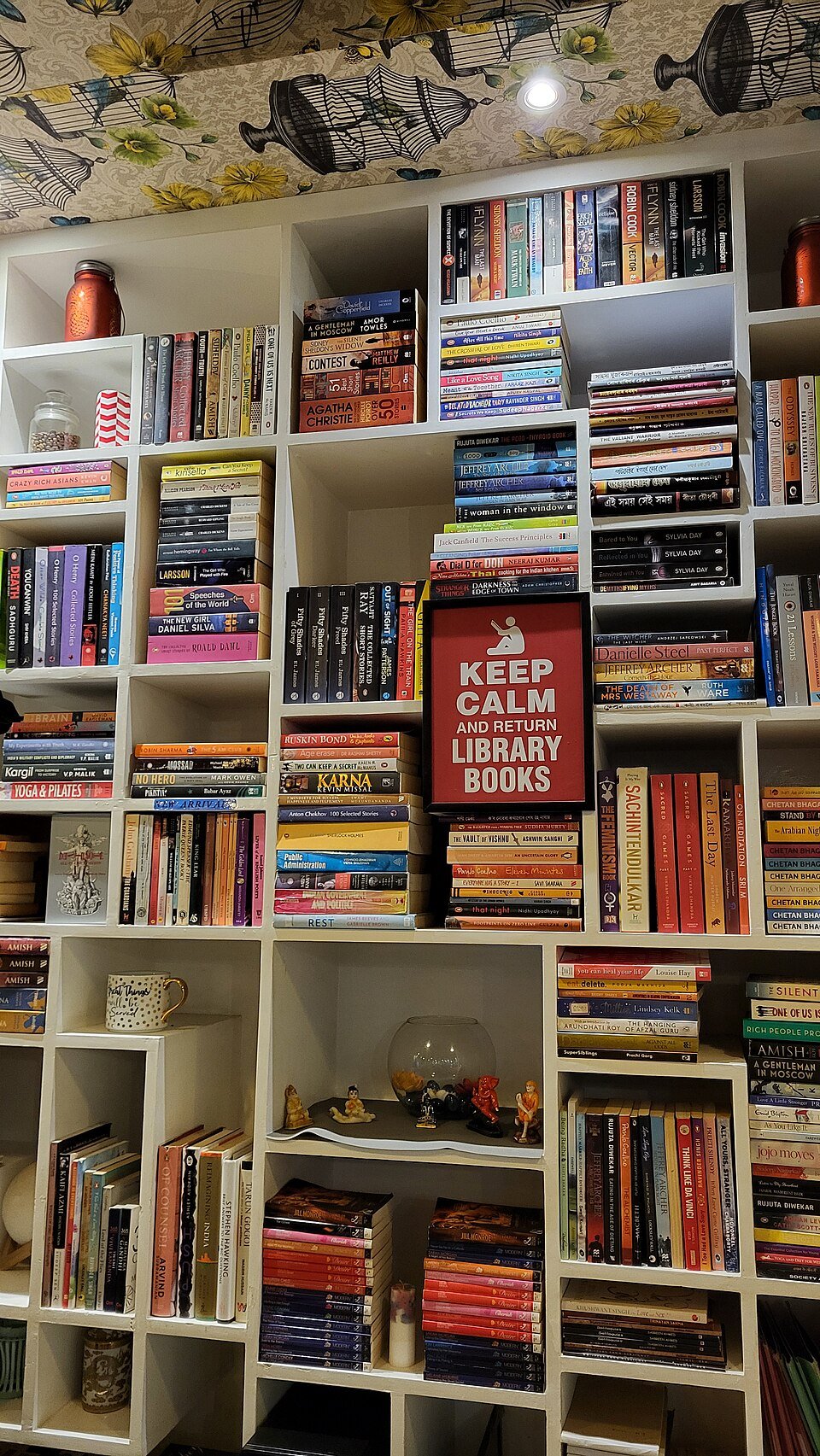
The desk occupies floor space immediately beside the bookcases, illustrating why access cannot be judged from shelf height alone. In the actual room, check the route, the space to approach and the space to leave using the person’s usual chair or mobility equipment. This furnished reference supplies no dimensions or accessible turning-space certification.
Photo & usage
Michael D Beckwith · CC0 · Source. Display copies resized and encoded as WebP; no instructional details were fabricated or removed.
Measure the actual route with handles, feet and doors included. If a wheelchair or walker is used, plan with the user and their device. Avoid experiments that require squeezing past a questionable obstruction. A clear route should remain available while alternatives are considered.
Notice whether another object must move before the seat can approach. A laundry basket or spare chair can turn an otherwise useful shelf into inaccessible storage. Assign those objects their own destinations. A plan depending on someone else clearing the approach for every retrieval should be described as assisted access, not independent access.
Observe visibility, grip and return separately
Place a representative item in a comfortable trial position. Ask the user whether its label or shape is visible before reaching. Then observe the grasp and return, keeping the movement within their ordinary supported range. Record what works without encouraging them to stretch farther.
A shallow open tray may improve visibility, while a high rim can obstruct fingers. A handle may be easier than a smooth lid, but its usefulness depends on the user's grip and the loaded container. Try the actual shape where possible rather than assuming every handled box is easier.
Return matters as much as retrieval. An object may slide out readily but need precise alignment or a lifting motion to go back. Keep the storage arrangement simple enough that the user can restore it without balancing other items on their lap. If a container needs two hands, include both hands and the destination surface in the sequence.
Compare an illustrative near and obstructed position
This comparison uses illustrative measurements, not a person's tested reach. A shelf edge is 28 cm from the seated reference position, and an object sits 8 cm behind that edge. The simple horizontal distance is 36 cm. A second arrangement moves a cabinet 12 cm in front of the shelf, increasing that horizontal path to 48 cm under the same assumptions.
The shelf height has not changed, but the obstruction has added 12 cm of reach depth. That helps explain why a height-only drawing can be misleading. It does not establish whether either position is comfortable or usable for any particular person.
The U.S. Access Board — Operable Parts guide similarly distinguishes unobstructed access from reaching over an obstruction. Its technical dimensions have specific applications and are not universal limits for a movable household arrangement. Use the comparison to identify what changed, then decide with the user whether the actual approach and movement are suitable. Do not use arithmetic to overrule their experience.
Put the most frequent complete actions in the easiest zone
Rank items by how often the whole retrieval-and-return cycle occurs. A daily pen tray may deserve a closer position than a larger box opened monthly. Keep dense or awkward categories from occupying convenient space merely because they look substantial, but also avoid moving them to positions that make handling unsuitable.
The CDC — Check for Safety: A Home Fall Prevention Checklist for Older Adults checklist recommends keeping often-used items on convenient lower shelves in its household context. For seated planning, translate the principle into the user's demonstrated comfortable zone rather than assigning the same shelf height to everyone. Lower can still be too low or hidden behind an obstruction.
Keep the trial kit small while the arrangement settles. Adding every possible object at once can hide which position works. Once the essential actions are reliable, assign occasional items separately and preserve the successful approach. Do not fill the space beside the seat with overflow that blocks the route used during the trial.
Choose containers for the user's actual operation
Check whether the user can identify and operate the lid, clip or drawer without a difficult twist or tight pinch. A container that another person finds simple may be unsuitable for this user. Ask for their preference and observe the ordinary movement rather than relying on a generic accessibility label.
Keep loads manageable for the intended handling and follow product limits. Divide categories when a full box is awkward, even if the shelf can carry it. The furniture's load rating and a person's convenient handling are different boundaries; satisfying one does not establish the other.
Avoid using movable storage as a support during reaching or standing unless designed for that role. If the user needs a support, preserve the appropriate aid and seek advice for the complete arrangement. Rearranging a tray should not change an established transfer or supported movement without considering its consequences.
Complete the map with the user's decisions
Write down accepted positions, container types and actions the user prefers assistance with. Use clear descriptions such as daily notebook on front left shelf. Record any position rejected because of poor visibility, awkward grasp or difficult return. Those reasons help prevent the same failure reappearing after a later tidy-up.
Try the arrangement through ordinary use, with consent and without staged reach testing. Check whether daily items remain in their assigned locations and whether new clutter obstructs approach. If something repeatedly moves closer, treat that as useful evidence about convenience rather than automatically returning it to the original position.
Completion means the intended person can perform the agreed actions with the approach and support they need. Preserve room for change if their needs or equipment changes. The useful reach map belongs to the user and the task, not to a universal distance printed on a furniture plan.
THE REFERENCE FILE
Sources & scope
Documentation reviewed 1 Nov 2026. Examples are illustrative; this article does not claim hands-on product testing. Follow the instructions for your actual material, model and location.