Decide what can be retained before making labels
A neat new label can accidentally erase the most important fact about frozen food: what happened before the label was written. Relabelling is a record change, not a treatment. Start with food already judged suitable to retain. When temperature history is uncertain, resolve that question before arranging an observational trial or a portioning session. Do not taste food to identify it or use a familiar smell as clearance.
The FDA refrigerator thermometer page includes advice for food affected by interrupted cold storage. Use applicable food-safety guidance when history is uncertain. A current frozen appearance and a handwritten date cannot reconstruct an earlier warm interval.
For this exercise, prepare labels and the inventory while the freezer stays closed. Portion food during an appropriate planned food-preparation task, using food-safe packaging and a safe handling method for that food. Do not partially thaw a solid block on the counter to make the record easier. If splitting requires a separate thawing decision, leave the package intact until that process has been planned safely.
Make the label answer three practical questions
Step 1 is to write identity, date information and quantity in plain language. Identity should distinguish raw from cooked and include a useful description: “cooked tomato bean sauce” is more informative than “red dinner.” Quantity should name its unit, such as 350 g, six dumplings or two household portions. A portion is a planning convention, so specify what it means if household members use different serving sizes.
Separate date events. For an illustrative label, “Prepared 29 October; frozen 30 October; relabelled 1 November” records three different things. If the preparation date was never known, write that explicitly. Preserve readable manufacturer storage instructions and original batch information where relevant. A homemade label should supplement original information rather than conceal it.
Give the package a short identity, such as BS12, that also appears in the inventory. Write it on a visible face using a label suitable for the packaging and freezing conditions. Avoid relying on colour alone; lighting, frost and colour vision can make a coloured dot ambiguous. Include words that another person can understand without consulting the person who packed it.
Open a parent record before creating child portions
Step 2 is a paper operation first. Find the existing inventory line and note its current location, quantity and unit. Decide how many child packages the planned split will create and write provisional child identities. Keep the common parent identity visible: BS12-A and BS12-B show the relationship without forcing anyone to remember a second coding system.
Do not overwrite the parent line immediately. Mark it “split pending” while the actual packing task occurs. Once the split is complete, close it as “superseded by A and B,” with the date. That preserves the explanation for why a package disappeared while two others appeared. It also prevents a later inventory count from treating all three entries as food still present.
Keep this preparation proportionate. Two portions do not need a complicated database, but they do need a clear relationship. If a commercial package has individual sealed units inside, you may only need to record the number removed and the remainder rather than unpack every unit. Preserve product instructions that apply to the contents after the outer packaging has gone.
Balance food quantity separately from package count
Step 3 checks the completed split against the original quantity. The following example uses invented quantities for recordkeeping only; it is not a recipe, cooling procedure or recommended portion size. Suppose an identified package holds 1,200 g of cooked sauce that is being handled under an appropriate safe process.
| Record | Quantity | Inventory action |
|---|---|---|
| BS12 parent | 1,200 g | Close as superseded |
| BS12-A | 450 g | Add one package |
| BS12-B | 450 g | Add one package |
| Used in the current meal | 300 g | Record as used, not stored |
The balance is 450 + 450 + 300 = 1,200 g. Stored quantity becomes 900 g, because 1,200 − 300 = 900. Stored package count changes from one to two: subtract the parent once and add two child packages. Recording three stored packages would double-count the closed parent; recording all 1,200 g as still frozen would ignore the meal portion.
If measured quantities do not balance, check the unit and whether container weight was included before altering the record. Record a genuine unmeasured remainder as uncertain. Do not invent a precise number to hide an unexplained difference.
Keep container weight visible when the split uses different packaging. In a second illustrative calculation, one empty container weighs 120 g and its filled gross weight is 570 g; another weighs 180 g and its filled gross weight is 630 g. Both hold 450 g of food: subtract each container’s own tare from its gross weight. Comparing the gross weights alone would falsely suggest a 60 g difference between equal portions. Write the net food quantity on the inventory, and retain the tare beside the working calculation if another person will check it. Use a suitable clean scale within an already appropriate food-handling process; weighing does not make an uncertain food history acceptable. Finish by confirming the package label and inventory both use net grams, rather than one using gross weight or millilitres.
Carry the original history onto both child labels
Step 4 transfers the meaningful dates, food identity and any relevant instructions to each child. Add the split date as a separate event. Portion A does not become newer than portion B because its label was written later. If the parent was frozen on a known date, both children retain that history; do not restart a quality clock simply because a new container looks cleaner.
The Cold Food Storage Chart makes freezer periods conditional on continuous storage at 0°F (−18°C) or below and identifies them as quality guidance. That is distinct from a food decision after an unknown warm interval. A label can document the known dates but cannot guarantee that the condition was maintained.
Place the newly recorded packages within the appliance's permitted storage arrangement. The Whirlpool manual finder is an official route to model instructions for that brand; use the correct regional brand resource for another appliance. Do not force an oversized portion into a drawer or cover an air opening for the sake of grouping matching identities together. Record separate locations if that is what fits.
Read the label as the next cook would
For an illustrative record of a partially used bag of individually frozen pieces, update the remainder without creating imaginary new packages. If ten pieces were recorded and four are removed, write six pieces remaining in the same bag, provided the starting count was reliable. If the cook only knows that a handful was used, replace the precise count with “part bag; remainder uncounted.” That loses apparent precision but improves the truth of the record. Count the remainder at a suitable later handling opportunity rather than extending an opening merely to restore a number on the sheet.
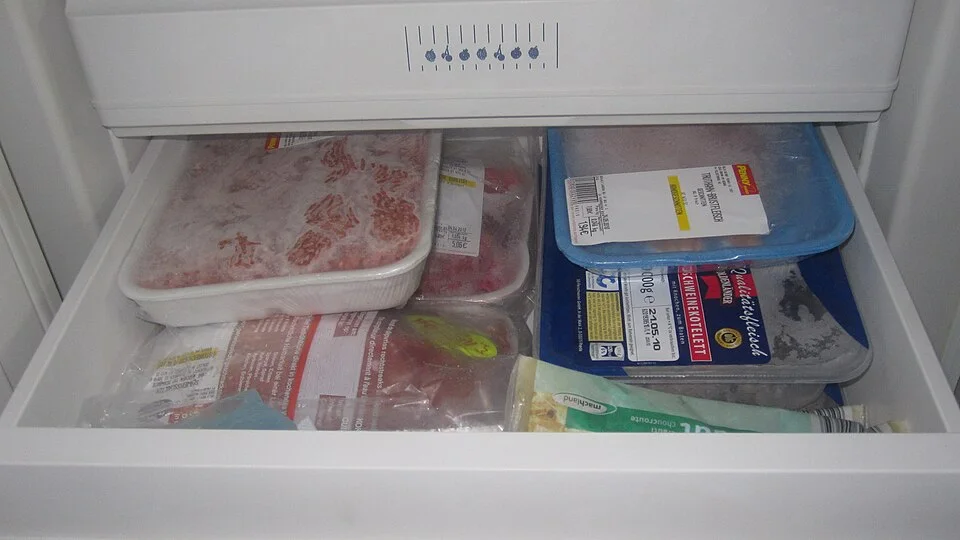
Labelled packages appear in a real open freezer drawer. The image illustrates label visibility only; it supplies no temperature history and does not show the illustrative sauce split.
Photo & usage
Tiefkuehlfan · CC0 · Source. Display copies resized and encoded as WebP; no instructional details were fabricated or removed.
Step 5 checks usability during the next ordinary retrieval. Can someone distinguish the food, understand the quantity and identify the relevant date without lifting several packages? Put the address beside each child on the inventory. If the two portions live in different drawers, “same place as parent” is no longer an adequate instruction.
The reference freezer-drawer photograph shows labelled packages among other contents. Notice that a label can face away or be hidden by another bag. It demonstrates why a visible identity matters, but it does not establish the safety or age of the photographed food and does not depict the invented sauce example.
When one child is used, close only that child entry. Leave the other available until it too is used or removed for a stated reason. Keep a small correction note if a label becomes detached: match it only where identity is reliably known. Completion means the parent is closed, child quantities balance, dates retain their meaning, locations are accurate and no unidentified package has been promoted to a confident meal plan.
THE REFERENCE FILE
Sources & scope
Documentation reviewed 1 Nov 2026. Examples are illustrative; this article does not claim hands-on product testing. Follow the instructions for your actual material, model and location.