Decide what one inventory unit means
A freezer inventory often fails at the word “one.” One bag might contain six portions, while another entry means one individual serving. Before opening a drawer, decide whether your main count represents physical packages, pieces or meal portions. For retrieval, physical packages make a dependable starting point: they are what a person can locate and remove. Record the contents separately when they are known.
Use a short record with these columns: package identity, food description, quantity within the package, drawer address, date information and confidence. “Soup, three” is incomplete. “S04, lentil soup, one sealed tub containing two portions, middle drawer front left” tells someone what to look for. Do not estimate a hidden quantity simply to complete the row.
First settle any food-safety concern. If there has been an outage, thawing or uncertain temperature history, make the food decision before conducting this stock exercise. The FDA thermometer guidance addresses that decision; a newly tidy drawer cannot establish earlier storage conditions. This method assumes food has already been judged suitable to retain.
Give each drawer a stable address
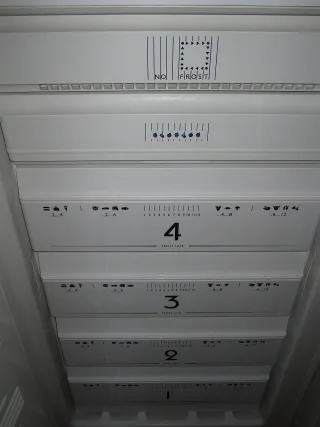
Step 1 is a map made with the freezer closed. Name the drawers from top to bottom, then divide each mentally into front and back, left and right. A compact address such as D2-FL means drawer two, front left. Write the key on the inventory. Use the positions people see from the front rather than switching left and right according to where someone stands.
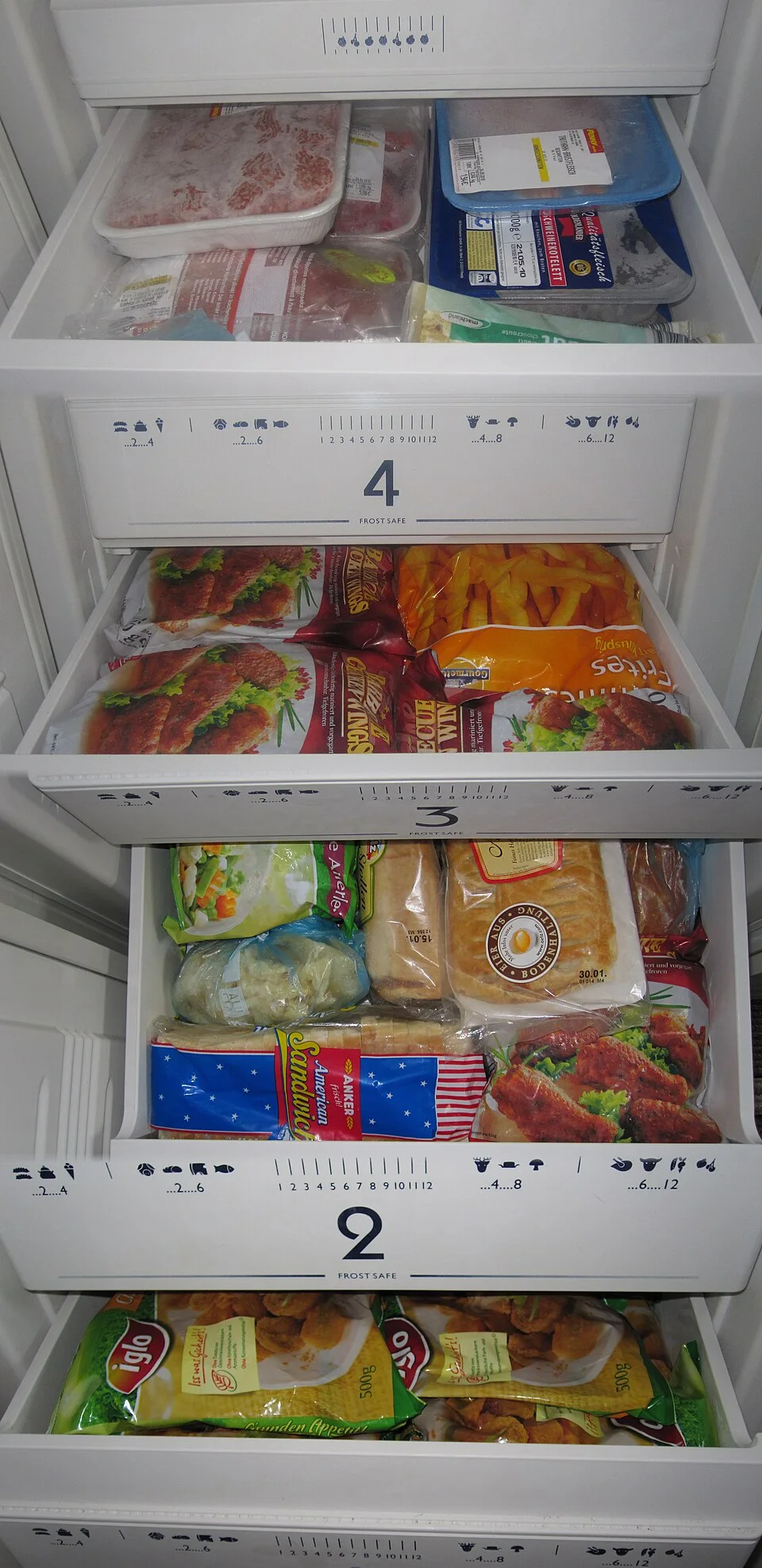
The reference shows open drawers containing packaged food. Use it to consider visibility, not as a loading plan or evidence of the illustrative package counts.
Photo & usage
Tiefkuehlfan · CC BY-SA 3.0 · Source. Display copies resized and encoded as WebP; no instructional details were fabricated or removed.
At the next ordinary opening, confirm how many usable drawers there are and note any manufacturer-designated compartments. Keep those designations; a special compartment should not be reassigned solely to make your map symmetrical. Consult the exact appliance instructions through the Whirlpool manual finder if yours is a Whirlpool, or the equivalent official finder for its brand and region.
The reference photograph of loaded freezer drawers is useful for noticing how containers can hide one another. It cannot show your drawer capacity, permitted loading or air routes. Do not copy its arrangement. Your addresses describe locations inside the existing permitted layout, without adding bins that obstruct openings or prevent closure.
Count a visible patch and close the drawer
Step 2 is deliberately small. Choose the front of one drawer that you can inspect during a normal retrieval. Have the sheet and pencil ready outside. Read labels, count the visible packages, and return anything briefly moved to a stable position. Close the drawer before expanding abbreviations or writing meal ideas. Work in further ordinary openings rather than emptying the freezer onto a counter.
Mark each completed patch on the map. A tick means “counted in this session,” not “food certified safe.” Leave a covered rear patch unticked until you can access it without a long search. If an item cannot be reached without removing a drawer, forcing frozen packages apart or disturbing a blocked mechanism, leave the count unresolved and consult the manual. This is inventory work, not an access repair.
Count overbags consistently. If a large bag contains three separately wrapped portions that are normally removed individually, choose either three package entries or one parent entry with three children. State the convention. Do not count the parent as a fourth edible package. An empty outer bag may remain a useful label carrier, but it contributes zero food to stock.
Explain the difference instead of changing the total
Step 3 compares the written ledger with the observed packages. Use a difference column: expected, observed and explanation. Common explanations include a meal removed without a tick, a package moved to another drawer, two identical descriptions referring to the same bag, or a new purchase never entered. Search the paper history before extending the physical search.
| Stock group | Expected packages | Observed packages | Finding |
|---|---|---|---|
| Soup | 6 | 5 | One recorded meal removal |
| Vegetables | 4 | 5 | One unrecorded addition |
| Bread | 3 | 3 | One package moved between drawers |
The expected total is 6 + 4 + 3 = 13 packages. The observed total is 5 + 5 + 3 = 13. Equal totals conceal two record errors. The bread movement changes an address but contributes no change to the total. Record both stock corrections and the location correction rather than writing “all correct” beside thirteen.
If you cannot explain a discrepancy, write “unresolved: one soup package” with the last counted patch. Do not create a fictitious removal or assume someone ate it. That distinction prevents the next shopper from trusting an unsupported number.
Keep age information separate from availability
A count answers whether a package was seen; it does not answer whether it should be eaten. Preserve the original freezing or preparation information when it is readable. If an old label is illegible, record “date unreadable” instead of assigning today's inventory date as the freezing date. Put the inventory date in its own column so later readers can tell the two events apart.
The FoodSafety.gov cold storage chart describes freezer storage periods as quality guidance when food remains continuously at 0°F (−18°C) or below. Do not apply that condition to an unknown history. Equally, reaching the end of a quality window does not, by itself, prove that continuously frozen food became unsafe that day.
A shopping list can use three statuses: available and identified, present but quantity uncertain, or unresolved absence. Purchase decisions should reflect those differences. Five packages of unidentified food do not reliably replace five planned dinners. Avoid opening sealed food merely to make the spreadsheet look complete; an honest uncertain description is more useful than an invented identity.
Update the address when a package moves
Keep a correction trail for the first cycle rather than erasing every previous number. Date a correction and write its reason on the same line. After the next shopping trip, those reasons show where the system needs attention: repeated unrecorded additions suggest the list is inconvenient at unloading, while repeated address errors suggest the drawer names are unclear. Choose one practical adjustment. Moving the pencil or renaming a confusing location is usually more useful than adding several new columns that nobody completes. Keep finished records separately if they help planning, but make the current sheet unmistakable.
Step 4 makes the record easy to maintain. Keep it where the household normally plans meals, with a pencil or shared editable list. On removing a package, cross out that identity or reduce its child quantity. On moving it, amend the address immediately after closing the door. An item that changed drawers has not been consumed.
When buying several similar packages, add distinct short identities before they become difficult to distinguish. Record a clear food description as well: a code alone is frustrating during retrieval. If two people update the record, agree whether a crossed-out line means used, discarded or superseded. Write the action explicitly wherever misunderstanding could affect stock.
Finish by asking another household member to find one ordinary planned item using only the record during a normal meal retrieval. If they locate the correct package without searching several drawers, the map works. If they cannot, improve the address or wording. Completion means all accessible patches are marked, unexplained differences remain visible, doors close normally, and the next removal has a clear place to be recorded.
THE REFERENCE FILE
Sources & scope
Documentation reviewed 1 Nov 2026. Examples are illustrative; this article does not claim hands-on product testing. Follow the instructions for your actual material, model and location.