Write a question that one week can address
This experiment is a plan reviewed on November 1, 2026 for release on November 14. No later household observations are represented as completed. Choose a small question that matters during ordinary use: does turning an existing reading lamp away from the television remove its reflection while keeping the page usable? A question about that relationship is more manageable than asking whether the whole room is comfortable.
Use one room, one occupied position and one recurring activity. State what would count as a useful improvement in plain terms before starting. In the lamp example, the viewer should no longer see the specific reflection and the reader should still follow the page from a normal posture. Keep those two conditions separate so an improvement for one person cannot conceal a new difficulty for the other.
The week supplies a decision opportunity, not laboratory proof. Weather, routines and expectations can change. A good plan makes those limitations visible and permits an inconclusive result. Do not choose a question that requires tolerating severe discomfort, delaying an obvious repair or altering equipment beyond its ordinary intended controls.
Define A and B so they can be restored
Call the current state A and the proposed single change B. Describe both precisely. For a lamp, record the same table position and control setting in both states, with only the intended shade direction changed. A small sketch may be more reliable than words such as “toward the wall.” Include the actual book or task and the normal viewing seat.
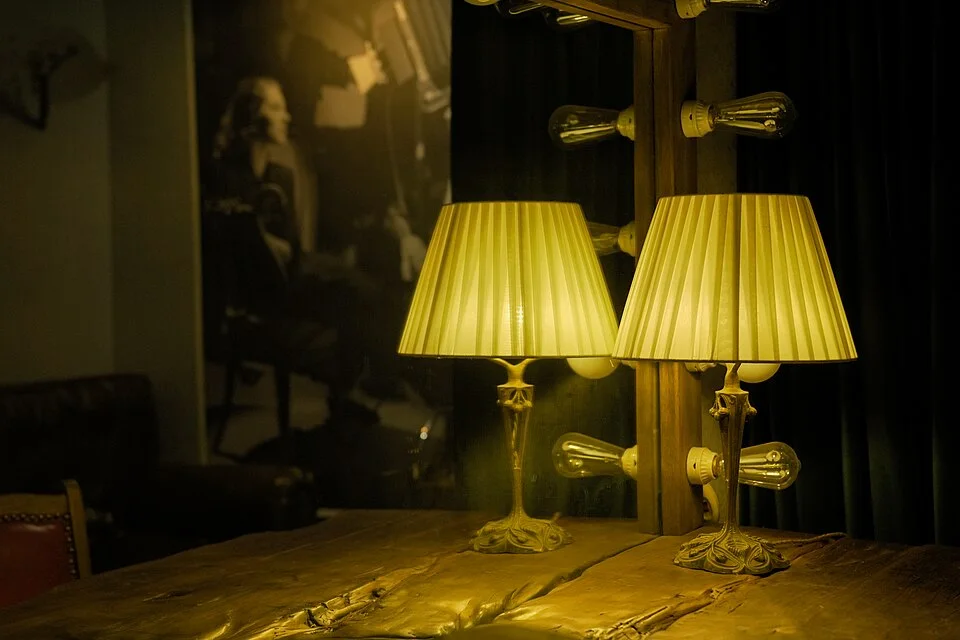
The lamp base, tabletop and reflected shade make its current arrangement describable. For a single-change trial, record the actual lamp position and ordinary control setting, then choose one reversible adjustment allowed by its instructions. Keep the task and seat fixed. The reflection here is in a mirror; it is not evidence of a tested window-glare result or a permitted shade adjustment.
Photo & usage
WANGYIFAN2024 · CC0 · Source. Display copies resized and encoded as WebP; no instructional details were fabricated or removed.
Choose a reversible action within the product’s instructions. Moving a chair, changing an intended blind angle or adjusting a lamp can be suitable. Changing a lamp, window, seat and room schedule together is a bundle of actions, even if it happens in one minute. Save the extra ideas on a separate future-options list rather than introducing them midweek.
CCOHS’s lighting guidance separates visibility from glare and contrast. For a lighting trial, use that distinction to select the outcome you observe. HSE’s thermal comfort guidance and CCOHS’s noise-control guidance offer analogous context when temperature sensation or sound is the chosen topic. None supplies a household pass mark for this experiment, and you need not combine all three topics into one week.
Choose a sequence that includes a return
Before day one, write a seven-day sequence that suits the household. One option is A on days one and two, B on days three and four, A on day five, and B on days six and seven. Returning to A can reveal whether a perceived improvement follows the setting or merely occurred later in the week. This sequence is a practical convention, not a statistical design guarantee.
Choose the same observation time relative to the activity, such as ten minutes after both occupants settle. Record actual clock time as well. Keep observation length manageable and consistent. If the task does not happen on a planned day, mark it missing. Do not invent a substitute session with different occupants and quietly treat it as equivalent.
Discuss the sequence with anyone whose room use will change. Nobody should discover halfway through an evening that their necessary lamp or preferred seat has become experimental property. Give every participant the right to stop the session. If the action requires help, arrange that before the week starts rather than creating a risky workaround to preserve the calendar.
Log the alternative explanations beside the result
Create a short row for each session: date, planned state, actual state, outcome and confounders. A confounder is something else that could explain the difference. Useful entries include unusually bright daylight, different task material, visitors, a changed seat, an appliance event or a different window state. Use concrete descriptions rather than a generic “conditions varied” note.
Write what happened even when it weakens your preferred conclusion. If B removes the reflection on an overcast evening while A was checked under direct sun, flag that mismatch. If the reader used a matte paperback in A and glossy pages in B, keep that detail. Do not delete inconvenient days after seeing the results; the plan should state how unsuitable comparisons will be marked.
Keep excluded sessions in the notebook with a reason. Distinguish “not observed,” “interrupted,” and “completed but confounded.” These categories mean different things. A completed session under changed conditions may still provide practical insight, but it should not carry the same comparative weight as a matched session. Honest exclusions are part of the result rather than evidence of a failed household.
Read an illustrative week without overselling it
The following invented record demonstrates the planned sequence. “Acceptable” means both the reflection and page-visibility conditions were met during that hypothetical session. It does not represent an actual trial or predict a November result. Day four is retained but set aside from the simple matched comparison because the reading material changed.
| Day | State | Outcome | Comparison note |
|---|---|---|---|
| 1 | A | Reflection remains | Comparable |
| 2 | A | Reflection remains | Comparable |
| 3 | B | Acceptable | Comparable |
| 4 | B | Page difficult | Glossy material substituted |
| 5 | A | Reflection remains | Comparable |
| 6 | B | Acceptable | Comparable |
| 7 | B | Acceptable | Comparable |
There are three comparable A sessions and three comparable B sessions: 3 + 3 = 6, with one of seven sessions marked confounded. All three comparable B sessions meet the written conditions; none of the comparable A sessions does. That pattern supports a practical trial decision for the checked materials. It does not justify “B works 100% of the time,” because the sample is small and the glossy-material difficulty remains relevant.
Set stop rules that override the timetable
Stop immediately if a change makes a route awkward, interferes with intended ventilation, places equipment in an unsuitable position or causes unacceptable discomfort. Restore the ordinary state when that is appropriate and note why. Completion of seven days is never more important than normal usable room conditions. Do not keep an arrangement merely because an unfinished table looks untidy.
Also define an evidence stop. For example, if the activity is missed on most planned evenings or the weather changes so much that no matched observations remain, end the comparison as inconclusive. You can retain the observations and plan a different question later. Extending the week indefinitely until the preferred answer appears changes the meaning of the original plan.
A participant’s request to stop needs no debate over the precision of their language. Write “session stopped at occupant request” and discuss alternatives later. If the change reveals a persistent issue outside ordinary adjustment, such as damaged equipment, stop experimenting with it. The diary can describe the observation without diagnosing the cause or postponing appropriate attention.
Make a limited keep, retest or stop decision
At the end, read the question and acceptance conditions before reviewing the most memorable evening. Compare the repeated matched observations, then look at the confounder column. Choose keep if the ordinary arrangement repeatedly meets the conditions and remains easy to use. Choose retest if a specific uncertainty can be addressed with another manageable observation. Choose stop if the change causes problems or the question is no longer useful.
Write the decision with its boundary: “Keep the lamp direction for matte-book reading with the checked seats; retest glossy pages.” That statement is more useful than a global comfort score. Preserve the original state description so the household can restore it when activities change. A kept change remains an ordinary preference, not a permanent rule imposed on future occupants.
Date the actual household decision when it happens. The November 1 review date belongs to this published plan and cannot stand in for the experiment’s completion date. Finish by recording the next action and the evidence that would make you reconsider. A week with honest uncertainty can prevent an unnecessary purchase as effectively as a week that finds a workable adjustment.
THE REFERENCE FILE
Sources & scope
Documentation reviewed 1 Nov 2026. Examples are illustrative; this article does not claim hands-on product testing. Follow the instructions for your actual material, model and location.