Choose a real unloading opportunity
A delayed wash is useful when it places the finish near a time someone can unload and begin the permitted drying routine. Start there. Write when you expect to be available, whether the drying space will be ready and whether the load can appropriately wait before washing under its care instructions. Delay is an operating convenience, not a remedy for an already damp or soiled load needing prompt attention.
Read the exact washer's delay instructions and general operating precautions. Do not schedule operation contrary to a manual, building rule or household safety arrangement. This article does not recommend unattended use where it is not appropriate. Keep children and pets away from the appliance and follow its door and control-lock guidance.
Whirlpool top-loading washer quick reference W11197737B describes a start-delay control on the covered washer. A different machine may use finish-in wording or another convention. The household plan must use the actual semantics, not assume every hour value means the same thing.
Distinguish delay hours from estimated cycle duration
Check whether the display is showing waiting time, remaining programme time or a target completion interval. Copy the wording and indicator rather than relying on memory. If the manual describes a confirmation step, follow it and verify that the delay is actually armed. A selected delay without the required start confirmation may leave the load waiting indefinitely.
Whirlpool: Compact Front Load Washer Control Panel Symbols and Usage documents controls and delay operation for covered compact washers. It illustrates why the control path is model-specific. Do not copy its button sequence onto another product simply because the knob looks similar. Some machines remember settings or have different cancellation behavior.
Record the chosen programme and options before calculating. Extra rinse, soil setting and other modifiers can affect duration on some models. If an option is changed after the delay is set, check the accepted display again. Keep the initial estimate distinct from a guarantee that the door will unlock at a particular minute.
Work backward without hiding the assumptions
This numerical example is illustrative and invented. Assume the hypothetical washer uses start delay, the estimated programme lasts 70 minutes and operation is appropriate under its instructions. The desired unloading opportunity is 18:30, and the user sets the machine at 14:00.
| Step | Time or interval |
|---|---|
| Desired finish before unloading | 18:30 |
| Subtract estimated 70-minute programme | Estimated start 17:20 |
| From setup at 14:00 to estimated start | 3 hours 20 minutes |
If the control allows only whole-hour starts, a three-hour delay would start around 17:00 and estimate completion at 18:10, leaving a 20-minute margin before 18:30. This is schedule arithmetic, not a recommendation for a particular maximum wet-hold time. Sensing, balancing and other factors can alter the actual finish, and the appliance's delay increments may differ.
Keep delay from changing dosing and access decisions
Follow the actual detergent, dispenser and automatic-dosing instructions for delayed use. Do not place a product in a compartment or dosing device that the manual does not permit. Different formulations and machines handle delay differently; a general schedule cannot supply a universal detergent placement rule.
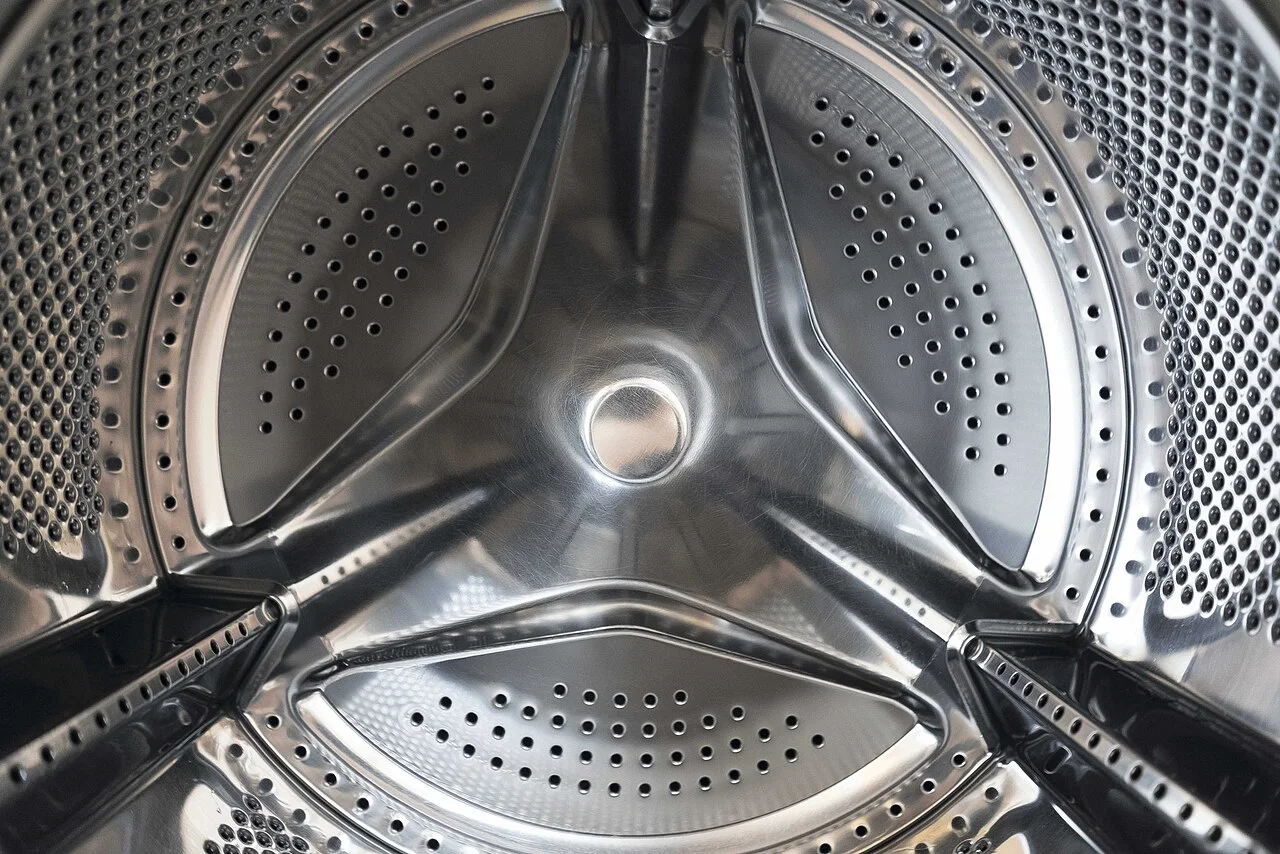
An empty washer drum is visible through the door opening. The reference does not demonstrate a delay control, detergent placement or permission for unattended use.
Photo & usage
Charrine Liu · CC BY-SA 3.0 · Source. Display copies resized and encoded as WebP; no instructional details were fabricated or removed.
Prepare pockets, fasteners and the load according to normal care guidance. Check that no item is caught in the seal or lid area, then close and start as instructed. Do not force a latch or defeat an interlock. A delay feature does not remove the need to identify an unsuitable load or correct a loading problem before operation.
Whirlpool front-loading washer use and care guide W11339488A provides model-specific cycle and operating information for a front-loading family. It is a reminder to keep the manual attached to the actual machine, especially in a shared laundry. A familiar programme name does not establish identical delay behavior, detergent handling or door access across different washers.
Use a margin rather than a perfect-minute promise
Some washers revise displayed time during sensing, heating, balancing or other normal stages. Plan a practical unloading window rather than a precise appointment. Record the estimate at setup, the actual start if observed and the actual finish. Do not infer a fault from one ordinary adjustment without checking the manual's explanations.
If timing repeatedly defeats the purpose, review the load, options and delay convention. A finish-in setting mistaken for start delay can shift the schedule by the whole programme duration. An unconfirmed start or retained option can also explain an apparent scheduling failure. Keep those user-level checks separate from equipment diagnosis.
Do not repeatedly cancel and restart a running programme just to recover the original timetable. Follow the documented pause, cancellation and restart instructions when a change is necessary. If the appliance is in an unknown stage, preserves water or displays an error, ask for the appropriate recovery route rather than assuming an added spin completes the wash.
Record what happens after the finish
At the unloading opportunity, wait for normal completion and unlocking. Do not force the door because the planned finish time has passed. Move the load promptly into its appropriate next care step when practical, and record any unexpectedly long holding period as an outcome of the schedule.
Do not use smell alone to certify a load's condition or make a medical claim about time in the drum. If laundry needs care after an interruption or prolonged hold, follow relevant fabric, detergent and appliance guidance. A delay schedule is not a sanitization procedure and does not supply a universal safe holding time.
Check whether the drying arrangement was actually available. A perfectly timed finish that leaves a basket waiting because the rack is full has not solved the household task. Include the handoff in the routine, especially where another person will unload. Keep instructions specific enough that they know which cycle ran and what the items need next.
Give the handoff a fallback
Agree what happens if the person planning to unload is delayed. The fallback may be another household member following the care note or a documented rescheduling decision before the programme begins. It should not involve forcing access to a locked machine or repeatedly interrupting a running cycle. Keep the practical arrangement consistent with the appliance instructions.
Record one missed handoff honestly. If the nominal finish was convenient but the rack was occupied or nobody was available, the useful adjustment may be to the household schedule rather than the washer's delay. This avoids progressively finer timer calculations that cannot solve a missing unloading opportunity. The task ends when laundry reaches its next suitable care step, so the person and drying space belong in the plan as explicitly as the start button.
Finish with a model-specific scheduling note
Write a short note stating whether the washer delays start or targets finish, the allowed increments, the required confirmation and how to cancel according to the manual. Add the programme usually used for this particular load and the observed ordinary timing range, clearly labelled as household experience rather than a manufacturer guarantee.
Recheck the note if programme options change or the machine is replaced. Do not preserve a sticker describing the previous washer's controls. In a shared laundry, make the unloading responsibility explicit without covering control labels or safety information. A simple plan works best when the next person can understand it at a glance.
Completion means the load starts as intended, finishes within a workable window and reaches its next care step without an avoidable wait. The useful result is a better household handoff, not a claim of lower energy use, superior hygiene or precise timing established by the delay feature alone.
THE REFERENCE FILE
Sources & scope
Documentation reviewed 1 Nov 2026. Examples are illustrative; this article does not claim hands-on product testing. Follow the instructions for your actual material, model and location.