Start with two access files
A moving vehicle can arrive on time while the move itself is unable to begin. The loading bay may be occupied, the reserved lift unavailable or the receiving building closed to deliveries that afternoon. Treat access as a separate project at each address. An excellent packing plan cannot supply a missing building reservation.
Ask the manager or owner which entrance, loading area and route may be used. Record the permitted dates, working hours and booking process. Distinguish written building rules from assumptions made by a concierge, neighbour or previous resident. Where parking permissions involve a local authority, obtain the applicable instructions directly.
Create one page for departure and one for arrival. Put the building address, management contact, mover contact and reservation reference on each. Keep any security details in a restricted copy. Share only the information each participant needs to perform their part of the move.
Give the carrier facts it can evaluate
Ask the mover what vehicle information the building needs, including dimensions or registration details where requested. Do not guess a vehicle size from an online photograph. Confirm whether the carrier intends to use a large truck, smaller shuttle or multiple vehicles, since the access plan may change with the actual arrangement.
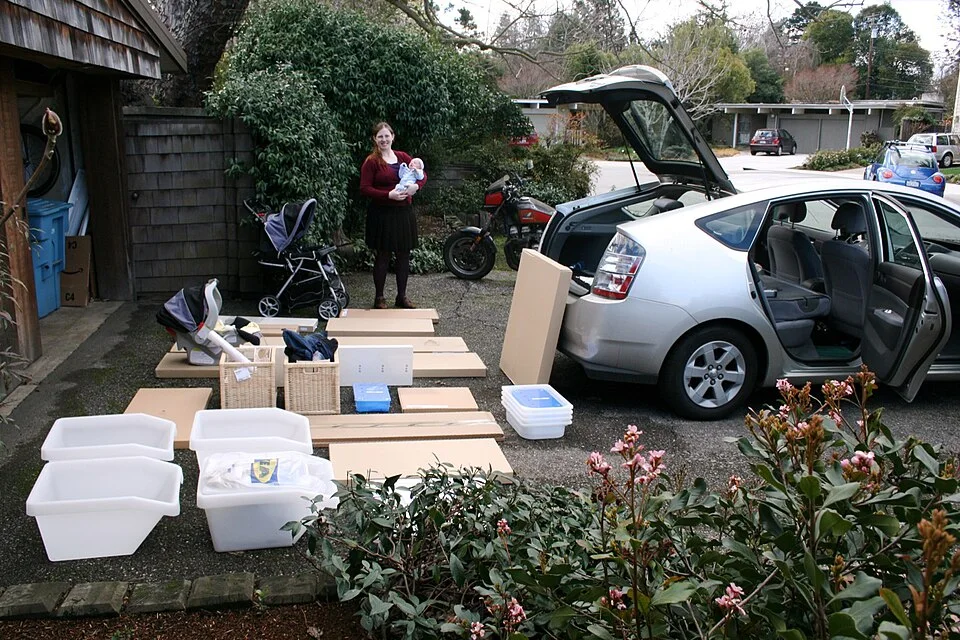
The packages beside an open hatchback show a vehicle-loading arrangement, not a carrier’s approved access plan. Give the actual mover the lawful unloading location, route photographs and building restrictions, then obtain the intended vehicle details. A household car in this photograph cannot establish truck dimensions, loading capacity, parking permission or suitability for a particular building entrance.
Photo & usage
Lisa Dusseault from USA · CC BY 2.0 · Source. Display copies resized and encoded as WebP; no instructional details were fabricated or removed.
Send photographs of the lawful unloading position and the route to the entrance. Identify gates, height restrictions, steep approaches and any point where a vehicle cannot wait. Let the carrier assess vehicle suitability; a resident's description of a space as “large enough” is not an access assessment.
If unloading must happen away from the entrance, ask how the extra distance affects the written service and charge. FMCSA's rights booklet is relevant to US interstate mover arrangements, but building permissions and parking rules remain local. Confirm both instead of assuming a moving contract overrides them.
Check the lift as a route and a reservation
Record the lift door opening, accessible interior dimensions and the approach on both floors. A lift cabin may be generous while its doorway or landing turn is restrictive. Room & Board's delivery guide identifies these separate measurements as part of a furniture access review. Give the actual furniture or package dimensions to the carrier as well.
Ask whether protective lining, a service key, an operator or a nominated lift is required. Establish who provides each item and when it becomes available. An email saying “lift booked” is incomplete if the key holder begins work after the moving team arrives.
Do not bypass a lift restriction or assume that doors, handrails or safety fittings can be removed. Where an item cannot be assessed from ordinary accessible measurements, request a professional access review. Resolve that question before booking a narrow delivery slot that depends on a speculative manoeuvre.
Allow time for the whole booked operation
Consider this illustrative booking calculation. A building offers a 120-minute service-lift reservation. The carrier estimates 20 minutes for setup, 70 minutes of lift trips and 15 minutes to clear the route. Those activities total 105 minutes, leaving 15 minutes inside the reservation.
If management also requires a 15-minute inspection before the lift is released, the full planned use becomes 120 minutes. There is no remaining allowance for a late key, an interrupted trip or a carton delivered to the wrong floor. The correct response is to discuss the timetable with the carrier and building, not to describe the slot as comfortably sufficient.
A longer reservation, a different loading plan or a second authorised window may be possible. These are negotiation options, not guaranteed rights. Write down the agreed start event: vehicle arrival, protective setup or first lift trip. Different interpretations of that start can consume the entire apparent buffer.
Connect departure and arrival constraints
Compare the two pages on one timeline. A morning departure slot does not guarantee an afternoon arrival if the contract allows a wider delivery period. Ask the mover what can actually be promised, and give the receiving building that information before reserving access.
Where arrival timing is uncertain, ask management about flexible bookings, notice requirements and rescheduling. If storage or a shuttle is proposed, request written details of handling, costs and responsibility. Avoid committing to a building slot that the carrier has explicitly said it cannot meet.
Check household access too. Someone must be able to enter the destination, unlock the assigned rooms and answer delivery questions. A key held by a person still travelling from the departure address is a dependency. Arrange a permitted handoff or a receiving person in advance, while keeping the carrier informed of who is authorised.
Write the fallback before it is needed
List a few concrete failures: lift unavailable, vehicle delayed, route blocked or building contact unreachable. Beside each, record the number to call and the person who can approve the next action. An alternative entrance belongs on the plan only if management has authorised it and the carrier has reviewed it.
Clarify the difference between waiting, rescheduling and cancelling. Ask the carrier and building what charges and conditions apply to each. Keep quoted monetary amounts in the original documents; a neighbour's experience from another move is not a reliable estimate for this booking.
Share the final access pages shortly before the move and request confirmation from the relevant contacts. FMCSA's checklist emphasises knowing how to reach the moving company throughout the move. Test the practical arrangement by checking that the named contact will actually be available during the booked hours.
Close the access file with a walkthrough
Walk the permitted route while it is still empty. Check that doors open, temporary obstructions have been reported and the room names match the receiving plan. Note existing marks on building surfaces using the building's agreed procedure. This is a condition record, not permission to attach protection to any surface you choose.
On the day, introduce the crew leader to the building contact where appropriate. Verify the reservation and any route restrictions before unloading begins. If conditions differ materially, pause for a decision from the responsible people rather than redirecting the team through an unreviewed route.
The access work is complete when both addresses have usable permissions, the carrier has assessed the route, the time windows are compatible and a reachable person owns each unresolved event. Save the correspondence through completion of the move so the final arrangement remains clear.
THE REFERENCE FILE
Sources & scope
Documentation reviewed 1 Nov 2026. Examples are illustrative; this article does not claim hands-on product testing. Follow the instructions for your actual material, model and location.