Start with the decision rather than the display
A thermometer near a window is easy to read, but that convenience does not make its reading representative. Before relocating it, decide what you want to compare. A fixed room reference helps you compare afternoons. A temporary seat-level check helps compare two places to sit. Those are different tasks, and they need different records.
Write the question at the top of a page. For example, does the dining room remain warmer than the hall after dinner? List the two locations, the observation times and which instrument will occupy each place. A short written plan prevents unconscious movement toward a result you expected to find.
An ordinary consumer thermometer supports household observations within its stated limits. It does not establish whole-room thermal comfort or the temperature of every surrounding surface. HSE identifies air temperature as one part of thermal comfort. Retain a separate description of sunlight, air movement and the person's activity instead of expecting one display to explain everything.
Remove obvious influences on the sensor
Inspect the proposed position while the troublesome conditions are present. Direct sunlight may reach a shelf only in late afternoon, even though it looks shaded at breakfast. Check for warm lamps, electronics, a radiator, an exterior wall, an open window and a cooling outlet. Move away from these local influences for a general room reference.
Keep the instrument supported according to its instructions, with its sensing openings unobstructed. Do not press it against a surface, wrap it in fabric or place it inside a decorative box. A sensor enclosure needs air exchange; concealing it can delay or distort its response. Avoid handling it immediately before reading, since your hand can warm the casing.
Choose a position that can stay undisturbed by children, pets and cleaning. Record enough geometry to find it again: on the open shelf, 1.1 metres above the floor, away from the television. That height is an illustrative description, not a universal measuring standard. Photographing the location is optional; a sketch and dimensions work just as well.
Check two instruments together first
When two thermometers will be used, compare them side by side in the intended indoor conditions. Leave a small gap so one does not cover the other's sensing openings. Allow the settling time recommended by each manufacturer, and extend the observation if either display is still changing. Note model, stated accuracy and display resolution if available.
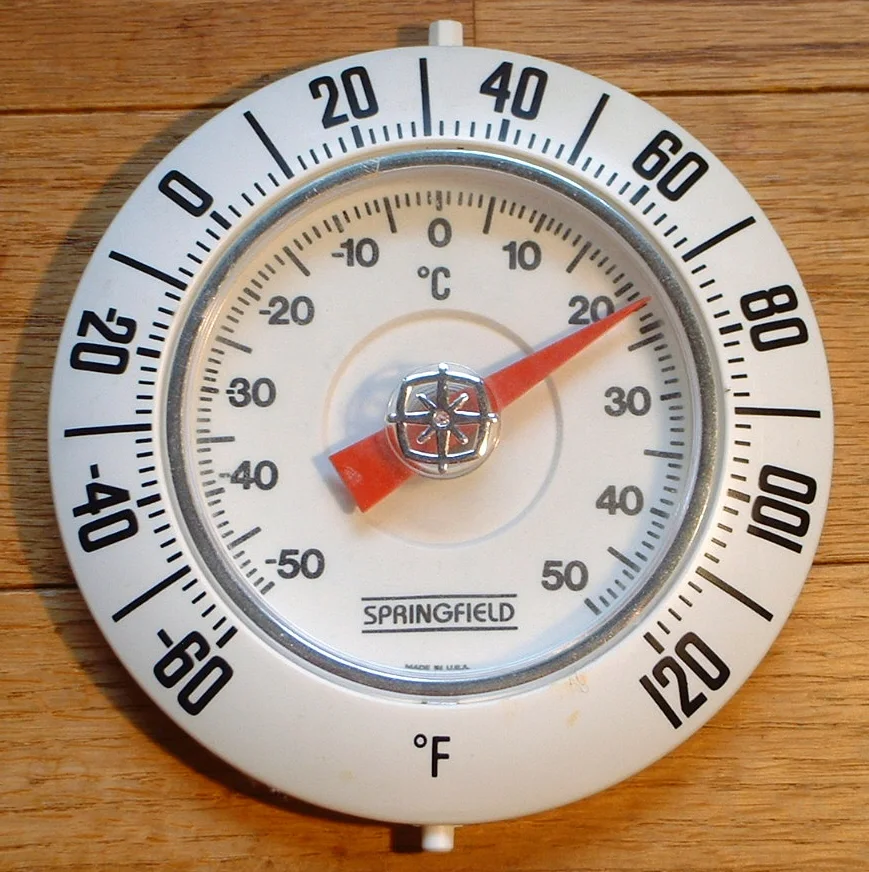
The two scales belong to one thermometer, not two independent instruments. Choose a common unit when recording the actual pair side by side, with sensing openings clear and settling time allowed. Note any persistent difference after several simultaneous checks. Agreement is a consistency observation; this photograph supplies neither a reference calibration nor evidence of either instrument’s accuracy.
Photo & usage
Stilfehler · Public domain · Source. Display copies resized and encoded as WebP; no instructional details were fabricated or removed.
Take several simultaneous readings rather than trusting one glance. If the difference is persistent, keep a note of it. Do not alter readings with a homemade calibration adjustment unless the manufacturer provides a supported procedure and you have an appropriate reference. Side-by-side agreement is a consistency check, not proof of absolute accuracy.
A display that rounds to whole degrees can alternate while another shows tenths. That alone does not mean one is faulty. Avoid comparing the last digit as if it were exact. If a proposed improvement is smaller than the observed mismatch or stated uncertainty, describe it as unresolved by these instruments and use repeated occupant observations alongside it.
Calculate what a mismatch can explain
Consider this illustrative set of side-by-side checks after both instruments have settled. Every value below is invented to explain interpretation; it does not describe a product test or recommended calibration method.
| Check | Instrument A | Instrument B | B minus A |
|---|---|---|---|
| First | 25.0°C | 25.6°C | 0.6°C |
| Second | 25.2°C | 25.8°C | 0.6°C |
| Third | 25.1°C | 25.7°C | 0.6°C |
The mean difference is (0.6 + 0.6 + 0.6) divided by three, or 0.6°C. If A later reads 27.0°C in the hall while B reads 27.7°C in the bedroom, the raw 0.7°C difference is only 0.1°C larger than the earlier mismatch. That evidence does not convincingly establish a warmer bedroom.
Swapping the instruments between locations and repeating under similar conditions can help reveal whether the pattern follows the instrument or place. Do not subtract 0.6°C forever and call B calibrated: the difference may vary across conditions. A robust room contrast should survive this simple cross-check in a way a tiny uncertain contrast may not.
Handle outdoor comparisons carefully
A convenient outdoor thermometer on a sunlit balcony may largely reflect its exposure. For an indoor-outdoor comparison, follow the outdoor instrument's placement guidance and use a shaded, ventilated, weather-appropriate position. Never lean out of a window or enter an unsafe location to achieve a theoretically better measurement.
If an appropriate outdoor position is unavailable, identify a local weather observation and record its location and timestamp. It describes that station, not the exact air at your window. A nearby road, enclosed courtyard or exposed balcony can differ. Use it as context and avoid calculating a precise window-opening trigger from a distant, stale report.
The Department of Energy's natural ventilation material relates cooling to suitable outside conditions and warns against poor outdoor air quality. Temperature is therefore only one opening decision. Record rain, smoke, security and humidity concerns separately. A numerically cooler outdoor reading does not automatically make opening the window appropriate for the household.
Keep sensor response out of the result
A thermometer moved from a warm room to a cooler room does not instantly adopt the new air temperature. The casing and sensor need time to respond. Follow its documented response guidance, and write the time moved as well as the reading time. If the settling interval is unknown, look for a stable pattern and describe the uncertainty.
Moving one instrument repeatedly between rooms is particularly weak when the rooms themselves are changing quickly. Where possible, keep instruments fixed and use the side-by-side and swap checks to understand their relationship. If you have only one, compare equivalent periods on several days rather than pretending successive readings were simultaneous.
Avoid placing the thermometer directly in a fan stream simply to show a cooling result. Airflow can affect response, while personal cooling and room air temperature remain different outcomes. YourHome's cooling discussion supports considering heat and air movement together, but neither principle turns a thermometer into a complete measure of how a seated person feels.
Leave a position record that survives tidying
Write the final location on the observation sheet and label the instrument with its room role. Include the date, any persistent side-by-side difference, and the conditions you avoid. If cleaning moves the device, return it before the next comparison and allow it to settle. A discontinuity in position belongs in the diary.
Perform a completion check during the actual uncomfortable period. The sensor must remain shaded, clear of warm equipment and readable without handling it. Confirm that the furniture arrangement has not placed a lamp or screen beside it. Repeat the side-by-side check if one instrument starts behaving differently or receives new batteries and its readings appear inconsistent.
The practical endpoint is a trustworthy comparison method, not an impressive number of decimal places. Keep a location only if it supports the question you wrote down. When the record cannot distinguish a small room difference from measurement uncertainty, say so and choose a more observable trial, such as whether moving the seat removes direct sun.
THE REFERENCE FILE
Sources & scope
Documentation reviewed 1 Nov 2026. Examples are illustrative; this article does not claim hands-on product testing. Follow the instructions for your actual material, model and location.