Close the record before judging the trend
A month of readings, bills and household notes can produce several plausible stories. One total is lower, another bill is higher and a new fixture was installed partway through. Begin the review by checking that each number describes the same supply, unit and interval before deciding what changed.
Choose a clear closing date and retain the raw records. Keep actual meter evidence, estimated bills and scenario calculations in separate columns. A household review should not blend them into one smooth consumption line.
EPA's bill guide explains varied units and charge structures, DC Water describes actual and estimated reading processes and New York City DEP provides a local billing example. Use the supplying utility's own rules for the account. The review method does not transfer another city's tariff or process to your household.
Check meter identity and continuity
Verify that opening and closing records belong to the same meter or a documented replacement sequence. Confirm the unit and any multiplier. If a reading is illegible or taken at an uncertain time, mark it rather than inventing a value that fits the trend.

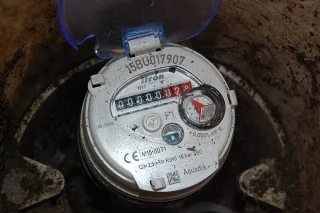
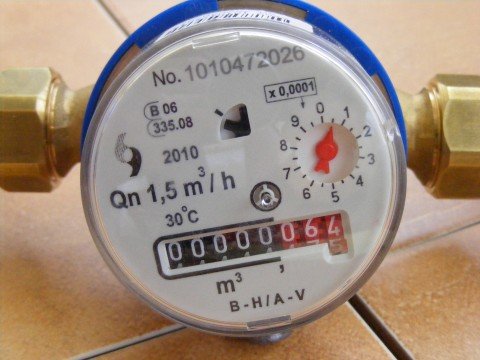
The Cubic Feet wording and visible identifier provide two checks before comparing records. Match opening and closing observations to the same meter, unit and timing basis, and document any replacement. A single register image cannot establish continuity across a month or explain a negative difference without the surrounding records.
Photo & usage
user:Stilfehler · Public domain · Source. Display copies resized and encoded as WebP; no instructional details were fabricated or removed.
Keep the physical and portal timestamps visible. A remote daily total may not align with a household reading taken in the afternoon. Ask the utility about reporting intervals where the difference matters.
If the register decreased, check transcription, replacement or rollover with the utility. Do not turn a negative result into zero and continue the analysis. The continuity question must be resolved before the monthly total can support a conclusion.
Align service periods and household context
Record elapsed days and the utility's bill interval. A calendar month and a service period may differ, so label them distinctly. Compare daily averages only after checking read type and boundaries.
Add occupancy and unusual-use notes at a useful level of detail. Keep outdoor activity, guests, absences and service visits visible. Do not assign unknown event volumes merely to explain every difference.
If a fixture or appliance changed mid-period, identify the date. The whole month is not a clean before-and-after comparison. Use appropriate fixture-specific evidence or wait for a comparable ordinary period, while continuing to record any unresolved fault promptly.
Reconcile an invented monthly total
This illustrative review begins at 1,240.6 cubic metres and ends at 1,252.0, giving 11.4 cubic metres over 30 days. That is 11,400 litres, or 380 litres per day. The previous comparable record is 12 cubic metres over 30 days, or 400 litres per day.
The daily difference is 20 litres, which is 5 percent of the earlier 400-litre figure. If occupancy or other conditions changed, that arithmetic remains correct but the cause is unresolved. It is not evidence that a new product alone produced the change.
If the current bill instead shows 12 whole cubic metres because of its own reading convention or different dates, do not overwrite either record. Ask how the billed interval and rounding relate to the household observations. The difference may be explainable without either record being fabricated.
Explain the bill separately from the volume
Reconstruct current-period charges using the actual tariff, fixed components and any sewer basis. Keep old balances, payments and credits in the account section. A higher amount due can coexist with lower daily consumption.
Record rate changes and effective dates. If the period crosses a change, obtain the utility's allocation method. Do not apply the newest rate to all historical volume just to make a household spreadsheet simple.
Where estimated reads or rebills appear, trace them to the relevant actual-to-actual interval. DC Water's published process illustrates why an estimate is not the same evidence as a physical read. The local supplier's correction method determines the actual account treatment.
State the strength of each conclusion
Use plain categories such as measured interval, estimated volume, conditional cost scenario and unresolved observation. These labels prevent a calculation from acquiring the status of a measurement as it moves into a summary.
For a trend, name the comparison conditions and the remaining differences. “Daily supplied volume was lower across two actual thirty-day intervals” is narrower and more defensible than “the household is now five percent more efficient.”
Do not infer health, water quality or heater performance from the monthly total. Those questions require appropriate evidence and processes. A household use review is valuable precisely because it can remain focused on traceable consumption and account records.
Choose a small set of next actions
Resolve the earliest uncertainty first: unit, identity, period or read type. A complex savings model is premature if the underlying register scale is unconfirmed. Give each question a responsible person and the appropriate contact.
Keep actual service concerns separate from routine observation. A visible leak or unsafe hot-water behaviour should not wait for next month's review. Follow the relevant reporting and safety instructions promptly.
For ordinary planning, choose one useful comparison for the next period rather than changing several routines at once. Record the intended observation and its limits. A modest, interpretable record is more useful than many simultaneous changes that leave the household unable to explain the result.
Archive the month with a reproducible summary
Save raw readings, bills, tariff references and the short conclusion together. Keep secure backups and avoid unnecessary personal information in a shared version. Verify that the file opens and the arithmetic can be reproduced.
Carry forward only open questions and the next planned observation. Preserve the original month as a closed record instead of continuously editing its numbers to match later expectations. Add a dated correction if new utility evidence changes it.
The monthly close is complete when the total reconciles or its gap is explicitly documented, charges have their own explanation and the next action follows from evidence. The result can be inconclusive and still be useful if it identifies exactly what needs to be checked.
Keep later corrections visible after closing the month
Use a dated correction entry if the utility later changes a reading, service interval or charge. Retain the original closed summary and state which conclusion is affected. Do not silently replace the old number and leave earlier decisions appearing to rest on evidence that was not available at the time.
In an illustrative record, a month initially shown as 11.4 cubic metres is corrected to 11.7. Across thirty days, the daily average changes from 380 to 390 litres. Against the earlier 400-litre baseline, the difference is now 10 litres per day, or 2.5 percent, rather than 5 percent.
The correction changes the size of the reported difference, but it still does not identify its cause. Keep occupancy and event limitations with the revised conclusion. If the original comparison supported a purchase decision, note the correction in that file as well.
For a charge-only correction, leave measured consumption unchanged unless the utility also revises the volume. A refunded fee is not evidence of lower water use. Keeping the correction type explicit prevents account administration from being mistaken for a household efficiency result.
At the next review, carry forward the corrected value with its reference while preserving the original evidence trail. That gives the household one current summary and an honest history.
THE REFERENCE FILE
Sources & scope
Documentation reviewed 1 Nov 2026. Examples are illustrative; this article does not claim hands-on product testing. Follow the instructions for your actual material, model and location.