Measure the shower you actually take
A shower’s water use has three parts: water running before you step in, water running while you wash, and any extra outlets running alongside the main head. A bucket measures flow; a timer connects that flow to your routine. Keeping these parts separate makes the result useful when deciding what to change.
This is a collection test using the existing controls. You need a wide, manageable bucket, a measuring jug with clear volume graduations, a timer and somewhere dry to record results. A helper can handle timing. Choose a bucket that can catch the entire spray without filling to the brim during a short catch.
Read any visible flow marking without loosening the showerhead. The Saving Water Partnership’s identification guide shows common marking locations on the face, handle and connection area. Record the spray setting too. The marked rating gives context; your catch measures what comes out under today’s conditions.
Make the catch possible before starting the clock
Check that you can position the bucket while standing securely, without climbing, stretching or lifting a full container overhead. Keep the drain clear and the timer outside the spray. If the bucket cannot intercept a fixed rain shower’s full spread, this method cannot give a reliable whole-head measurement. Ask your water utility about a suitable measuring bag instead of improvising a platform.
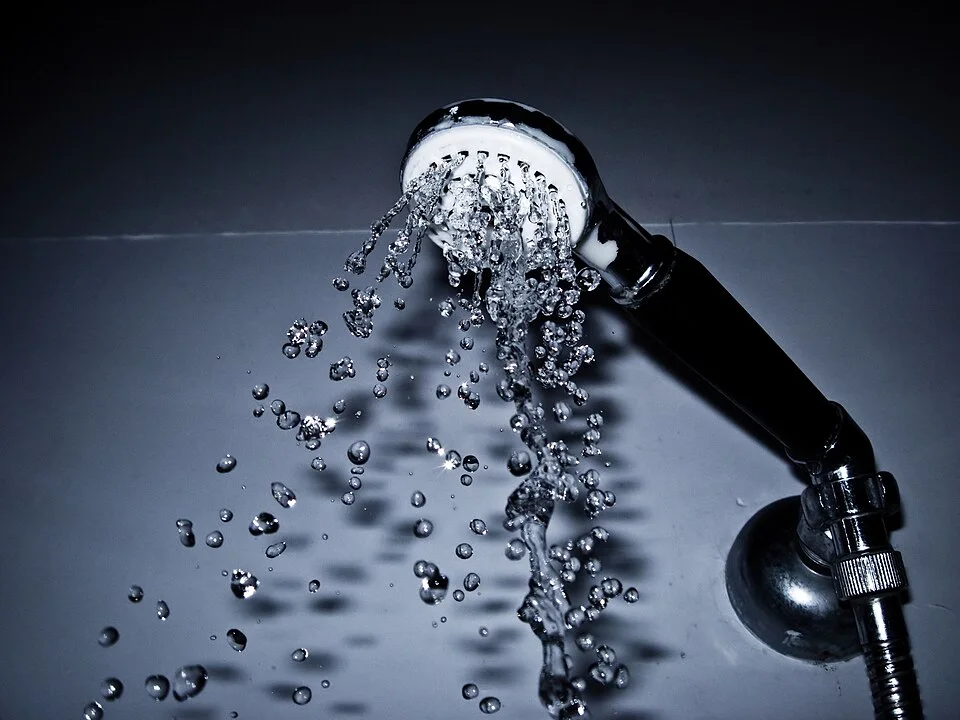
The separate jets make the spread of the shower stream visible. Before timing a household catch, confirm that a stable container can intercept the entire ordinary spray without climbing, stretching or spillage. This photograph contains no collecting vessel or timed volume and cannot supply a flow rate; mark incomplete captures invalid.
Photo & usage
JovanCormac · CC BY 2.0 · Source. Display copies resized and encoded as WebP; no instructional details were fabricated or removed.
If the bucket has no trustworthy graduations, make a reference line on its outside while it stands level. Add measured jugfuls to a convenient volume, mark the waterline, then empty it. Alternatively, measure each catch afterward with the jug. Use one unit throughout: litres or explicitly labelled US gallons. An imperial gallon is a different volume.
Set the shower to the comfortable temperature, flow-control position and spray mode normally used. Let it settle before collecting. Record whether other household water use is occurring, and avoid starting a washing machine or another shower midway through the catches. Do not deliberately provoke a temperature change by opening other taps.
Stop if the temperature becomes unpredictable or the controls will not maintain comfortable water. Have a plumber or the shower manufacturer investigate before continuing. DOE’s faucet and showerhead guidance explains why a mixing valve must suit the showerhead’s flow to limit temperature fluctuations and scalding risk.
Collect short samples, then look for agreement
The EPA showerhead technical sheet uses a 15-second collection as a flow check. Here, use that interval to establish a household baseline rather than certify a product.
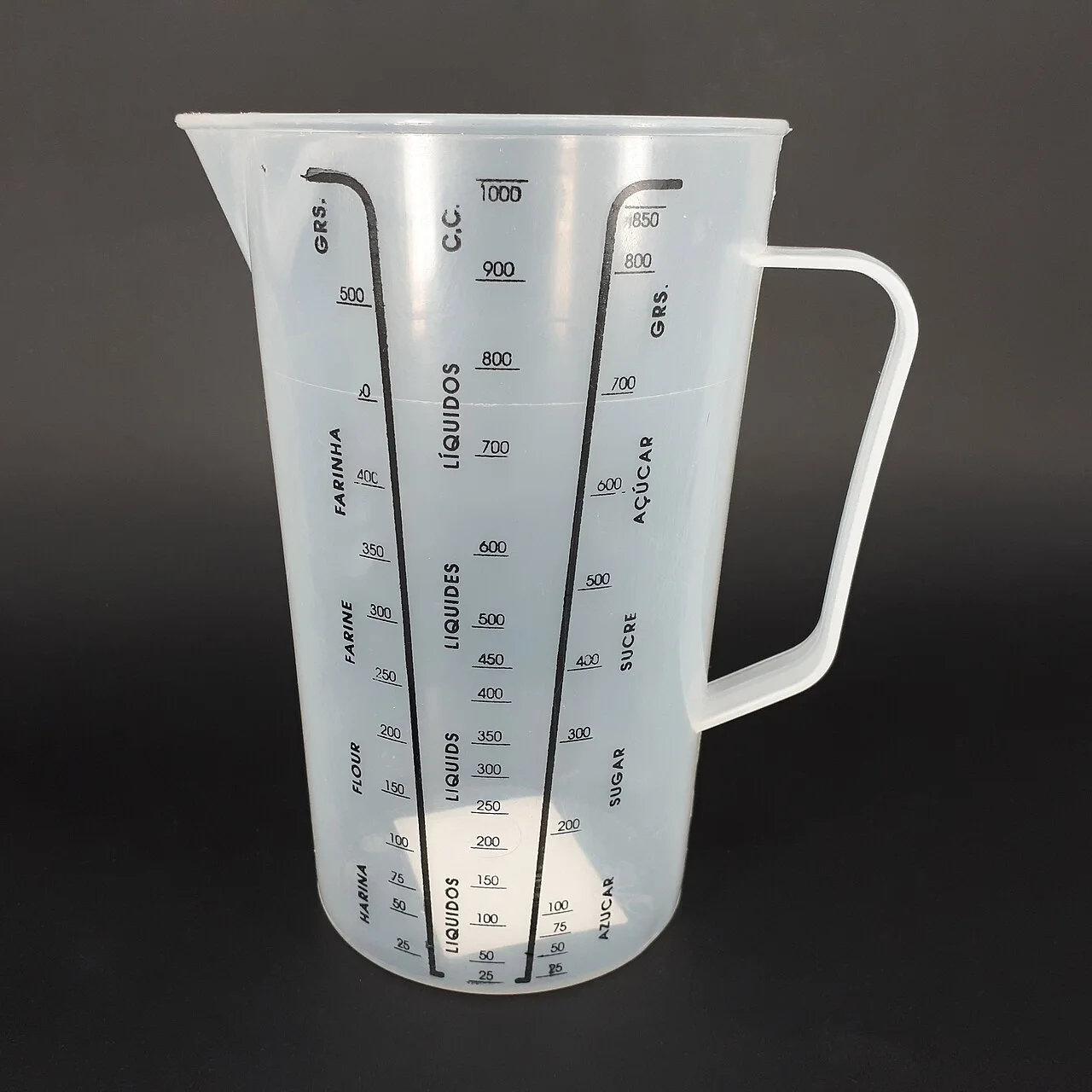
Choose a container with a readable litre or millilitre scale. This jug also has ingredient scales: flour and sugar mass markings must not be used as water volume. Record the actual timed catch, not the container’s maximum capacity.
- With the spray already steady, move the empty bucket into position. Start timing when it catches the full stream, not when you first turn the tap.
- Collect for 15 seconds. Move the bucket out at the end, then turn the shower off using its normal control. If it approaches overflowing, end early and record the actual elapsed seconds.
- Let the captured water settle. Read the volume on a level surface, or transfer it through the measuring jug in counted portions. Record volume, seconds, spray mode and any missed spray.
- Empty the bucket and repeat under the same settings for a second catch. If results disagree enough to change your decision, check the collection method and make a third catch.
Reject a sample if spray escaped, the bucket tipped, water overflowed or someone changed the controls. A low result caused by missed water is not evidence of an efficient shower. Longer catches can reduce the influence of reaction time, but only when the bucket has ample capacity and remains easy to handle.
For a handheld shower, keep its normal spray mode and avoid kinking its hose. For two simultaneous outlets, do not measure each separately with the other switched off and assume their totals represent combined operation. Their flows may change when both run. If you cannot capture their combined discharge safely, record the test as incomplete.
Turn the catch into a rate you can use
Litres per minute = collected litres × 60 ÷ collected seconds. The same calculation with US gallons gives US gallons per minute, or gpm. Divide litres per minute by 3.785 to convert to US gpm. Keep the unrounded result for calculations and round only the figure you report.
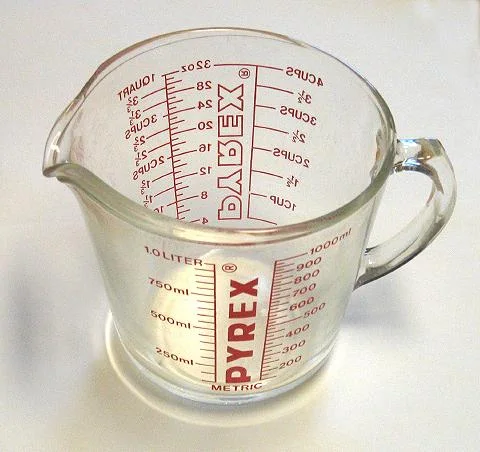
The jug carries several volume scales, including metric millilitres and litres. Choose one applicable unit and read the collected water consistently with the jug level. This empty reference shows graduations, not a measured catch; record actual collected volume and elapsed seconds before calculating a shower flow rate.
Photo & usage
Dpbsmith at English Wikipedia · CC BY-SA 3.0 · Source. Display copies resized and encoded as WebP; no instructional details were fabricated or removed.
| Catch | Collected volume | Time | Calculated flow |
|---|---|---|---|
| First | 1.9 litres | 15 seconds | 7.6 litres/minute |
| Second | 2.0 litres | 15 seconds | 8.0 litres/minute |
| Third | 1.9 litres | 15 seconds | 7.6 litres/minute |
In this hypothetical example, total collected water is 5.8 litres over 45 seconds. The combined estimate is 5.8 × 60 ÷ 45 = about 7.7 litres/minute, or 2.0 US gpm. Combining total volume and total seconds also works when valid catches have different durations. Keep the observed range, 7.6–8.0 litres/minute, beside the estimate so a tiny later difference is not mistaken for a meaningful improvement.
That rounded 2.0 US gpm result does not prove certification. EPA’s WaterSense guidance says labelled showerheads use no more than 2.0 US gpm, approximately 7.6 litres/minute, and undergo independent efficiency and performance certification. A bucket cannot test spray force, coverage or performance across different supply pressures.
Add time without hiding the warm-up
On the next ordinary shower, record two intervals: turning the water on to stepping in, then stepping in to final shutoff. If you normally pause the flow, count only the running portions of the second interval. Avoid reaching for a timer while washing; a helper or a dry, accessible timer makes this simpler.
Multiply your measured rate by minutes of steady running. In a separate hypothetical example, a measured 8 litres/minute for seven running minutes gives 56 litres, about 14.8 US gallons. That is the washing portion alone. It does not include the wait for comfortable water.
If practical, capture the entire warm-up on a later comparable occasion and measure its volume directly. Start with the same usual controls, record when comfortable water arrives, then turn off. If the bucket fills first, end the collection and mark it partial. Do not empty and juggle buckets beneath running water.
Hypothetically, 3 litres of separately collected warm-up water plus that 56-litre washing portion gives 59 litres, about 15.6 US gallons, per session. Multiplying steady flow by warm-up time is only an estimate when startup flow differs. Also note whether another person recently used hot water: a second shower immediately afterward may have a different wait.
THE WORKING FILE / LOG
Three catches are more useful than one confident-looking number
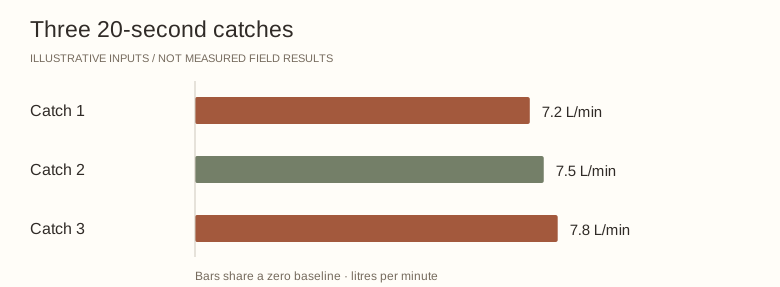
Three hypothetical catches each last 20 seconds and collect 2.4, 2.5 and 2.6 litres. Keep the normal shower setting unchanged between catches. The slight variation is visible in the record rather than hidden by reporting only the middle result. Do not collect extra samples if the setup is unstable or water could cause a slip.
| Observation | Working | Result |
|---|---|---|
| Catch 1 | 2.4 L × 60 ÷ 20 s | 7.2 L/min |
| Catch 2 | 2.5 L × 60 ÷ 20 s | 7.5 L/min |
| Catch 3 | 2.6 L × 60 ÷ 20 s | 7.8 L/min |
| Eight flowing minutes, using mean | 7.5 × 8 | 60 L |
| Six flowing minutes, using mean | 7.5 × 6 | 45 L |
Read the result
The mean is 7.5 L/min and the observed span is 0.6 L/min. That span describes these catches, not a statistical confidence interval or the meter’s accuracy. Two fewer flowing minutes would save an illustrative 15 litres per shower at the same flow. Add separately measured warm-up water once; do not count it again inside timed shower use.
Your log record Blank worksheet
Get a repeatable flow estimate and distinguish shower time from warm-up water.
- Date and shower setting
- ________________________________
- Catch duration seconds
- ________________________________
- Catch 1 litres
- ________________________________
- Catch 2 litres
- ________________________________
- Catch 3 litres
- ________________________________
- Mean L/min
- ________________________________
- Flowing shower minutes
- ________________________________
- Warm-up litres
- ________________________________
- One proposed change
- ________________________________
Before closing the file
- Container capacity exceeds the intended catch.
- Settings stay constant.
- Warm-up water is counted once.
Use the result to choose one change
Match the action to the largest measured part. If warm-up dominates, stop running the shower before you are ready to enter once the temperature is comfortable. If washing time dominates, try shortening one routine stage. If flow is high and comfort is already good, investigate a compatible efficient showerhead rather than altering internal restrictors or plumbing.
Compare changes with the same arithmetic. In the hypothetical 8-litres/minute example, removing one running minute saves 8 litres, about 2.1 US gallons, per session. A hypothetical reduction to 6.5 litres/minute over the original seven minutes saves 10.5 litres, about 2.8 US gallons. These are alternative calculations, not promised product savings; longer rinsing could reduce the benefit.
Before buying a lower-flow head, check the shower and heater manufacturer’s compatibility requirements, particularly for electric showers or systems with minimum operating flows. Where compatibility or mixing-valve protection is uncertain, ask the manufacturer or a qualified plumber. Temperature instability, persistent leakage after shutoff or a sudden unexplained flow change calls for investigation rather than further adjustment.
Finish by checking the controls are off, emptying the bucket and leaving the floor dry. Keep the dated catches, setting, running time and warm-up note together. After one change, repeat under comparable conditions and confirm the shower still rinses comfortably. Retain the change only when its measured benefit survives ordinary use.
THE REFERENCE FILE
Sources & scope
Documentation reviewed 1 Nov 2026. Examples are illustrative; this article does not claim hands-on product testing. Follow the instructions for your actual material, model and location.