An electricity bill can rise while consumption falls. The explanation may include a higher energy rate, a different fixed charge or a change in when electricity was used. A useful record separates those effects instead of dividing the total amount due by kWh and calling the result the new tariff.
Build a rate ledger around effective dates. Keep original statements and the applicable supplier documents. This is a household comparison method using illustrative arithmetic, not advice to change tariffs or a claim that any example price applies to a particular account.
Copy the exact plan and charge basis
Record the plan name, service period and the electricity charge lines. Separate charges expressed per kWh from charges expressed per day or billing cycle. Keep taxes, credits and prior balances visible as distinct account items. A total payment amount is not an energy price.
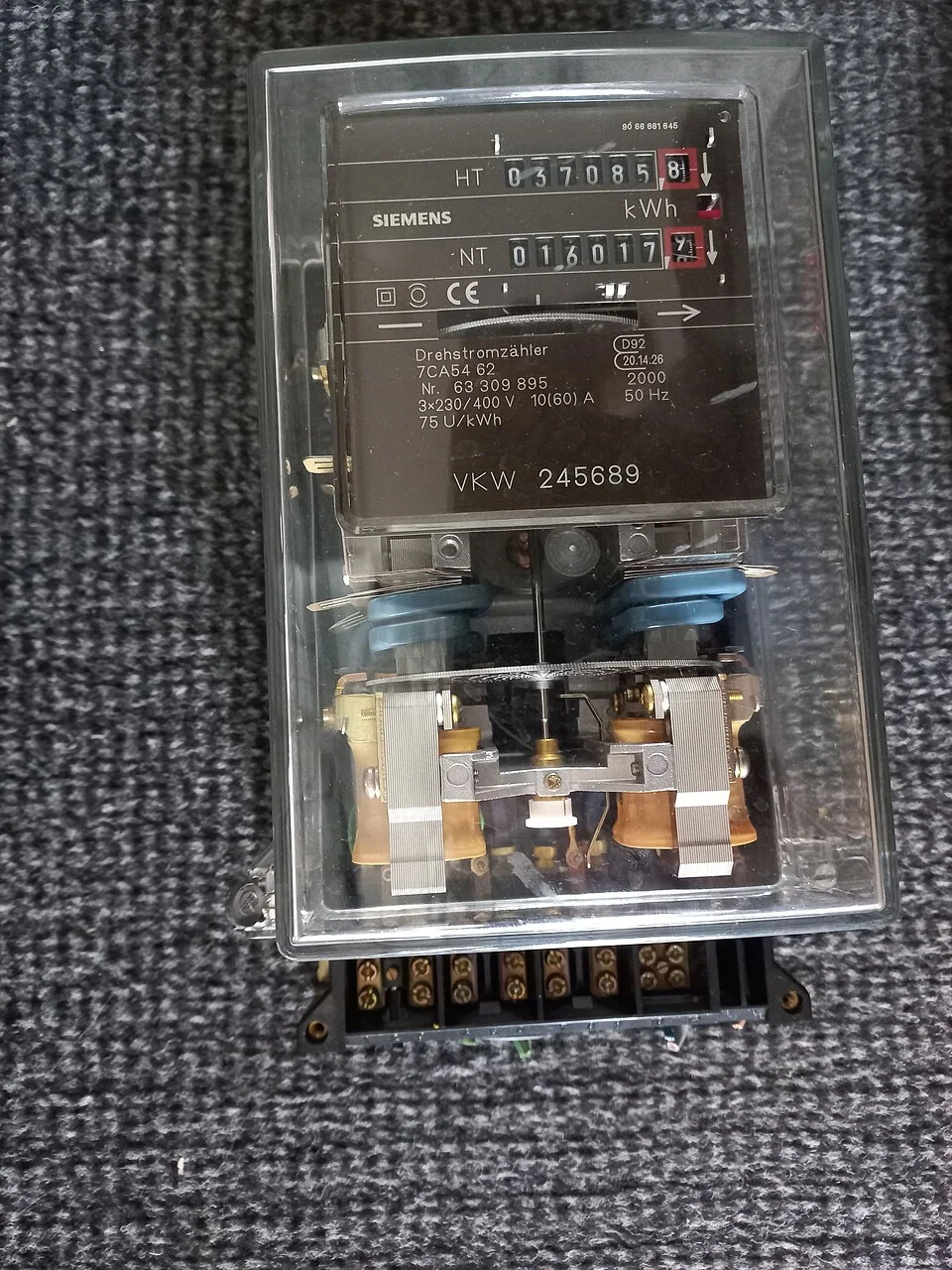
The registers are labeled kWh, identifying accumulated energy rather than money. Keep their identities with actual observations, then take per-kWh, per-day and per-cycle charge bases from the applicable statement. This display does not reveal the tariff price or determine how taxes, credits and fixed charges belong in a bill comparison.
Photo & usage
Asurnipal · CC BY-SA 4.0 · Source. Display copies resized and encoded as WebP; no instructional details were fabricated or removed.
The PG&E — Understand Your Bill glossary shows why line names and charge bases matter. Use your own supplier's definitions for your account. Similar labels can cover different services, and a delivery charge might be usage-based, fixed or a mixture depending on the tariff.
Do not combine rates from different statements before checking their dates and scope. One price may exclude supply while another includes it, or one may already incorporate an adjustment. Record which components belong in the comparison so the same charge is not added twice. Where the bill is unclear, obtain the relevant explanation rather than guessing from the label.
Locate changes inside the billing period
Find the effective date of the rate change in the statement or official notice. Check whether the bill splits consumption into dated sections. Preserve that allocation when available. A single average for the whole period can hide how the supplier treated the boundary.
Portland General Electric — Understanding My Bill publishes bill explanations and rate-adjustment information for its customers. It is an example of the kind of primary record to retain, not a price schedule for other homes. Save the document or reference that actually applies to your account and the period being analyzed.
If the change occurs mid-period and no measured split is available, do not claim to know exactly how much electricity was used before it. Use the supplier's documented allocation or label a household approximation clearly. A daily prorated estimate is not a substitute for interval measurements where consumption varies substantially.
- Save the applicable plan and official effective date for every changed energy component.
- Copy the supplier’s consumption split where available and mark any household allocation as estimated.
- Reprice one consistent quantity or use the stated bridge convention before attributing the bill difference.
Choose a comparison that answers one question
For the effect of price alone, apply old and new rates to the same defined kWh quantity and usage pattern. For the effect of consumption alone, apply one consistent rate basis to both periods. State which comparison you are making before calculating.
If time-of-use pricing applies, preserve the peak and off-peak quantities. Southern California Edison — Time-of-Use Plans describes plans where timing affects price. A single blended rate from one month's pattern may not be valid for another month with a different distribution, even if total kWh is identical.
Keep any tier or allowance treatment consistent with the actual tariff. Changing both usage and rate assumptions at once produces a combined scenario, which may be useful but cannot isolate the cause of a bill increase. Label combined scenarios honestly rather than presenting them as a decomposition supported by the original statement.
Calculate an illustrative split-rate bill
All prices and quantities here are illustrative. A period contains 120 kWh billed at USD 0.18 per kWh and 180 kWh at USD 0.22. The energy charges are USD 21.60 and USD 39.60, totaling USD 61.20 for 300 kWh.
At the old rate throughout, the same 300 kWh would cost USD 54.00. The difference is USD 7.20. That is also 180 × USD 0.04, because only the later 180 kWh receives the higher illustrative rate. Applying USD 0.22 to the entire period would instead produce USD 66.00 and overstate this specific split.
The calculation excludes fixed charges, taxes, tiers and other adjustments. It assumes the 120/180 kWh allocation is known. If it were only estimated, the USD 7.20 result would inherit that uncertainty. Keep the allocation source alongside the arithmetic so a precise-looking monetary result does not conceal an approximate energy split.
Keep fixed-charge changes out of the kWh price
Record a new or changed fixed charge separately. A charge for service availability can increase the bill without changing the marginal price of one additional kWh. Conversely, a lower energy price can coexist with a higher fixed charge. The household's total effect depends on its usage and the complete applicable structure.
Do not calculate a supposed appliance-saving rate by dividing the full bill by kWh. That average includes charges the appliance may not change. Use the applicable avoidable energy components for a running-cost comparison, retaining any relevant taxes or usage adjustments only when their treatment is understood.
If a minimum bill or demand-based component applies, stop the simple fixed-plus-energy model and obtain the exact rules. The arithmetic here cannot establish how those features respond to a household change. Keep a clearly marked limitation rather than forcing every charge into a familiar two-column format.
Decide whether the evidence explains the increase
Reconcile the energy lines under the applicable dated rates. Then compare fixed charges and account adjustments separately. If the components explain the difference, record that conclusion without attributing it to an appliance or occupant. If they do not, identify the exact unmatched line.
Check consumption per day before concluding use increased; unequal periods can affect total kWh. Review actual versus estimated status as well. A rate change and a catch-up reading can occur on the same bill, creating two separate issues that should not be compressed into one explanation.
Contact the supplier with a concrete question when the statement cannot be reproduced from its stated quantities and rates. Keep your assumptions visible and ask about allocation, rounding or the applicable schedule. Do not treat a small rounding difference as proof of a wider billing fault without examining the source precision.
Use a two-scenario bridge for a changed period
When both quantity and price change, calculate an intermediate scenario explicitly. Start with the earlier quantity at the earlier rate, then price the later quantity at the earlier rate, and finally apply the later rate. This chosen order creates a transparent bridge; another decomposition order can assign the interaction differently, so state the convention.
For an illustrative flat-rate case, 250 kWh at USD 0.20 costs USD 50. Later use of 300 kWh at the old price would cost USD 60, and at a new USD 0.23 price it costs USD 69. Under this bridge, quantity contributes USD 10 and applying the new price to the later quantity contributes USD 9.
The USD 19 combined difference reconciles, but the assignment is a calculation convention rather than a physical separation of money. Extend this method only when the applicable tariff structure is understood. Time periods, tiers and credits can require several component bridges instead of one flat multiplication.
Finish with a dated comparison record
Save the plan identity, effective dates, component rates, period quantities and the comparison question. Retain unrounded calculations where possible and display USD totals at an appropriate precision. Note whether the quantity split came from measured data, the bill or a clearly labeled estimate.
Write the conclusion narrowly: price explains a stated amount under the defined comparison, consumption also changed, or allocation remains uncertain. That wording prevents a scenario from later being remembered as an observed saving or exact account correction.
Completion means another reader can follow which rates applied to which quantities and which charges remained separate. Update the ledger when the supplier changes the plan or issues a correction. A dated record is more durable than a single remembered price per kWh.
THE REFERENCE FILE
Sources & scope
Documentation reviewed 1 Nov 2026. Examples are illustrative; this article does not claim hands-on product testing. Follow the instructions for your actual material, model and location.