Describe which items finish first
A dryer that leaves a thick waistband damp while lightweight shirts are ready has an uneven-endpoint problem to investigate. Do not begin by extending every future run. List the items that are ready and the ones still needing care after normal completion. Their construction, starting wetness and arrangement matter more than the general description a mixed load.
Check the actual dryer manual and each item's label. Some pieces cannot share a heat setting or tumbling action even if their colours match. Keep unsuitable items out of the appliance. A drying routine should not sacrifice care limits to avoid a second basket.
Whirlpool: Using Auto Dry, Timed Dry and EcoBoost notes that loads too large to tumble properly can take longer. That supports reviewing capacity and movement before treating the sensor as faulty. It does not establish a universal half-drum rule or prove that every uneven load is overloaded. Record the actual composition and permitted capacity.
Do not ignore the washer handoff
Confirm that the preceding wash and spin completed normally. If one bulky item retained much more water, note it separately. A load entering the dryer unusually wet is not comparable with a normally extracted load, even if the drying settings are identical. Do not infer extraction quality from drum speed alone.
Unfold items as the care and appliance instructions permit and avoid a dense bundle that prevents ordinary tumbling. Do not add dry towels as a universal shortcut or put incompatible material in to fill a small load. The actual model may give a minimum or special instruction for small automatic loads; use that guidance.
Whirlpool: Auto Dry or Timed Dry on a HybridCare Electric Dryer describes automatic and timed drying within the covered HybridCare system. It is relevant because regrouping can change how a sensing cycle encounters the load. The useful question is not simply fewer items, but whether the new group is appropriate for the selected programme, capacity and stopping method.
Sort by care needs and observed construction
Where practical, group compatible lighter items separately from compatible thicker pieces. Check heat, action and any special programme requirement first. A heavy delicate item should not be placed in a high-heat sturdy group solely because it dries slowly. Keep load size within the actual instructions for each programme.
Record the groups in ordinary detail: number and type of items, any thick seams and whether a large piece could wrap smaller items. If the guide uses dry mass, weigh safely with a suitable scale; if it does not, do not invent a kilogram limit from the machine's total capacity. Programme capacity can differ.
Use required screens and filters and complete the model's normal user maintenance. Do not open equipment or alter venting to make the comparison more controlled. If abnormal heat, burning smell or errors occur, stop and seek support. Load regrouping is an ordinary-use choice, not a method for testing a suspect dryer through repeated operation.
Do not let a large piece conceal the smaller group
If a sheet or similar permitted large item wraps smaller pieces during ordinary use, record that geometry rather than labelling every damp item a sensor problem. Follow the manual's loading and item guidance for the next necessary run. Do not add rigid objects, fastening devices or improvised separators to prevent wrapping. Any dryer accessory needs its own explicit compatibility and use instructions.
After safe unloading, inspect the enclosed pieces separately from the outer fabric. A dry outer face does not describe the bundle's interior. If regrouping avoids the observed wrapping, state that limited outcome and keep other differences visible. The result supports a practical load arrangement; it does not show that the machine reached a particular internal moisture level or that every mixed load should be divided in the same way.
Compare full-task time rather than one countdown
The following data are illustrative and invented. They do not predict actual drying time or energy use. Assume the hypothetical appliance and fabrics permit all routes and no overlapping machine operation is possible.
| Route | Recorded intervals | Total machine time |
|---|---|---|
| Mixed run plus repeat for damp pieces | 60 minutes plus 20 minutes | 80 minutes |
| Two compatible groups | 35 minutes plus 50 minutes | 85 minutes |
The separated route totals 85 minutes, which is 5 minutes longer than 80. It could still provide a more manageable endpoint for particular items, but the table does not establish that outcome or an energy saving. Sorting is not automatically faster. The useful evaluation includes care compatibility, repeat handling and which already-dry items receive unnecessary further drying, not just the first run's duration.
Make the result specific enough to compare
After normal completion and safe unloading, check the same construction features: waistband, heavy seam, folded edge or pocket. Note the lighter group's result as well. A routine that improves thick pieces while over-drying unsuitable lighter items has not solved the whole task. Do not use warmth or fragrance as a dryness certificate.
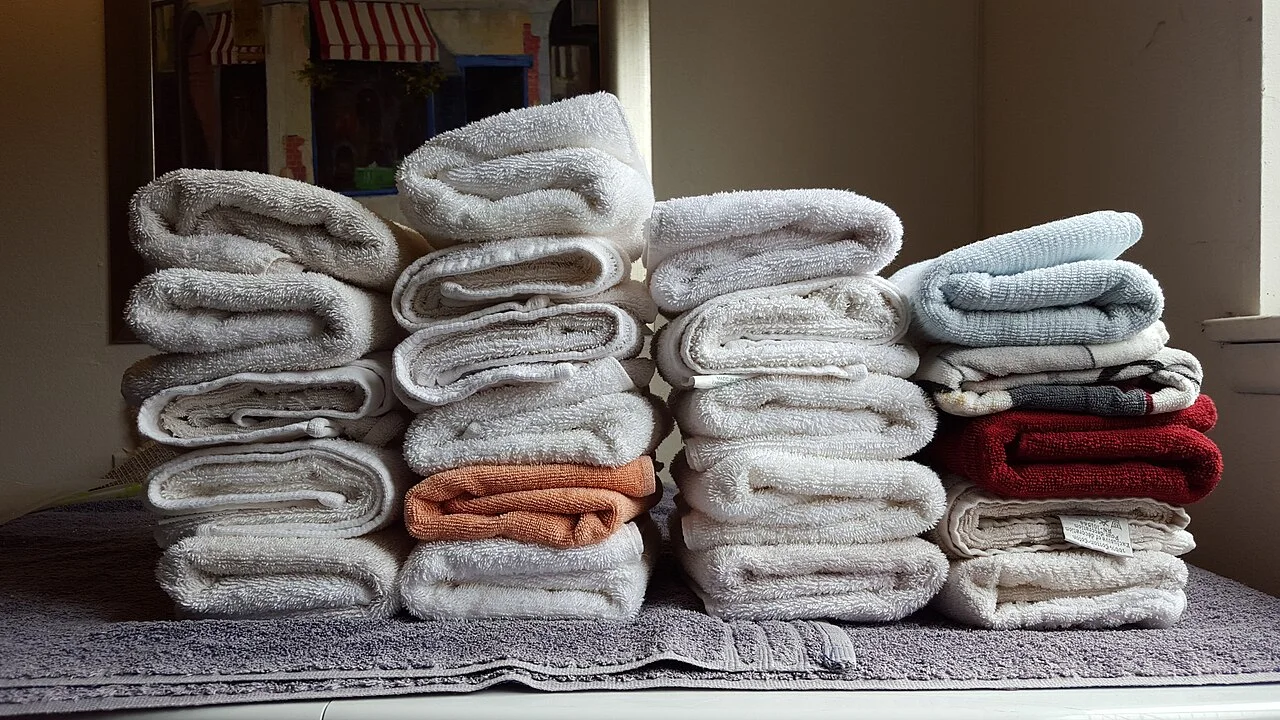
Stacks of folded towels show layered textile construction. They are a material reference, not proof of dryness, dryer loading or measured cycle performance.
Photo & usage
HanSangYoon · CC BY-SA 4.0 · Source. Display copies resized and encoded as WebP; no instructional details were fabricated or removed.
Record whether a piece was ready for its next care step, required further permitted drying or needed another arrangement. Keep the descriptions consistent. You do not need to assign a moisture percentage to fabric unless you have an appropriate measurement method; this article does not establish one.
Whirlpool: Dry Time Keeps Going Up discusses changing automatic-cycle estimates. Keep actual elapsed time distinct from the starting display in each group. A separated group may produce a different estimate because the load and sensed conditions changed. Do not compare the first displayed number from one run with the final elapsed time from another and call the difference a measured improvement.
Escalate repeated poor drying under appropriate use
If both compatible groups remain unexpectedly wet, revisit the programme, starting extraction and model's user-level checks. Repeated poor results may need support even when sorting is sensible. Do not keep making the groups smaller until the machine happens to finish one acceptable item while an unresolved equipment problem remains.
Check only the maintenance and access areas identified for users. Do not dismantle a vent, open a heater or reach into internal ducting as part of this comparison. Different dryer systems have different service requirements. A heat-pump filter instruction does not apply automatically to a vented dryer, and a vented-dryer airflow check may not fit a condenser system.
Share the group descriptions, accepted settings, actual times and endpoint observations with the manufacturer if needed. Include errors and abnormal operation rather than hiding them in a successful final run. A useful record can show that ordinary appropriate loads repeatedly fail without claiming to diagnose a sensor, heater or refrigerant circuit.
Choose the grouping the household can maintain
Select the practical grouping that respects care limits and gives a manageable endpoint. It may be two groups, a compatible mixed group with a defined follow-up, or a different permitted drying method for one difficult item. The best routine depends on the actual household task, not a rule that every load must be split.
Write the successful group description and the feature to inspect at unloading. Keep the total task visible, including any follow-up and handling. If the routine depends on someone being present to remove ready items, make that responsibility clear and follow the appliance's interruption and cooldown instructions.
Completion means compatible items receive appropriate drying, known damp areas are not stored prematurely and repeated cycles have a clear purpose. Do not claim lower bills, safer air or longer fabric life from the timing table. The evidence supports a specific load-handling choice and a more honest picture of what the dryer task actually requires.
THE REFERENCE FILE
Sources & scope
Documentation reviewed 1 Nov 2026. Examples are illustrative; this article does not claim hands-on product testing. Follow the instructions for your actual material, model and location.