Start with one accessible compartment
A musty wardrobe smell can become a whole-room project before anyone identifies what is actually affected. Start with one accessible shelf or hanging compartment. Record when the smell is normally noticed: on opening the door, after rain, when putting away laundry or during a colder season. Do not place your face inside the cupboard or repeatedly sniff suspected growth.
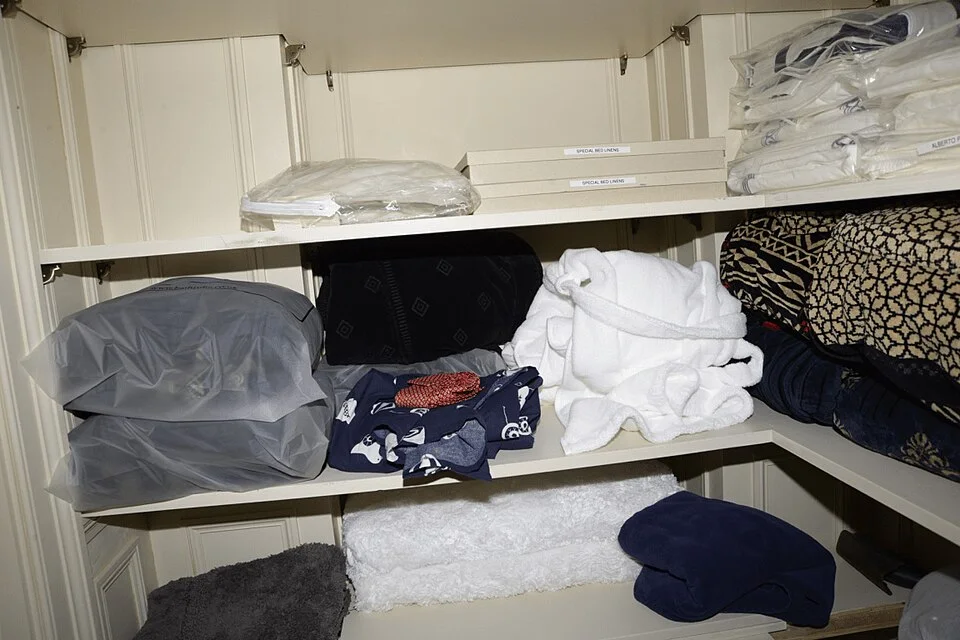
The shelf edges and separate groups of stored textiles provide visible boundaries for a small inspection area. Name the actual accessible shelf or compartment, record when the smell occurs and provide a clean dry temporary place for unaffected items if needed. This photograph shows no confirmed growth, odour or moisture source; do not unpack suspected material merely to reproduce the view.
Photo & usage
Federal Bureau of Investigation · Public domain · Source. Display copies resized and encoded as WebP; no instructional details were fabricated or removed.
Choose a clean, dry temporary place for ordinary unaffected items. Keep exits and walkways clear. Leave heavy furniture and anti-tip restraints in place. This is an inspection of accessible contents and surfaces, not permission to dismantle a fitted wardrobe or open the wall behind it.
Health Canada: Guide to addressing moisture and mould indoors treats persistent musty odours without an obvious source as a reason to consider hidden moisture assessment. A simple compartment record can improve that conversation, but it should not delay help when there is visible damage or a history of water entry.
Keep item observations separate from shelf observations
Remove a manageable group and list what was there: recently washed shirts, shoes, spare bedding or a rarely used bag. Record any item that went into storage before it was fully dry. Check care labels before choosing a drying or cleaning method. Do not assume that all fabrics can be hot-washed or tumble-dried.
Look at the now-accessible shelf, backing and corner from a normal distance. Note water, staining, swollen board, peeling finish or clear surfaces. If suspected mould is present, stop routine sorting in that area and use suitable assessment and cleanup guidance. Do not shake affected textiles or brush a contaminated board to improve the photograph.
Keep suspect items apart from clean storage without carrying them through the house unnecessarily. Valuable, delicate or materially affected items may need specialist advice. Ordinary airing can help a recently damp clean garment, but it is not a universal restoration method or proof that an odour source has been removed.
Review loading and the surrounding room
Look at how tightly the compartment was packed and whether clothing touches an external wall or damp backboard. Space is useful only if the cabinet and room can actually manage moisture. A loosely packed wardrobe beside a leak will still have a problem. Avoid prescribing a single gap that supposedly guarantees dry storage.
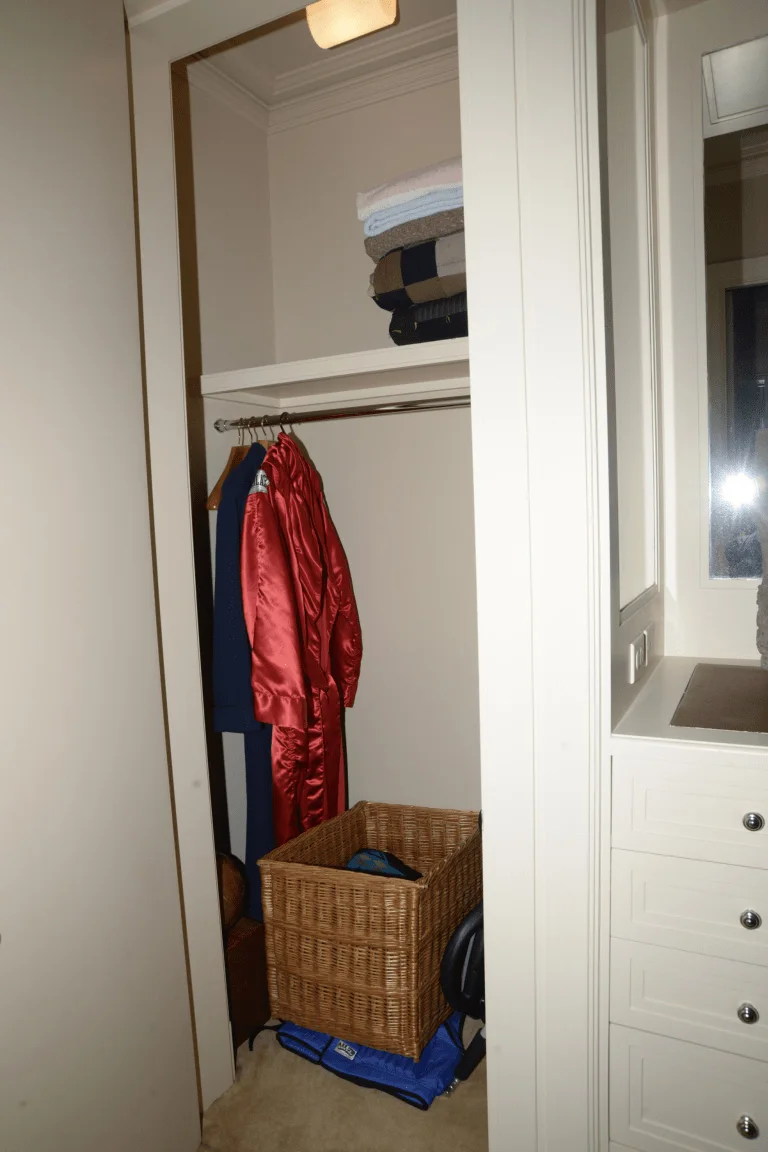
The hanging garments, upper shelf and floor basket show separate parts of a storage compartment to describe before repacking. Observe whether your actual clothes touch a damp backboard and keep the room’s intended air openings clear. The visible space does not guarantee dry storage, identify the wall construction or establish that the cabinet has a moisture problem.
Photo & usage
Federal Bureau of Investigation · Public domain · Source. Display copies resized and encoded as WebP; no instructional details were fabricated or removed.
Keep intended room vents and heating clear. Note indoor laundry drying, humidifier use and a nearby bathroom if relevant. A room meter belongs in a representative position, not pressed into a pile of fabric. If you take a local cupboard reading, label it separately and follow the device's settling instructions.
Canadian Conservation Institute: Incorrect relative humidity explains why cool locations can have different local humidity conditions and why materials respond differently. Its collections guidance supplies physical context, not a universal household target for every garment. Do not turn one central RH number into proof that a wardrobe backboard or stored duvet is dry.
Compare the contents with the empty space
This is an illustrative invented observation comparison. No wardrobe, textile or cleaning treatment has been tested. The scenarios show why the next step depends on what remains after a manageable compartment is emptied.
| Observation | What it supports | Next action |
|---|---|---|
| One recently stored damp towel affected; shelf clear | An item-related contribution is plausible | Follow textile care; correct drying before storage |
| Empty compartment remains musty; backing distorted | Storage location needs investigation | Request moisture assessment |
| Several cupboards worsen after rain | A wider building pattern is possible | Record locations and rain timing |
An odour remaining in an empty compartment does not identify a mould species or prove the wall cavity is affected. Likewise, improvement after removing a towel does not rule out another source. The comparison narrows the work and preserves a clear boundary between an observation and a diagnosis.
Do not add another source while tracking the first
Skip fragrance sachets, deodorising sprays and scented liners during the investigation. They change the odour background and may make the compartment seem improved without correcting moisture. A passive moisture absorber also cannot repair water entry or prove that the cabinet's contents are dry. Follow its handling instructions if one is already used.
EPA: Improving Indoor Air Quality places source control at the centre of indoor-air improvement. In this setting, that means addressing damp contents or the wet storage location rather than masking the symptom. Ventilation can help where appropriate, but it does not make a damaged backboard sound again or remove concealed contamination automatically.
Do not use an ozone generator or improvise chemical treatments inside a closed wardrobe. For ordinary shelf care, follow the cabinet manufacturer's finish instructions. If mould cleanup is needed, choose appropriate guidance and scope rather than treating a household air freshener as a remediation product. Keep cleaning methods separate from the observation record.
Return only suitable dry items to a suitable space
Once the source has been addressed and any necessary care completed, check that the compartment and contents are ready for storage. Do not return a dry shirt against a damp wall or place a partly dried duvet in a sealed bag. Product-specific textile and furniture requirements still apply.
Repack in a manageable arrangement that leaves access for an ordinary inspection. Keep a note of which items returned and whether they were cleaned, dried or replaced. Do not combine those different outcomes into one claim that airing solved everything. If the wardrobe remains musty or damaged, postpone repacking that section and obtain suitable advice.
For a rental, share the accessible surface observations, dates and known water history with the manager. Ask for investigation of the moisture source and appropriate restoration. A useful handover does not require a purchased mould test or a humidity threshold crossing. It requires a clear description of the persistent problem and where it occurs.
Finish after an ordinary closed-storage interval
Revisit after the wardrobe has been used and closed in its normal way, then again during the original weather or laundry trigger. Check the same compartment rather than selecting a different shelf that smells better. Record whether the dry items remain in good condition and whether the backing shows new changes.
Completion means the affected items received appropriate care, the storage location no longer has unresolved wetness and the original odour does not promptly return. If it returns, preserve that result and seek further assessment. Do not keep adding fresh liners while calling each short improvement a successful repair.
Keep the ongoing routine simple: store genuinely dry items, avoid pressing contents against suspect cold or damp surfaces, and inspect the previously affected location during normal cleaning. The wardrobe record should leave the household with a manageable practice and an escalation trigger, rather than an endless cycle of emptying every cupboard in the home.
THE REFERENCE FILE
Sources & scope
Documentation reviewed 1 Nov 2026. Examples are illustrative; this article does not claim hands-on product testing. Follow the instructions for your actual material, model and location.