A bedroom chair often becomes the destination for clothes that are neither ready for washing nor ready to return to clean storage. The pile grows because the category has no boundary. A dedicated zone can help, but only if it remains small, suitable for the garments and separate from the room's necessary seating and movement.
Start by deciding what belongs in this temporary category. The aim is not to recommend wearing unclean clothes again or to replace fabric-care guidance. It is to give appropriately reusable items an identifiable destination while making the next wash or return decision easy.
Define the condition for entering the zone
Follow garment care labels and your household's hygiene needs. Clothing that is wet, soiled or otherwise due for washing belongs in an appropriate laundry process rather than a between-wears area. Do not use this category to postpone dealing with stains, persistent odors or dampness.
Decide which ordinary items may return here, such as a lightly worn outer layer that remains suitable to wear. Make the distinction personal and practical. Different people and activities produce different needs, so avoid a universal number of wears for every garment.
The Canadian Conservation Institute — Basic Care: Textiles publication explains that dirt and unsuitable storage can damage textiles. Use that as a reason to inspect condition and support, not as a substitute washing schedule for everyday clothes. If the garment needs specialist care, follow appropriate advice rather than placing it in a generic hanging zone because the rail has space.
Observe what the existing pile contains
Sort the current chair pile by decision: ready for clean storage, suitable for the temporary zone, due for laundry and uncertain. Deal with the first and third categories through their normal destinations. Keep uncertain items visible for a prompt decision instead of folding them into a permanent miscellaneous pile.

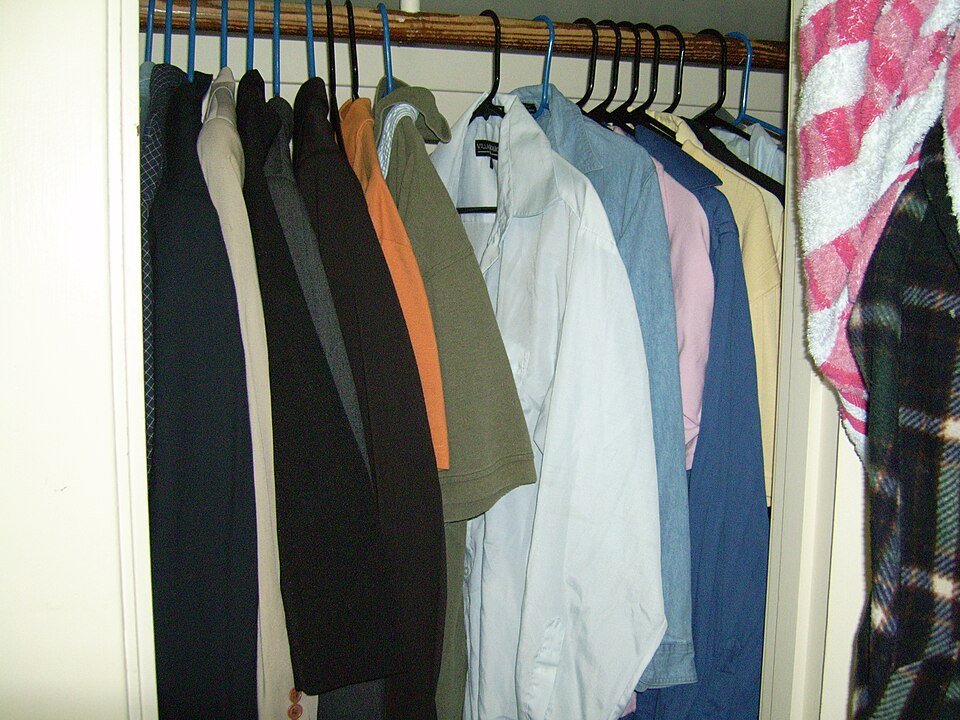
The spread-out garments make category and quantity easier to see before choosing storage. For a between-wears zone, first separate items ready for clean storage, those due for laundry and any uncertain pieces. The photograph does not establish cleanliness or suitability for rewear; assess the actual garments and keep the walking route clear while sorting.
Photo & usage
Donald Trung Quoc Don (Chữ Hán: 徵國單) - Wikimedia Commons - © CC BY-SA 4.0 International.(Want to use this image?)Original publication 📤: --Donald Trung 『徵國單』 (No Fake News 💬) (WikiProject Numismatics 💴) (Articles 📚) 10:10, 16 July 2019 (UTC) · CC BY-SA 4.0 · Source. Display copies resized and encoded as WebP; no instructional details were fabricated or removed.
Count the genuine between-wears items after that sort. Notice whether the group is mostly jackets, trousers or soft knits. The storage form should support those garments appropriately. A hook that suits one coat may distort a heavier knit or hide a second item beneath it.
Record how long items typically remain. An untouched garment can occupy the zone through several laundry cycles simply because it has become visually familiar. A short review linked to your existing laundry routine is more realistic than a new elaborate daily inspection. Choose a trigger the household already remembers.
Compare three suitable storage forms
An existing rail section can keep garments visible on appropriate hangers, provided the whole wardrobe arrangement remains suitable and clean storage is clearly separated. A shallow open basket may suit a small folded category, but it should not compress items or become an indistinguishable heap.
A freestanding garment rack can serve a larger defined group if its footprint, load rating and instructions suit the room. The IKEA — MULIG Clothes Rack, Article 601.794.34 page provides one specific example of dimensions and load information. Do not assume every narrow rack carries the same load or that an open rail can safely stand anywhere.
Avoid selecting a floor basket merely because it fits under a chair. If retrieving clothes means moving the chair into a passage, the new storage recreates the old conflict. Measure the complete loaded envelope, including sleeves, hanger ends and handles. Choose the smallest suitable form that holds the observed category without borrowing necessary room functions.
Set an illustrative capacity boundary
Here is an illustrative allocation, not a recommended wardrobe size. A designated rail section is 40 cm long. Two light jackets use a planning allowance of 7 cm each and three shirts use 4 cm each. The allocation is 14 + 12 = 26 cm, leaving 14 cm for spacing and selection.
Adding two more jackets would use that remaining 14 cm exactly. The rail might still physically hold them, but the original working allowance would disappear. Instead of treating the end of the rail as the only boundary, define the maximum active group from your successful retrieval trial.
The numbers do not establish load safety or garment condition. Check those independently. The value of the example is the explicit decision at capacity: review and move an existing item to its proper destination before adding another. An overflow chair is not a second part of the plan unless it is deliberately assigned and does not remove needed seating.
Place the zone beside the actual change routine
Observe where clothes come off and where the next morning's dressing happens. Position the zone so return is easy without blocking a wardrobe or the route out of bed. A destination on the far side of the room may remain empty while the convenient chair refills.
The AHRQ — Reducing Falls: A Safety Checklist for the Home home checklist includes clear pathways. Keep this temporary clothing category outside those paths and away from heating equipment. Do not hang garments over lamps, controls or ventilation openings merely because they are close to the dressing position.
Check whether the chosen location exposes clothes to direct strong light, moisture or repeated contact with other objects. Ordinary convenience does not justify unsuitable storage conditions. Where space is tight, reduce the temporary category or use a suitable existing cupboard section rather than adding a rack whose loaded clothes project into the room's useful route.
Make the next decision visible
Give each temporary item a review point. That might be the next laundry sort or the next time the garment is considered for wear. At review, choose its proper destination according to condition: wear, return to suitable clean storage or launder as appropriate. Avoid leaving the same indecisive item in place indefinitely.
Use category labels if the zone is shared. Personal sections can prevent one person's unused clothes from consuming the other's small allocation. Keep the rule simple enough that another person can recognize when the section is full without counting hidden layers.
Do not stack new garments over older ones where the bottom disappears. Visibility is part of the review system. If the storage form conceals the contents, use fewer items, a shallower arrangement or a clear category inventory. Adding labels to a deep undifferentiated pile does not make the individual garment decisions easier.
Check the category at the next laundry sort
At the next normal laundry sort, inspect every item in the temporary zone. Decide its next destination according to condition and care requirements. Count items that remain uncertain, and ask whether the uncertainty comes from condition, missing cleaning information or simply forgetting the garment was there.
If several pieces remain untouched through repeated reviews, reduce the active group or assign an appropriate longer-term destination. Do not keep expanding the rail to avoid the decision. The useful limit is the collection the household can see and review, not the largest pile a basket can contain. Keep any garments needing different care outside a generic reuse rule.
Confirm that the chair and floor stay available
Review the arrangement through an ordinary laundry cycle. Check whether the chair remains usable, the floor stays clear and the temporary zone contains only its defined category. Items due for washing should move through the laundry process rather than accumulating behind the reusable group.
If overflow appears, identify whether the capacity is too small, the location is inconvenient or the review trigger is not happening. Change that cause before buying a second container. A larger zone can make an unresolved decision less visible while taking more room from other activities.
Completion means clothes enter the category for a clear reason and leave through a clear next decision. Keep the successful capacity as a boundary, with suitable garment support and unobstructed access. The useful result is an available chair and a manageable clothing routine, rather than a more attractive version of the same growing pile.
THE REFERENCE FILE
Sources & scope
Documentation reviewed 1 Nov 2026. Examples are illustrative; this article does not claim hands-on product testing. Follow the instructions for your actual material, model and location.