A closed bedside drawer hides a cluttered collection. An open tray keeps objects visible. Neither is automatically the better choice in a tight room. The useful distinction is how each front behaves when the person is in bed, sitting at the edge or standing in the narrow space beside it.
Observe a few ordinary evenings before replacing furniture. You are looking for repeated movements: opening, searching, setting down and returning. This field-note method turns a vague preference for tidy storage into a decision about which actions need to happen easily and which objects deserve a protected location.
Start with an object-by-object use log
Write down the small collection currently kept beside the bed. For each item, note when it is used, whether it needs protection and whether it returns immediately after use. Glasses, a bookmark and a notebook can behave differently even though all are small. Do not count each possession as an equal storage unit.
Observe rather than stage the sequence. If an item repeatedly stays on the mattress or floor, record where the intended return breaks down. The drawer may be too far away, too full or simply wrong for an object that remains in use overnight. More compartments will not necessarily fix any of those causes.
Exclude items with separate storage requirements from a casual tray decision. Medicines, sharp objects and anything that must remain inaccessible to children need appropriate arrangements. Keep those requirements distinct from the visual preference for a clear tabletop. A bedside comparison should not weaken an existing safe storage practice.
Map the drawer while the user is in position
Measure the drawer's full projection including its handle. Then observe where the user sits or stands to open it. If it opens toward the bed, a frame or hanging cover may block it. If it opens across the bedside passage, it may occupy the place needed for feet or a mobility aid.
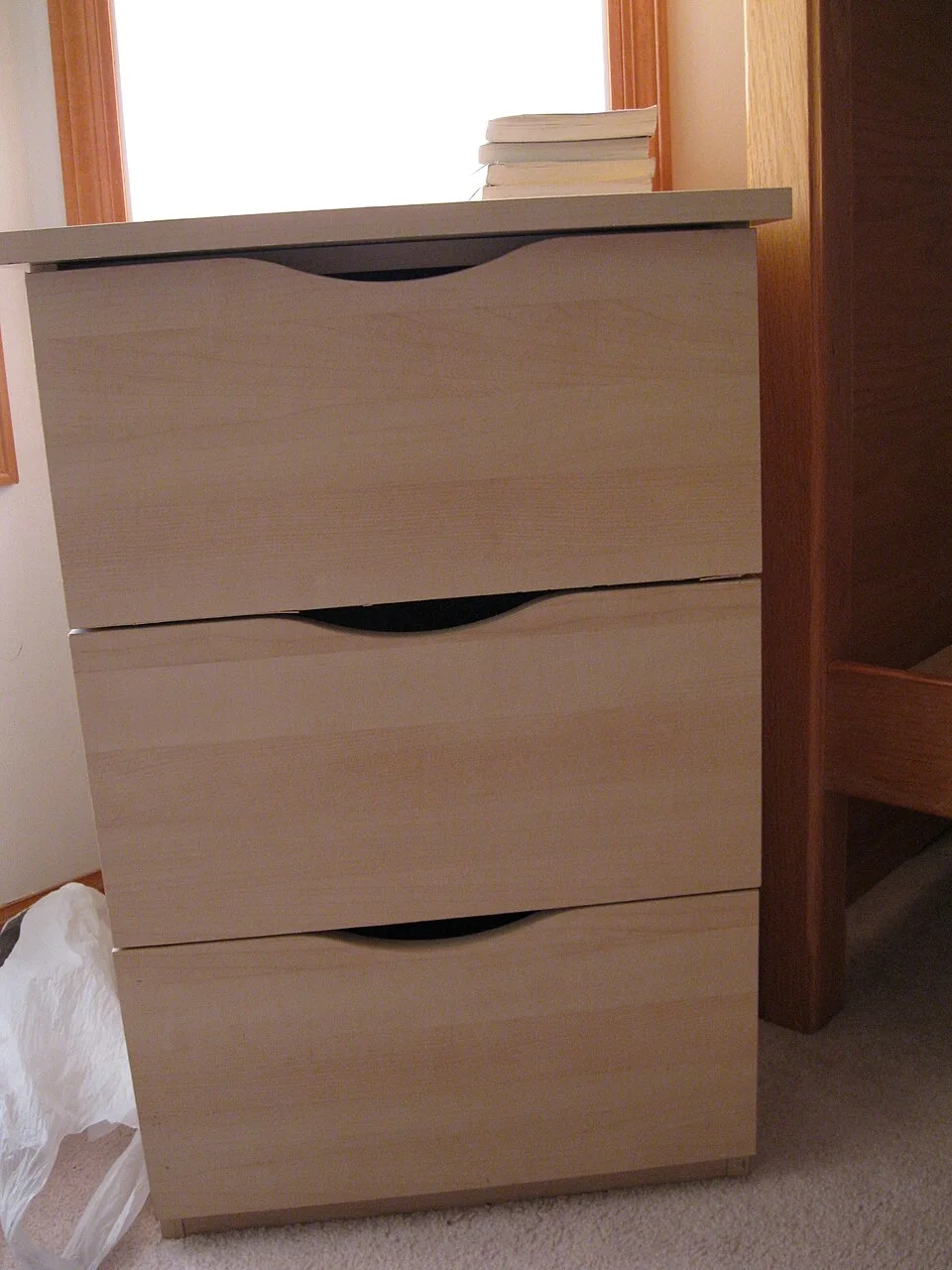
The closed drawer fronts and recessed grips show where the opening action begins, but not how far the drawers travel. For a bedside comparison, measure full permitted projection and observe the intended user sitting or standing beside the bed. Check approach and reach without defeating drawer stops; this photograph supplies no projection measurement or one-handed usability result.
Photo & usage
Trongphu · CC BY-SA 3.0 · Source. Display copies resized and encoded as WebP; no instructional details were fabricated or removed.
Try the ordinary sequence with the existing drawer if it is suitable to operate. Do not pull furniture forward or defeat drawer stops to gain extra access. Check whether the user can see the back of the compartment from their normal position, and whether they must reach over the open front to find a small object.
The U.S. Access Board — Operable Parts guide treats approach and obstruction as separate factors in access. Those concepts help explain a bedside failure without turning a private furniture trial into a compliance assessment. A handle can be at an apparently convenient height while the bed itself prevents a useful approach. Record both the handle position and the body position.
Test what an open tray would actually change
Place the intended tray on a suitable stable surface and lay out only the active overnight kit. Keep objects within the edges rather than stacking them to simulate extra capacity. Check whether the user can distinguish the items in the room's normal lighting and return them without disturbing something fragile.
An open tray can reduce the opening step, but its rim may make small items harder to grasp. A dark glasses case on a dark tray may be difficult to identify. Choose by the actual object contrast and hand movement, not by a product photograph showing a large empty surface.
Open storage also exposes contents to dust and accidental contact. If a drink belongs nearby, separate it from paper and electrical equipment in a way the surface can support. Do not add a tall pile of organizers that recreates the reaching barrier the tray was meant to remove. Sometimes the useful change is a smaller kit on the existing top.
Read an illustrative evening-use comparison
This is an illustrative observation comparison, not a report of testing. Over four invented evenings, glasses are retrieved and returned twice per evening, creating eight return actions. A spare notebook is used once in total. A charging cable is handled once per evening, creating four positioning actions.
If glasses require opening and closing a drawer for every return, that adds eight opening-and-closing cycles to the four-evening routine. The spare notebook requires only one cycle. Keeping glasses in an appropriate accessible tray and the notebook in a drawer would target the frequent action without exposing every stored item.
The calculation does not prove that open storage is faster or safer. Some users may prefer the drawer's defined location, and a tray may be easy to knock. Its purpose is to distinguish frequency from quantity. One frequently handled object can justify a different front even when a dozen rarely used items fit neatly behind a drawer.
Preserve the route out of bed
Check the arrangement with the user sitting at the bed edge and preparing to stand. A tray that projects past the table can be as intrusive as an open drawer. Keep object edges and furniture handles out of the ordinary foot placement and movement path.
The CDC — Check for Safety: A Home Fall Prevention Checklist for Older Adults checklist calls for an accessible bedside light. Preserve that access when adding a tray or reorganizing a drawer; do not bury the switch behind the new container. Observe whether the user reaches across the tray for the light and catches an object on the return movement.
AHRQ — Reducing Falls: A Safety Checklist for the Home includes keeping pathways clear in its home checklist. Here, treat the completed return as part of that goal: a drawer left open or a tray placed on the floor has changed the room even though the stored objects are organized. If the routine naturally leaves either obstruction behind, choose a different arrangement rather than relying on constant correction.
Use a mixed solution when the evidence supports it
There is no requirement to choose one front for every bedside possession. A small open destination can hold the active kit while a drawer contains less frequent items. Define that division explicitly so the tabletop does not gradually become overflow for the whole drawer.
Make the drawer interior shallow and legible where possible using suitable existing organizers. Avoid filling it so tightly that a person must remove one object to grasp another. Label a category if it helps another household member maintain the arrangement, but do not add a complex filing system for a handful of ordinary objects.
If the drawer cannot open without blocking essential movement, it may be the wrong furniture for the position. Removing the drawer or using a cabinet in a modified way is not automatically permitted. Choose a product intended for the needed configuration, or reduce the nearby inventory enough that the existing safe surface can serve it.
Decide after the return routine is reliable
Review the log after several ordinary nights. Keep the observations practical: which items returned to their place, which drawer remained open and which objects migrated to the floor. Do not convert a small household trial into claims about health outcomes or universal time savings.
Check that the chosen surface remains stable, the light control stays accessible and bedding does not drag the container toward the edge. If the bed is shared, review each side separately. Equal furniture widths can be less useful than solutions that match different routines and available space.
Completion means the active objects have obvious destinations and the user can leave the bed without first restoring the storage. Keep occasional possessions in their suitable protected location. The successful choice is the front that supports the actual evening and morning sequence, including the easy return that keeps the room clear.
THE REFERENCE FILE
Sources & scope
Documentation reviewed 1 Nov 2026. Examples are illustrative; this article does not claim hands-on product testing. Follow the instructions for your actual material, model and location.