Separate clean-but-wet from unwashed
A plastic container holding droplets beside a dry ceramic plate can look like a failed dishwasher cycle. First state the actual problem. Is the item visibly clean but wet, is food still present, or is water pooled in an upward-facing recess? Those observations need different responses. Do not rerun an otherwise clean whole load before identifying which drying task remains.
Check both the dishwasher manual and the item's dishwasher suitability. Some plastics have placement or temperature restrictions, and a drying option does not override them. Keep the exact model's method in view: appliances may use condensation, heated drying, automatic door opening or other arrangements.
Bosch: Tips to Maximize Drying describes condensation drying and additional drying options in its Bosch context. Use it to understand that drying systems differ, not to apply a lower-rack plastics statement to every dishwasher. A different machine with an exposed heating arrangement may have different instructions and risks.
Confirm the accepted setting and relevant products
Write the programme and drying option actually selected, including whether drying was deselected. Check the final indicators because some controls remember earlier choices. A quick or special programme may have a different default drying stage from the ordinary programme. Read the option matrix rather than assuming all cycles include identical drying.
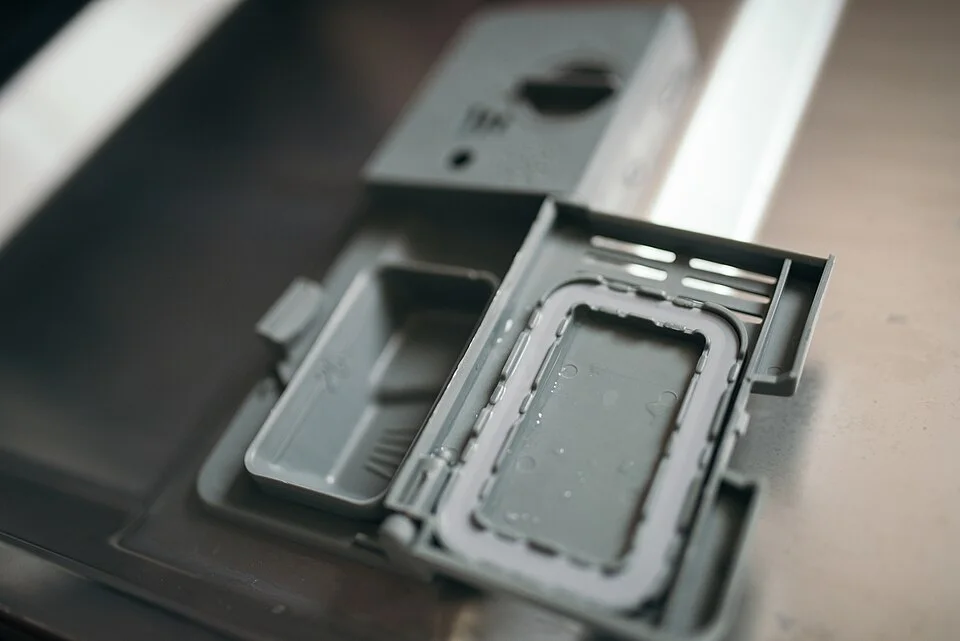
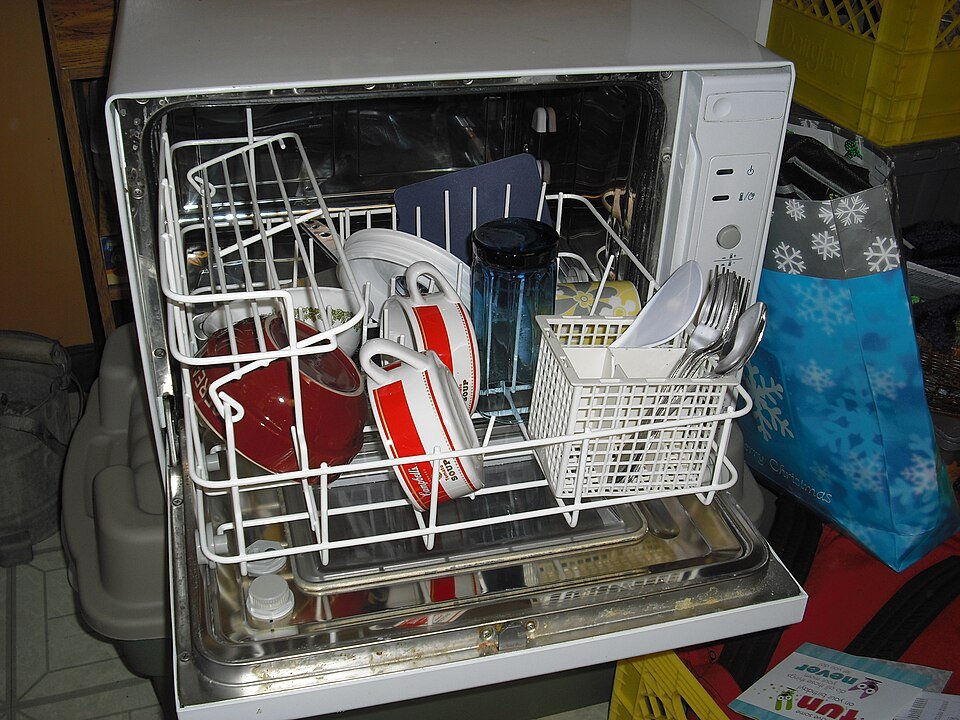
The open detergent well and separate cap show why compartments must be distinguished before adding products. Confirm their functions in the exact dishwasher manual, and follow the relevant product label. Keep any rinse-aid replenishment or setting change in the comparison record; an open compartment does not establish the selected drying option.
Photo & usage
Nenad Stojkovic · CC BY 2.0 · Source. Display copies resized and encoded as WebP; no instructional details were fabricated or removed.
Use rinse aid and its setting only as the actual appliance instructions direct. Do not pour it into a detergent compartment or substitute another chemical. Record whether the reservoir was replenished or its setting changed between observations. Otherwise a programme comparison may silently include a product change.
Whirlpool dishwasher cycle and options guide W11538005B describes Heat Dry and its added time for covered Whirlpool models. That instruction is not the same as the Bosch condensation-drying explanation. Keep each manufacturer example attached to its system. A selected option's name alone does not reveal the mechanism or permit a universal recommendation.
Observe materials and geometry separately
Choose a few ordinary permitted items already in a necessary load: a ceramic plate, a glass and a suitable plastic container or lid. Note their shape and position. Do not add new items solely to create a test. A deep recess can retain a pool even when its surrounding material dries well.
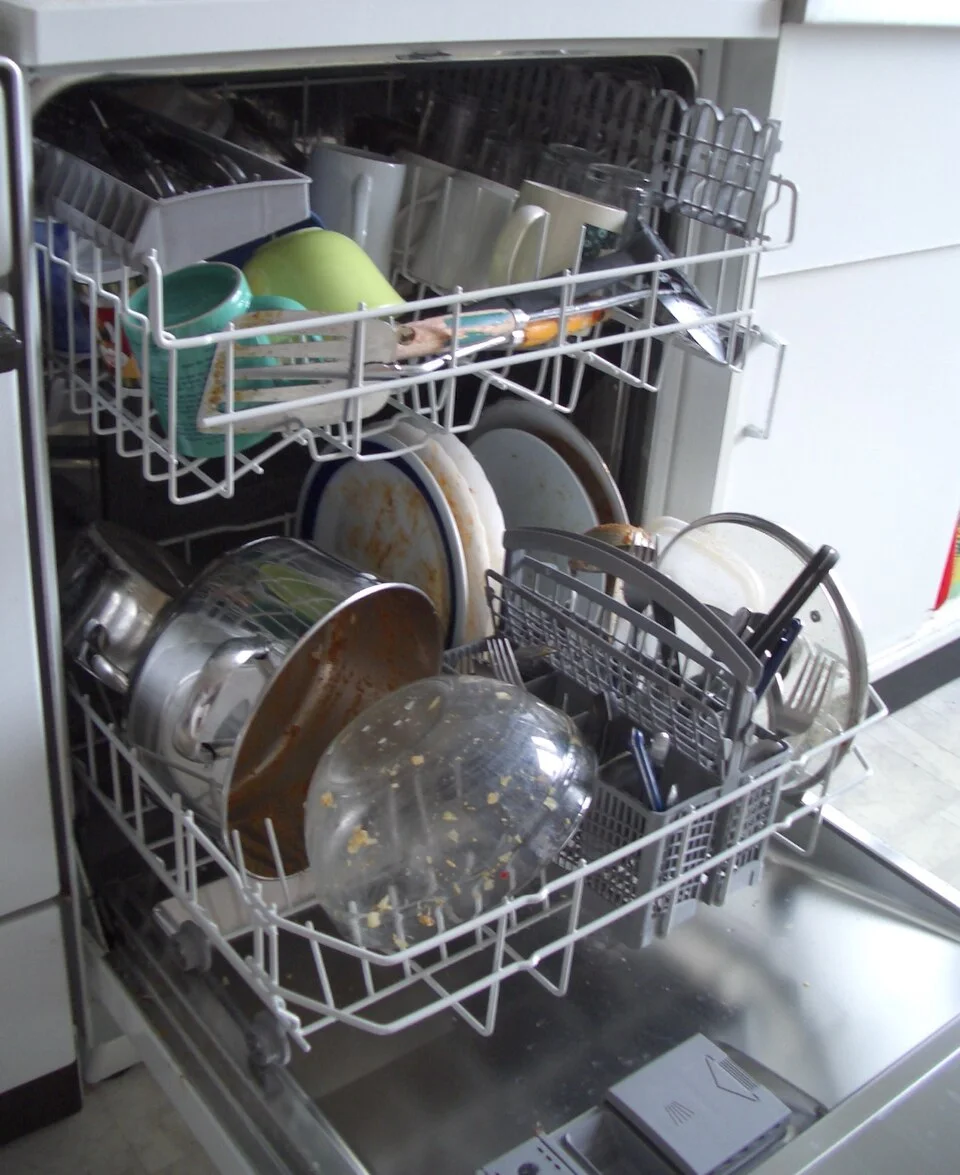
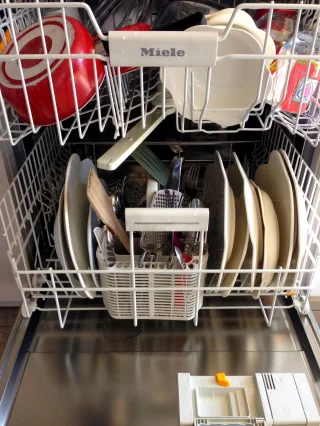
Cups, plates, bowls and cookware present different shapes and recesses in this load. Identify the actual material and dishwasher permission from each item’s instructions, then choose comparable representatives already needed in an ordinary wash. A visible shape or colour does not establish plastic compatibility or predict the drying result.
Photo & usage
The original uploader was Tim Simms at German Wikipedia. · CC BY-SA 3.0 · Source. Display copies resized and encoded as WebP; no instructional details were fabricated or removed.
Load according to the actual rack and item instructions, preserving ordinary spray access. This is not a comparison of every possible loading pattern. Keep orientation consistent enough that the drying option is not confused with a bowl turned from upright to angled. If a geometry change is necessary, record it as a separate deliberate action.
Whirlpool dishwasher cycle and options guide W11589943C provides programme and option information for another covered family. Read its permitted combinations and item context rather than copying times or temperatures. The household record should identify which actual selection ran and why each observed item belongs in that programme.
Keep item identity stable across the comparison
Use the same ordinary lid or container shape where it appears naturally in later loads, and record any replacement. Two plastic pieces can differ in geometry, material and thickness even when both are called food containers. A new shallow lid is not a fair substitute for the recessed base that originally held a pool. Keep the comparison attached to identifiable items without introducing an unnecessary test load.
If one item is removed because its manufacturer does not permit the chosen programme, preserve that exclusion. It is a useful care decision, not a missing data point to be filled by trying it anyway. A successful drying option must remain within the requirements of every item included. Better visible drying cannot justify deformation, damage or use of an item on a rack that its instructions prohibit.
Compare droplets and pools as different results
This table uses illustrative invented observations. It is not a drying-performance test and does not establish a percentage improvement for any product, material or option. All items are assumed suitable under their actual instructions.
| Item | After permitted option A | After comparable permitted option B |
|---|---|---|
| Ceramic plate | No visible droplets | No visible droplets |
| Plastic lid | Scattered droplets | Fewer visible droplets |
| Recessed container base | Pool in recess | Pool remains in recess |
The lid observation supports a possible practical drying improvement under the recorded conditions. The persistent pool raises a geometry question that more drying may not resolve conveniently. The comparison does not prove all plastics respond alike or that the option removed a measured volume of water. Keep visible food residue in a different field so a drying improvement cannot conceal a cleaning problem.
Keep the observation from changing during handling
Wait for the model's normal completion and safe unloading instructions. Do not open a hot appliance abruptly to accelerate the comparison. Where the machine has automatic door opening, preserve its intended clearance and operation rather than disabling it to match another drying system.
Observe the selected items before water from an upper rack drips onto them. Bosch's guidance recommends unloading the lower rack first to avoid that transfer in its context. Follow the actual machine's instructions, and note if handling creates new droplets. A plate wetted during unloading should not be reported as wet at programme completion.
Handle pooled water carefully so it does not spill onto floors or electrical controls. Use an appropriate clean drying method for a clean item when needed rather than restarting the whole load automatically. Do not store known wet containers tightly nested or closed simply because the programme displayed finished.
Choose between an option and an item-handling adjustment
If scattered droplets on permitted plastics are the main issue, review the actual drying and rinse-aid guidance. If a pool sits in a recess, review the allowed orientation or post-cycle handling. If ceramics and glasses are also unexpectedly wet, check that the intended drying stage actually ran before blaming the plastic material.
Use the next ordinary comparable load for any comparison. Keep programme, product and item geometry broadly consistent except for the chosen change. If several change together, the result may still support a practical routine but cannot isolate the option. Do not report a numerical water-removal or energy benefit from visual observations.
Seek support for repeated poor drying under the documented conditions, especially with errors or other abnormal behavior. Do not open a heater, fan assembly or drying duct. A household endpoint record cannot diagnose those components. Provide the model, accepted options, representative item observations and any interruptions instead.
Finish with clean items ready for their next use
Choose the permitted programme and drying routine that handles the household's actual items acceptably. Note which plastic shapes need an ordinary final drying step and which option is useful for the load. A small manual finishing task may be more practical than rerunning everything, but suitability depends on the actual items and instructions.
Keep the outcome specific: the chosen lid had fewer visible droplets, the ceramic plate was already dry, or the recess still needed emptying. Do not turn that into a universal statement about all plastic or all condensation drying. Retain the model and product context with the record.
Completion means the items are appropriately cleaned and dried for their intended next use, with pooled water and handling drips understood. It does not establish sanitizing completion, sterility or a measured efficiency gain. The useful result is a drying decision based on the materials and shapes actually in the rack.
THE REFERENCE FILE
Sources & scope
Documentation reviewed 1 Nov 2026. Examples are illustrative; this article does not claim hands-on product testing. Follow the instructions for your actual material, model and location.