A cupboard can look organised while leaving an acidic toilet cleaner directly above bleach, ready to drip into the same basket. Grouping everything by room hides that problem: two products labelled “bathroom” may need different storage locations.
Build your system around a more useful question: where does each bottle return after use? The answer should account for its label, neighbouring products, access by children or pets, and the space needed to retrieve it. Start with the bottles you own, then choose organisers.
Inspect the cupboard before moving its contents
This is a closed-container organising job. You need readable product labels, a notebook, access to manufacturers’ instructions and an uninterrupted work period with children and pets elsewhere. Have your local household hazardous waste service’s contact details available. Leave products closed; there is no need to apply, dilute or test anything.
Look into the cupboard before reaching inside. Check for liquid underneath containers, crust around caps, damaged packaging and unreadable labels. An unidentified puddle changes the job. Do not pull every bottle through it to start sorting, or add a cleaner to remove it.
The US Environmental Protection Agency’s household hazardous waste guidance directs people with corroding containers to seek instructions from their local hazardous materials official or fire department. Treat leaking or damaged packaging as a reason to obtain product-specific handling advice before continuing. Do not carry a suspect bottle through the house to a communal sorting pile.
For intact products, make your first inventory in place. List the exact product name and current location. This avoids turning the kitchen table into a temporary chemical store.
Give every intact bottle a storage record
Read the back label as carefully as the front. Copy the storage conditions and incompatibility warnings into your notebook. Record any expiry date actually printed; do not invent a discard date from the bottle’s appearance. If directions are missing, contact the manufacturer using the exact product name and formulation details available.
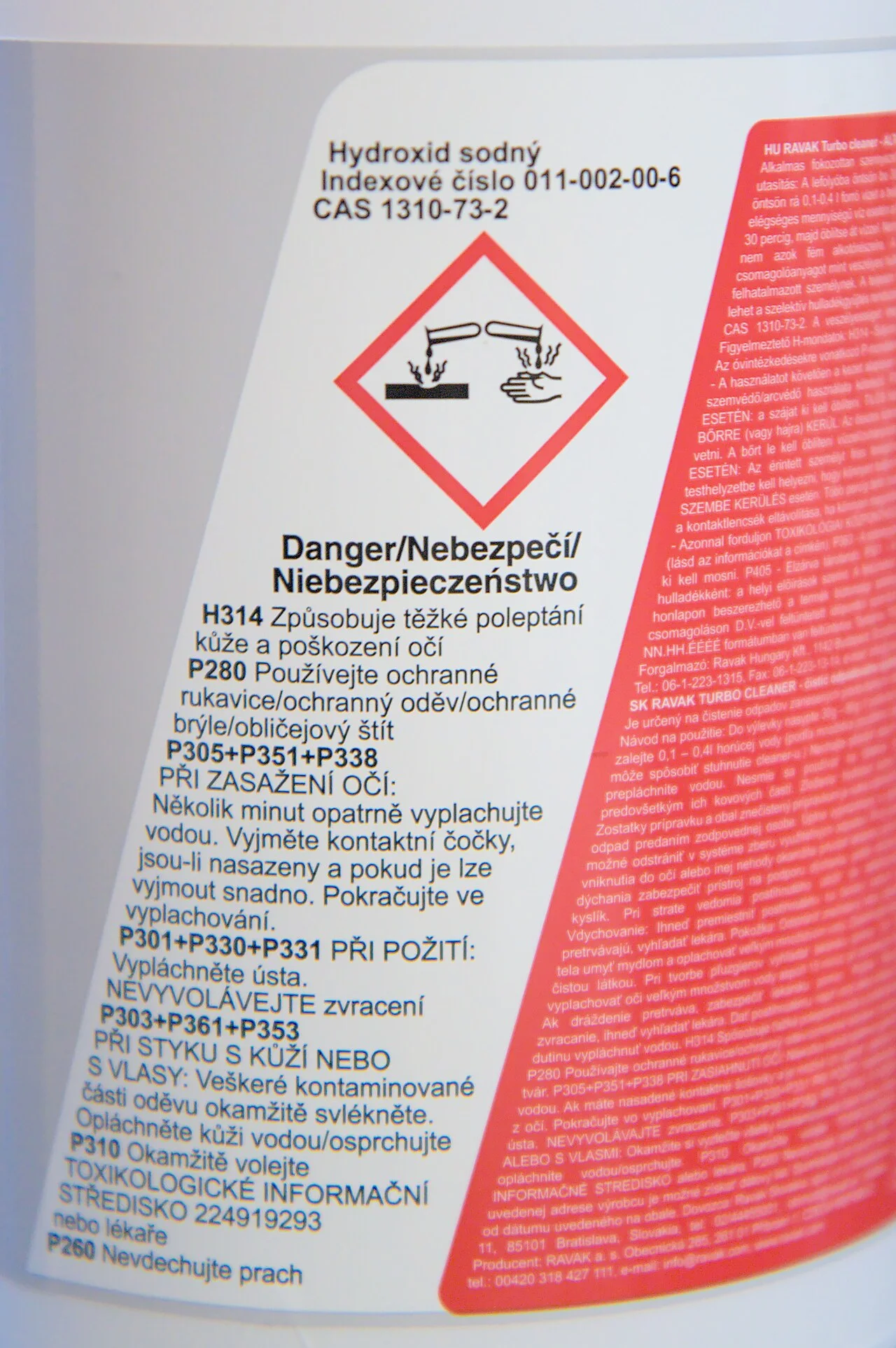
The close photograph shows a real cleaner label with hazard wording. The pictogram is a prompt to read the complete handling and storage instructions, not enough information to choose a dilution or mix products.
Photo & usage
Petr Kadlec · CC BY-SA 4.0 · Source. Display copies resized and encoded as WebP; no instructional details were fabricated or removed.
| Record | Useful detail |
|---|---|
| Identity | Full product name, including whether it contains bleach |
| Label restrictions | Required temperature conditions, heat warnings and named incompatible materials |
| Condition | Readable label, intact container and correctly fitting closure |
| Destination | A specific cupboard or shelf position, or “awaiting manufacturer advice” |
Keep products in their original containers with labels visible. Matching dispensers remove information you need at the moment of use. Never use food or drink containers, and do not combine partly used bottles to save space. EPA warns against mixing hazardous household leftovers; a smaller collection should come from fewer purchases and appropriate disposal.
For an unreadable bottle, “probably glass cleaner” is not an identity. Leave it unused and seek disposal advice rather than opening it to investigate. A fresh handwritten label cannot recover missing safety directions.
Separate incompatibilities before grouping by task
Transport Canada’s cleaning-product safety guidance explains that mixing bleach with acids can release chlorine gas, while bleach with ammonia-based cleaners can produce harmful chloramine vapours. It also advises keeping incompatible materials apart. Use those warnings to identify storage conflicts, without attempting chemical experiments.
Check formulations rather than assuming every toilet cleaner is acidic or every window cleaner contains ammonia. Where the labels confirm those ingredients, give bleach, acidic cleaners and ammonia-based products separate storage locations. Do not place incompatible bottles above one another or in one catch tray: a leak would defeat the separation.
This is not a complete compatibility chart. Oven cleaners, drain products, solvents and other specialist products may carry additional restrictions. If the label does not resolve a proposed grouping, ask the manufacturer; do not infer compatibility from similar colours, scents or “natural” branding.
The CDC’s bleach guidance also says never to mix bleach or other disinfectants with cleaners or disinfectants. A bathroom caddy should therefore not become a collection of bottles intended to be used together. Select the product for the particular task separately.
Choose locations that survive everyday use
Transport Canada recommends cool, dry, well-ventilated storage away from sunlight and heat. Check each product’s directions against the actual location. A damp under-sink cupboard or sun-heated shed is not automatically suitable because it has spare space. If the cupboard is wet from a plumbing leak, resolve that problem before making it a permanent store.
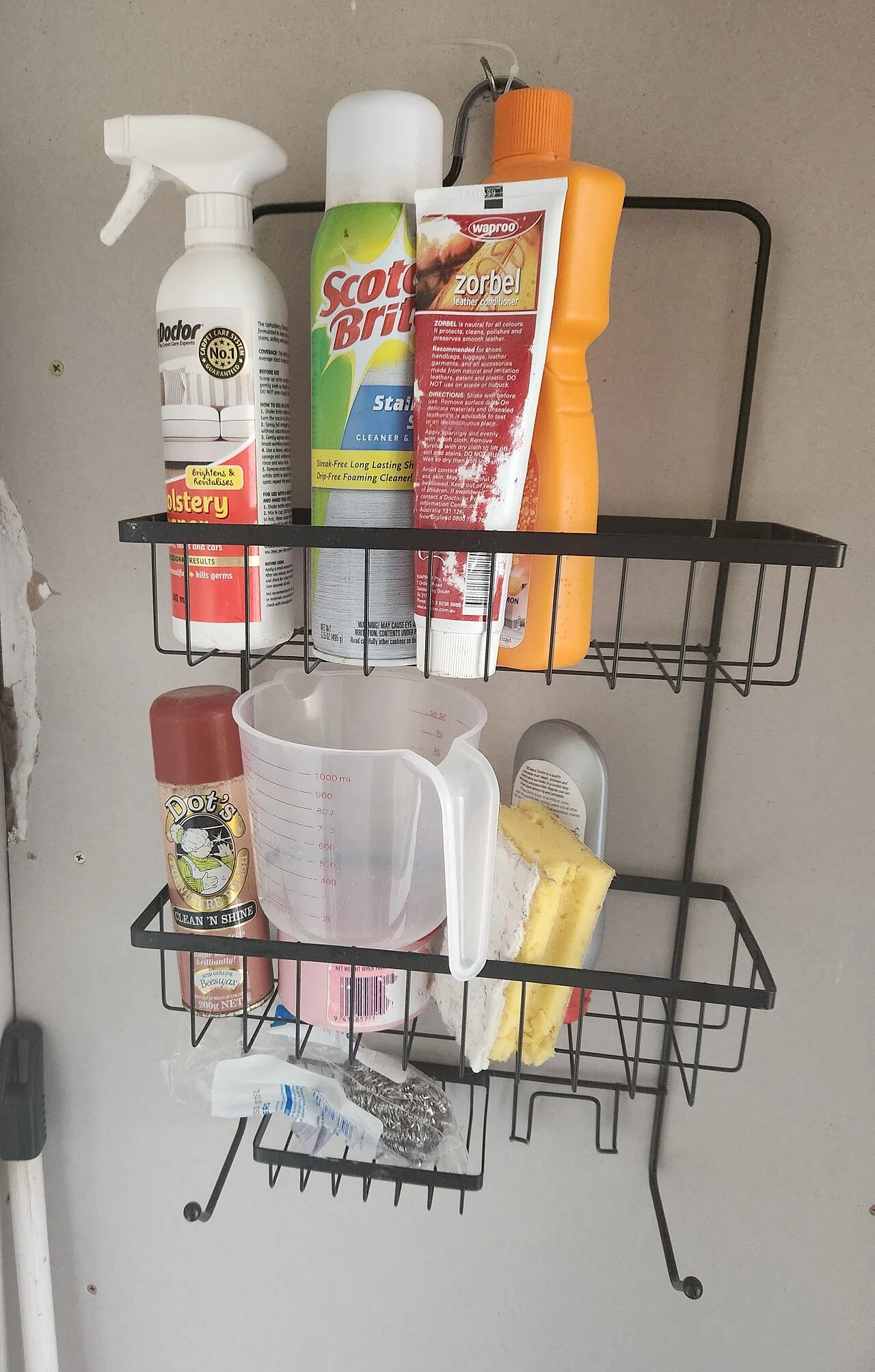
This open wall basket is a layout to assess, not a recommended safe store. Check access by children and pets, container stability and each product’s separation instructions; a tidy appearance does not demonstrate compatibility.
Photo & usage
Panamitsu · CC BY-SA 4.0 · Source. Display copies resized and encoded as WebP; no instructional details were fabricated or removed.
Health Canada’s household-chemical advice calls for a locked cupboard out of children’s reach and warns that child-resistant closures are not child-proof. Include visiting children in your planning. Keep pets from accessing the storage area too.
Choose an existing sound shelf you can reach without stretching over your face or balancing on furniture. Check its stated capacity if available; bowing or loose supports mean it needs assessment before loading. Store containers upright with room to grip them. Do not force a tall bottle sideways to close a door.
Measure usable space around hinges and pipes before buying a tray. Any tray must suit the stored product and its manufacturer’s advice; a household organiser is not guaranteed chemical containment. Separate incompatible products by location first. Keep food, medicines and food-preparation equipment elsewhere, so retrieving a cleaner never requires handling them.
Worked example: the cupboard cannot take everything
Consider a hypothetical household with six intact containers: bleach, an acidic descaler, an ammonia-based window cleaner, a surface cleaner and two bottles of the same laundry detergent. These numbers describe an organising example, not a recommended inventory.
The narrow utility cupboard cannot provide separate locations for all three incompatible products. Buying three small baskets would make them look divided while leaving them crowded together. Instead, the household maps other secure storage before moving anything.
- Assign individual destinations. The bleach gets one suitable locked cupboard. The descaler and ammonia-based cleaner each need another secure location that meets their labels. If those locations do not exist, stop planning around keeping all three.
- Check the remaining products individually. The surface cleaner gets a destination only after its own warnings have been reviewed. The two detergent bottles remain separate and closed; their contents are not consolidated.
- Resolve excess stock. Contact the local hazardous waste service about unwanted products, describing their names and condition. Confirm acceptance, preparation and transport instructions before a trip.
The useful result may be less stock rather than more storage. Until disposal is arranged, unwanted intact products still need appropriate secure, separated storage. A box labelled “to go” is not a reason to leave them by the front door.
Make returning the bottle the easiest step
Move only intact containers whose destination is ready, one at a time. Put a plain location label on the shelf edge, leaving the manufacturer’s label uncovered. Use specific wording such as “descaler returns here” rather than a broad category that invites unrelated bottles.
Keep the inventory inside the cupboard door or somewhere household adults can find it. List each product’s home and any unresolved disposal arrangements. When a bottle is empty, the note helps another person buy the intended replacement rather than a similarly named formula with different warnings.
Before putting a product away after use, follow its closure instructions and check that its exterior is clean and dry. If you find residue or damage, consult its directions instead of returning it above other supplies. Keep used applicators out of the bottle-storage trays so an organiser does not become a shared receptacle for chemical residues.
THE WORKING FILE / ROUTE
“Fits in the cupboard” is not a storage rule
A hypothetical cupboard has six intact products and four convenient shelf positions. Two products carry incompatible storage or use warnings. Reducing clutter to four baskets does not resolve those instructions: a tray separates small spills, but is not a guarantee against fumes, leakage or incompatible storage.
Identity
- Record needed
- Original readable label
- Bad shortcut rejected
- Decant into matching unlabelled bottles
Compatibility
- Record needed
- Product-specific separation instructions
- Bad shortcut rejected
- Put all bathroom products together
Access
- Record needed
- A secure location suited to the household
- Bad shortcut rejected
- Place a hazardous bottle high but unsecured
Capacity
- Record needed
- Enough suitable locations
- Bad shortcut rejected
- Stack containers until the door closes
Read the result
Resolve compatibility before grouping by task or colour. If suitable secure storage is unavailable, reduce unnecessary inventory through the local permitted disposal route; do not invent a more compressed arrangement. Give every retained bottle a single return location and check the system after actual cleaning, when wet tools and partly used products have come back.
Your route record Blank worksheet
Assign each intact product a label-compatible return location that the household can maintain.
- Product / label
- ________________________________
- Container intact
- ________________________________
- Storage instruction
- ________________________________
- Separation requirement
- ________________________________
- Assigned secure location
- ________________________________
- Return after use
- ________________________________
- Unused stock disposal route
- ________________________________
Before closing the file
- Containers stay original and identifiable.
- Compatibility precedes convenience.
- Actual return-to-storage use is tested.
Check the finished system and know when to stop
Close and reopen each cupboard. Confirm that the lock engages, nothing presses against a trigger or cap, every label remains readable and each intact bottle can be lifted out independently. Check that incompatible products have separate locations and that no bottle blocks the door from latching. Have another household adult find a product from the inventory and identify its return position.
Revisit the arrangement whenever a replacement product changes formulation, a visitor brings a cleaner, or a bottle no longer fits. Repeat the label check before finding space for it. Do not let an unplanned purchase occupy the gap reserved for safe retrieval.
If fumes or a suspected chemical reaction occur, stop organising and leave the affected area. Seek urgent advice from your local poison centre; breathing difficulty or unconsciousness requires emergency services, as HRSA’s Poison Help guidance states. Do not attempt to neutralise an unidentified spill. Provide product details only if you can obtain them without re-entering an unsafe area.
THE REFERENCE FILE
Sources & scope
Documentation reviewed 1 Nov 2026. Examples are illustrative; this article does not claim hands-on product testing. Follow the instructions for your actual material, model and location.