Describe lingering sound and arriving sound separately
A room can make your own voice sound hollow while also admitting traffic or neighbour noise. These may coexist, but they are not the same problem. Start with two separate observations: what happens after a small sound made inside the room stops, and what arrives while you remain quiet. This distinction prevents an ordinary furnishing change from being oversold as soundproofing.
An audible echo is a distinguishable repeat; reverberant sound is a more blended lingering tail. Household language often calls both echo. Use plain descriptions rather than pretending to measure either from memory. Write voice has a short hollow tail near the bare wall or low rumble arrives while nobody here is speaking. These observations are enough to start.
Choose one normal seat and a quiet period. Keep windows, doors, curtains and equipment states in the notes. If the room contains a continuous appliance hum, do not mistake it for a lingering tail. Switch off only optional equipment that can be stopped normally and safely, then restore it afterwards. Essential ventilation remains in service.
Listen without provoking the suspected source
First sit quietly for a few minutes and describe arriving events without assigning a definite source. A low rumble could be traffic, equipment or a building path; a muffled voice-like sound does not identify which dwelling produced it. Do not try to understand or record private speech. Record timing and broad character only.
Next say the same short neutral phrase at an ordinary conversational level from a marked position inside the room. Listen after you finish. A helper at the selected seat can report whether the phrase seems to linger, without judging its loudness as a number. Keep the speaker facing the same direction and standing the same distance from the seat.
A gentle single hand clap is optional if it is comfortable and appropriate for the household, but there is no need for repeated loud claps, balloons, amplified sweeps or banging on a wall. Do not deliberately disturb neighbours to investigate disturbance. If the environment makes even an ordinary voice comparison unsuitable, limit the exercise to passive notes.
Make one reversible furnished-room change
Choose a change involving furnishings you already own and can place safely. Close an existing curtain, move an ordinary upholstered chair into a permitted location or lay an existing rug flat where it is suitable for the floor and cannot slip. Photograph or sketch the reference layout first. Do not hang loose blankets near lights or heaters.
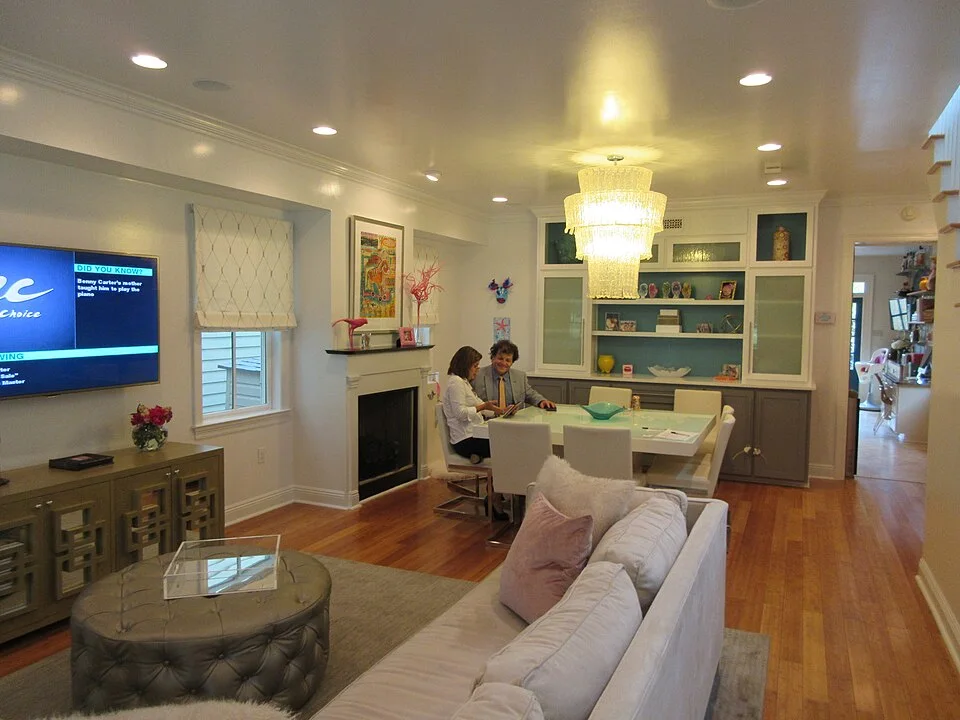
The rug and upholstered seating show sound-absorbing furnishings beside harder surfaces. Choose one existing, manageable furnishing change and compare the same ordinary sound before and afterward while keeping its source and listening position fixed. This photograph does not measure reverberation or incoming sound, and it does not establish that any particular item is safe to move.
Photo & usage
Infrogmation of New Orleans · CC BY 2.0 · Source. Display copies resized and encoded as WebP; no instructional details were fabricated or removed.
Keep the source position and listening seat fixed. Avoid placing a new furnishing directly between them, because that changes the direct path as well as the room surfaces. If moving a chair would obstruct an exit or require awkward heavy lifting, select another comparison. Do not improvise ceiling treatments or attach materials to building finishes.
CCOHS, NIOSH and WorkSafe guidance distinguish sound absorption and barriers within larger noise-control methods. The relevant household principle is that a softer room surface can affect reflected sound without becoming a tested separating construction. Their industrial examples and performance figures should not be transferred to a cushion, rug or domestic curtain.
Compare the same small sound before and after
Repeat the phrase several times in the reference layout, leaving a quiet gap between attempts. Record the listener’s description after each one: obvious hollow tail, slight tail or no clear tail heard. These are local listening categories, not reverberation-time measurements. Do not estimate seconds from an impression and label it an acoustic test.
Make the single furnishing change and repeat from the same positions. If possible return to the original arrangement once more. A reference-change-reference sequence helps reveal whether the difference persists when the layout is restored. If traffic begins during a phrase, mark that attempt interrupted and repeat later rather than counting it as a longer tail.
Keep voices ordinary and similar, without trying to force precisely equal output by ear. Acknowledge that the speaker cannot guarantee identical sound on each attempt. A consistent obvious change across several repeats is a useful household observation; a subtle uncertain difference should remain uncertain. The exercise cannot establish material absorption coefficients or a certified room rating.
Read an illustrative furnished-room comparison
This invented record has four phrase attempts in each layout and separate ten-minute quiet-listening periods for incoming events. The furnishing change is an existing curtain closed normally. Windows and doors remain unchanged. Counts describe the observer’s notes and do not measure sound energy.
| Layout | Phrase attempts with obvious tail | Incoming events during ten minutes | Listener note |
|---|---|---|---|
| Reference, curtain parked | 4 of 4 | 3 | Voice sounds hollow |
| Curtain closed | 1 of 4 | 4 | Shorter-sounding voice tail |
| Reference restored | 4 of 4 | 2 | Hollow quality returns |
The obvious-tail count changes by 4 minus 1 = 3 attempts after closure, then returns to four. Incoming counts are 3, 4 and 2 in different ten-minute periods, totalling 3 plus 4 plus 2 = 9. Their variation cannot establish that the curtain changed incoming transmission, because the outside or neighbouring activity was uncontrolled.
The supported interpretation is narrow: this listener consistently preferred the room’s response to the ordinary phrase with the curtain closed. Incoming events were still heard. Do not describe the curtain as reducing incoming noise by three quarters because three of four phrase attempts changed category. That would convert a subjective count into a false transmission measurement.
Look for coexisting paths and conflicting clues
After the phrase comparison, sit quietly in both layouts during ordinary use. If the hollow voice quality improves but a vehicle rumble remains, write both results. Sound can enter through windows, doors, ventilation, separating constructions or connected structures. Listening at one seat cannot map all those paths or establish a specific building defect.
If an arriving sound seems strongest near an opening, note the location without blocking it. Never seal required ventilation, cover an appliance grille or interfere with a fire door to investigate a path. Keep doors in their required state. An appropriate building or acoustic professional can assess persistent transmission concerns where the household comparison cannot.
Common mistakes are confusing fewer outside events with better isolation, using a louder voice after a furnishing change and adding several soft items at once. Another is buying foam because the room sounds hollow and assuming it will stop neighbour sound. The present comparison only supports the effect actually heard in the room; it cannot predict a product’s installed performance.
Finish with two separate conclusions
Write one sentence about the room response and another about incoming sound. For example, the existing curtain made the spoken phrase sound less hollow at the chosen seat; passing rumbles remained and their path is unverified. If no repeatable change was heard, retain that result instead of inventing an improvement to justify the effort.
Completion means the same modest sound was compared from fixed positions, only one safe furnishing change was made and an original-layout repeat was attempted where practical. Incoming observations should list attended time and uncertainty. Restore furniture safely and keep routes clear. The resulting notes can guide an ordinary furnishing choice or a later professional question, but they do not certify isolation, diagnose a neighbour or establish regulatory compliance.
THE REFERENCE FILE
Sources & scope
Documentation reviewed 1 Nov 2026. Examples are illustrative; this article does not claim hands-on product testing. Follow the instructions for your actual material, model and location.