An orange ring beneath a plant container can suggest rust, but color alone does not identify a stain. Soil, food, organic matter and earlier cleaning products can create similar shades. Even when the source is clearly corroding metal, a remover suitable for that metal may be unsuitable for the stone beneath it. Treat the source and the receiving surface as separate materials.
This guide concerns orange-brown marks on natural-stone furniture or counters. It does not duplicate a general limescale routine or provide a universal poultice recipe. The practical outcome is an evidence-based stain question, a compatible first clean and a clear boundary for specialist treatment when the mark remains.
Identify the stone before the stain remover
Find the stone name, finish and any sealer or coating from the installer. Marble, limestone, granite and quartzite can impose different limitations, and trade names may not fully describe composition. A resin repair or topical coating adds another compatibility question. Record uncertainty rather than treating every hard pale surface as marble.

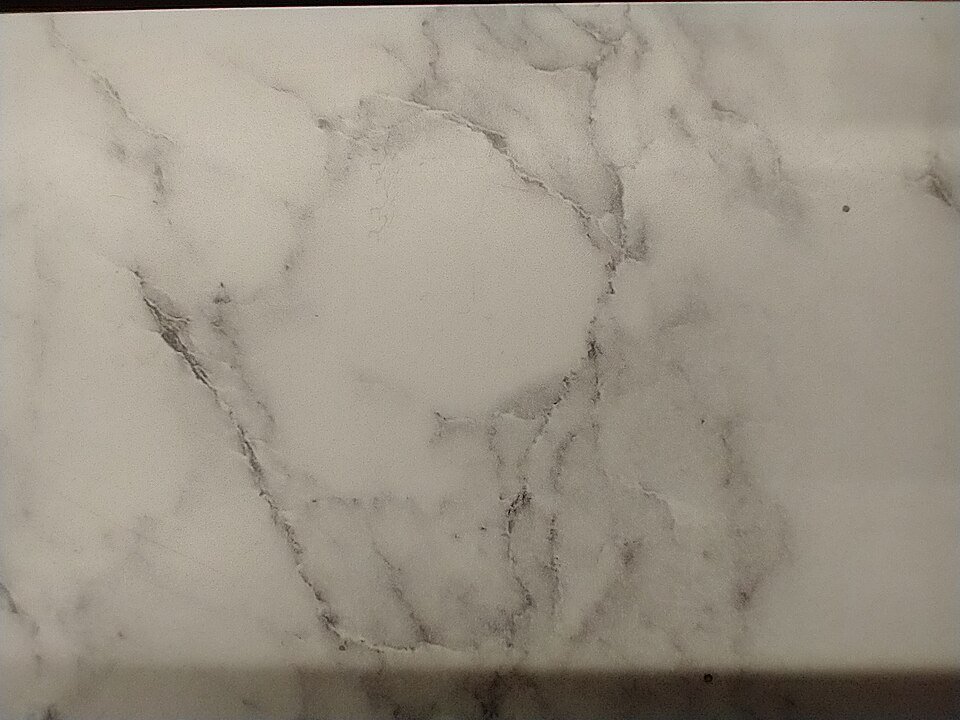
The veining and reflections are visible observations to record, not a material identification test. Obtain the stone name, finish and coating information from the installer before treating an orange mark. This marble-slab reference does not show rust or establish compatibility with a remover; do not transfer a product intended for laundry, toilets or a different stone merely because the surface looks similar.
Photo & usage
Stilfehler · CC BY-SA 4.0 · Source. Display copies resized and encoded as WebP; no instructional details were fabricated or removed.
The Natural Stone Institute warns against acidic cleaners on calcareous stone and cautions that some rust-removal products can attack even siliceous stone. Daltile's natural-stone guidance also covers material-sensitive care. The useful boundary is broad: a laundry or toilet rust remover is not a default stone treatment. Do not test a strong product in a visible corner to identify the material by whether it etches.
Trace the orange mark to its surroundings
Lift the suspected object with suitable support, avoiding sliding metal feet across the stone. Examine its underside for wetness, rust, exposed screws or a corroding rim. Photograph the object and the matching stone outline. A ring that follows a container base is useful evidence, though it does not prove that every color within the ring has one cause.
Look for a second route such as rusty runoff, an embedded fixing or a metal repair near the stone. Note nearby soil, plant water, tea, coffee and colored products. Do not repeatedly wet the mark to see whether orange returns. That changes the condition and can move additional staining material. Record whether the source is removable, fixed in place or unknown, because that distinction shapes the next step.
Separate surface dirt from a persistent stain
Remove loose dry debris gently with a clean soft tool. Blot existing liquid without spreading it. Use only the routine cleaner approved for the stone, finish and sealer, first completing a small inconspicuous trial. Follow its dilution, application, removal and drying requirements. Keep the suspected metal source away from the cleaned area.
After full drying, compare color and reflection with the starting photographs. Loose orange dust that transfers is different from an unchanged stain below a smooth face. A dull splash beside the color can indicate a separate finish alteration. Do not classify all remaining marks as rust merely because a metal pot was nearby. Give the supplier the complete dry observations and the ordinary-cleaning result.
Observe shape, color and reflection together
| Observation | Useful interpretation | Next question |
|---|---|---|
| Orange ring matches a corroding container rim | A metal source is plausible | Which stone-compatible metal-stain treatment applies? |
| Brown patch follows plant-water runoff with no clear metal contact | Organic staining may also be involved | What sources should be distinguished? |
| Loose dust lifts but color remains | Both surface material and absorbed staining may exist | Does the remainder need specialist removal? |
| Dull pale patch remains after a previous remover | Finish damage may accompany staining | Are stain treatment and restoration separate jobs? |
These invented comparisons are observational aids, not chemical identification. Their value is the precision of the follow-up. A request that includes source, pattern, stone identity and earlier products gives a specialist a better basis than a photograph labelled rust stain with no history.
Address the metal source independently
The Canadian Conservation Institute's iron-care guidance explains the role of moisture and the need to account for associated materials. Use that principle to remove ongoing contact, not to transfer an iron-cleaning recipe to stone. A metal object may require its own cleaning, coating, repair or replacement under its maker's instructions.
Do not clean a rusty container while it sits on the stone. Slurry, oil or remover can reach the receiving surface and introduce a different stain. Work in a suitable separate location if treatment is appropriate, or ask a specialist for fragile or significant objects. Before returning anything, confirm that its base is sound, clean and dry and that any protective support is compatible with the stone. A leaking pot remains a source even after its visible rim looks brighter.
Choose specialist stain treatment by substrate
The Natural Stone Institute describes metal stains and notes that deep rust staining can be difficult or permanent. It discusses poultices as a treatment category. That does not establish one recipe for every stone, stain depth, sealer and adjacent material. Ask the stone supplier or restorer to specify a compatible product and complete procedure.
Check preparation, dwell, coverage, removal, drying and any repeat limits before starting. A ready-made stain product may still exclude acid-sensitive materials or coatings. Do not combine household chemicals to create an improvised poultice, and do not use a metal polish on the stone because the stain came from metal. If no compatible process is documented, preserve the clean dry surface for professional assessment rather than escalating chemistry by trial and error.
Describe the area with a cautious numerical example
Suppose an illustrative circular container leaves a ring within a 12-centimeter-diameter outline. The area of the bounding circle is pi multiplied by 6 squared, approximately 113.1 square centimeters. If the visible ring is narrow, its actual stained area is smaller; the bounding circle does not measure the stain precisely.
These invented dimensions help communicate location and scale, not calculate a chemical dose. Photograph a ruler beside the mark without dragging it across the finish. Include a wider view showing seams and repairs. A small mark across a filled crack can require a different treatment decision from the same-sized mark on intact stone. Avoid promising cost or success based on area alone, and use USD if discussing any actual later quotation.
Preserve the distinction between stain and surface damage
If an earlier rust remover left a dull island, removing the orange color may still leave the reflection problem. A stain poultice does not necessarily restore polish, and a polishing step may not remove the color. Ask the restorer to explain which observed feature each proposed process addresses.
Do not add sealer over unresolved staining as a cosmetic fix. Sealing changes resistance under a specified system; it does not extract metal color or rebuild an etched finish. A water-beading observation also cannot prove that acid damage is impossible. Keep the actual sealer record and its renewal criteria separate from the stain event so future care does not become an automatic coat-after-every-mark routine.
Complete the response with a recurrence check
Inspect the dry stone after the authorized cleaning or specialist work, comparing both color and reflection. Record any remaining mark honestly and keep treatment details. Check the source object and its support before returning it; relocate it if ongoing moisture cannot be controlled. Lift trays periodically to inspect hidden contact areas.
Completion means removable surface soil is gone, the staining source has been addressed and any remaining color or finish issue has a defined next step. A permanent residual mark can be an informed outcome after compatible options are assessed. Repeated use of unrelated rust removers is not required to prove that a natural-stone surface has been cared for properly.
THE REFERENCE FILE
Sources & scope
Documentation reviewed 1 Nov 2026. Examples are illustrative; this article does not claim hands-on product testing. Follow the instructions for your actual material, model and location.