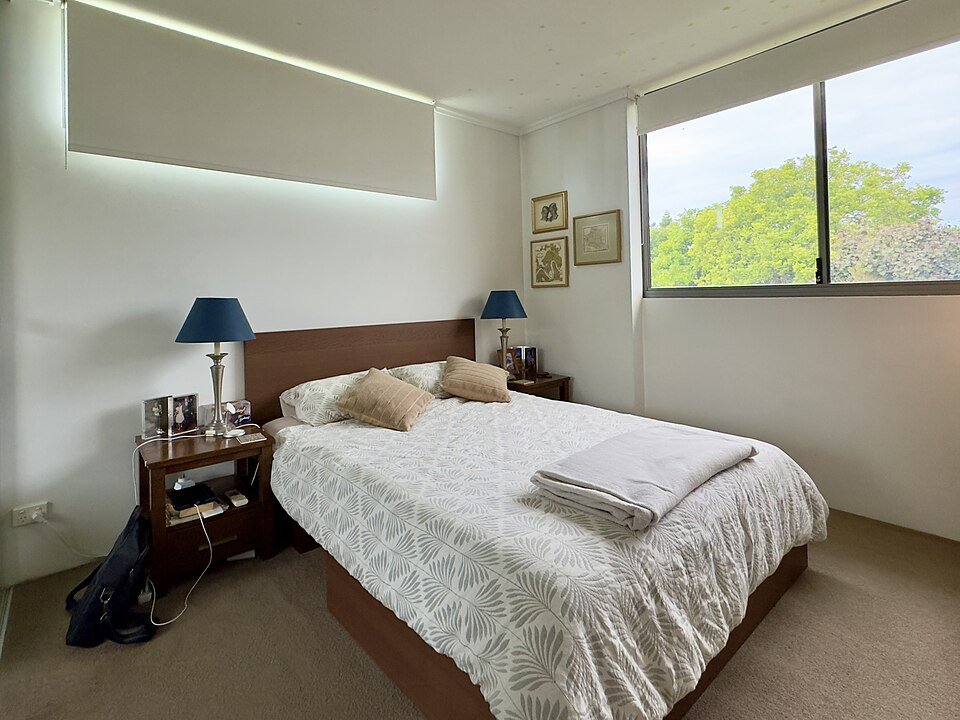
A spare room can appear ready when the bed is made while leaving no place for a guest's bag, clothes or glasses. The visitor then uses the only chair as luggage storage and places shoes in the narrow bedside route. Prepare the room for a person arriving with belongings, rather than for an empty-bed photograph.
Measure the guest layout with the existing furniture and a realistic luggage footprint. This room study covers reversible arrangements, not altering the room or installing supports. Ask about relevant access needs in advance where possible, and keep the household's escape arrangements clear.
Define what changes when the guest arrives
List the room's ordinary functions and what can genuinely pause during the visit. A work desk may need to remain available, while a hobby project can move to its assigned carrier. Give displaced objects real destinations before clearing the bed; moving everything to the floor creates an immediate access problem.
Record the sleeping arrangement in its fully deployed state. A sofa bed or folding bed may occupy more room than its closed footprint, and its mechanism must operate according to the manufacturer's instructions. Include bedding and any projecting frame parts in the plan.
Identify who will restore the room afterward. Keep the guest arrangement simple enough that setup does not require dismantling unrelated storage. If a piece of furniture must be moved, follow its instructions and use appropriate help. Do not improvise changes to restraint arrangements merely to gain temporary floor space.
Assign a luggage position before adding decoration
Use the expected bag type if known, or state a realistic assumption for planning. Measure it open as well as closed if the guest will live from it. An upright case may park compactly but require a larger clear area to open and retrieve clothing.
Choose a stable suitable surface or floor position outside the route. Do not assume the bed can be the only luggage surface; the bag needs a destination while the guest sleeps. A luggage stand must suit the load and intended use, and it should not become an improvised support for a person.
Leave a small defined destination for shoes and an outer layer without borrowing the room door or essential controls. If the room cannot accommodate a full open case continuously, explain the convenient opening position and where the closed case returns. The guest should not have to discover the only workable sequence by moving household possessions.
Calculate an illustrative deployed footprint
This example is illustrative. A room measures 3.0 by 2.8 m, giving 8.4 square meters. A deployed bed occupies 2.0 by 1.4 m, or 2.8 square meters. A desk occupies 1.0 by 0.5 m, or 0.5 square meters. Their combined furniture footprint is 3.3 square meters.
Subtracting gives 5.1 square meters, but that is not one usable empty rectangle. It includes narrow strips, door arcs and approach areas. An open case measuring 0.8 by 0.6 m adds 0.48 square meters in a particular shape that must fit somewhere suitable.
Do not conclude that the room is generous because 5.1 exceeds 0.48. Draw the case in its intended position and check the path around the bed and desk. This illustrates the difference between leftover area and usable geometry. The dimensions do not establish access for a particular guest or compliance with any room standard.
Prepare the bedside essentials around the sleeper
Provide a suitable place for glasses, a phone and the current small personal kit without requiring the guest to reach across a lamp. Check the light control from the bed's ordinary supported position. The CDC — Check for Safety: A Home Fall Prevention Checklist for Older Adults checklist specifically highlights an easily reached bedside light.
Trace the lamp and charging leads to suitable existing sockets. Keep them out of the foot placement and walking route, and follow equipment instructions. Do not offer a charging arrangement that requires a lead across the floor or equipment hidden under bedding to keep the tabletop clear.
Leave some genuinely empty surface for the guest. A bedside top already filled with decorative objects and household storage is not usable capacity. Keep only the items that serve the stay, and give removed objects their own destinations. Avoid assuming a guest wants to unpack into a drawer containing private household belongings.
Check approach and privacy with the furniture in use
Ask about the guest's relevant needs rather than inferring them from age or appearance. If a mobility aid, assistance or particular bed approach is required, plan with that information. The U.S. Access Board — Clear Floor or Ground Space and Turning Space guide distinguishes approach and turning space, but a generic room sketch cannot establish what an individual guest can use.
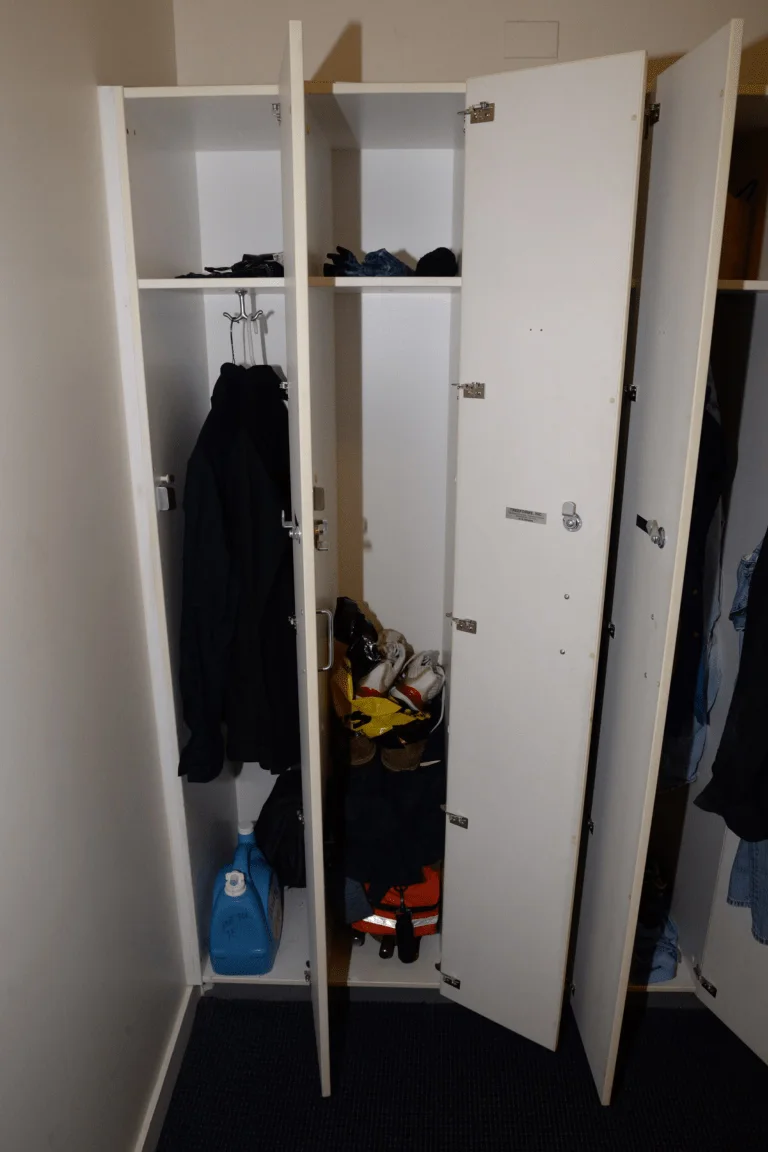
The open doors show why a cupboard’s operating space matters beyond its closed footprint. Before a guest arrives, identify which household belongings must still be retrieved and move daily items elsewhere when appropriate. Check the guest’s own approach needs with the actual room in use; this view supplies no turning-space measurement or assessment of accessibility.
Photo & usage
Federal Bureau of Investigation · Public domain · Source. Display copies resized and encoded as WebP; no instructional details were fabricated or removed.
Preserve access to the room door, window controls and any necessary household equipment. The U.S. Fire Administration — Home Fire Escape Plans guidance calls for clear doors and windows in the escape plan. Do not place the case, chair or spare bedding in those paths, including temporary setup positions.
Consider which cupboards need household access during the visit. Move daily household items elsewhere in advance when appropriate so the guest is not repeatedly disturbed. Keep private documents and valuables in suitable existing storage. The guest arrangement should make ordinary boundaries clear without relying on a long set of instructions after arrival.
Walk through an arrival and overnight sequence
Carry a representative light bag into the room, place it at its assigned destination and open it. Retrieve an item, close or park the bag and approach the bed. Keep the exercise in good light and do not stage risky movements to prove a tight layout works.
Check the evening state: shoes stored, lamp accessible, bedding deployed and the route clear. Then check the morning state with luggage open and the desk or chair in its ordinary position. Notice which object has to move twice and whether the destination remains available.
If the sequence is complicated, reduce household contents or choose another suitable sleeping arrangement. Do not solve it by expecting the guest to keep every object precisely aligned. A practical room tolerates ordinary variation, such as a coat placed in its assigned area or a case returned slightly off its original mark.
Reserve a place for the bag while the bed is occupied
Check the room with the bed fully ready for sleep and the guest’s case closed in its assigned position. A layout that uses the mattress as the only luggage destination has no complete overnight state. The case needs a stable suitable place that does not borrow the foot placement or exit route.
If the expected bag size changes, revisit that destination before arrival. Do not assume every guest will bring a compact carry-on or be able to lift it onto a high surface. Ask about relevant practical needs and retain an alternative when the room cannot accommodate them. The illustration is a planning assumption, not a promise that the room suits every visitor.
Complete preparation with a simple orientation
Show the guest the light control, suitable charging location, luggage destination and household escape arrangements. Keep the explanation practical and brief. If an access limitation remains, discuss it honestly before relying on the arrangement rather than presenting the room as universally suitable.
Check the room after setup for loose objects, obstructed fronts and leads displaced during furniture movement. Confirm any deployed bed mechanism is secured as its instructions require. Keep the guest's empty storage allocation empty until they arrive.
Completion means the room accommodates the sleeper and their ordinary possessions while preserving clear movement. After the stay, note any practical problem the guest identifies and revise the plan. The useful record is a specific change, such as a better bag destination, rather than a claim that the room was professionally tested or approved.
THE REFERENCE FILE
Sources & scope
Documentation reviewed 1 Nov 2026. Examples are illustrative; this article does not claim hands-on product testing. Follow the instructions for your actual material, model and location.