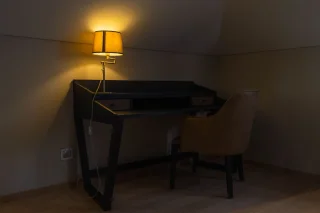
A bedside table is often chosen to fill the strip left beside a bed. That reverses the useful sequence. The sleeper needs to reach a light, set down glasses and get out of bed before a particular table shape deserves the space. Start with those movements and a deliberately small nighttime inventory.
Measure from the finished bed, including its frame and normal bedding. Mattress dimensions alone can understate the occupied width. The aim is a surface that holds the actual kit and remains easy to use, without narrowing the exit route or creating a tangle of leads beside your feet.
Observe the two moments that matter most
First sit on the bed edge as you normally do before standing. Note where your feet land, where you place a hand and which direction you turn. Then, while comfortably supported in your usual resting position, identify where a lamp control and glasses would be convenient. Do not stretch toward an imaginary table edge to validate a preferred purchase.
These positions may favor different parts of the surface. An object easy to reach while sitting can be far behind you when lying down. Mark the distinction on a sketch. Ask the other sleeper to make their own observations rather than assuming symmetrical furniture will serve both sides equally well.
Avoid practicing in darkness or removing needed support to measure a reach limit. Keep the room well lit and stop short of uncomfortable movement. This is a planning observation, not a mobility assessment. If getting out of bed already requires assistance or a prescribed aid, retain that arrangement and obtain individualized advice before changing surrounding furniture.
Reduce the inventory to a genuine overnight kit
Lay out the things used between bedtime and getting up. Typical examples might include glasses in a case, a book, a phone and a light control. Record what each object needs: a flat resting place, charging connection, protection from a drink or room to open. Avoid adding a whole stationery collection simply because a drawer is available.
Separate bedtime essentials from morning-only or occasional items. A book you are currently reading differs from a growing stack of unread books. Keep the active item nearby and assign the rest to appropriate storage. A smaller kit often makes a simple surface possible, but do not remove something the user depends on merely for visual neatness.
For medicines, follow their storage directions and household access requirements; an exposed bedside top is not automatically appropriate. Do not redesign medical routines through a furniture exercise. List any item whose conditions need separate advice and preserve its suitable existing storage while planning the ordinary objects around it.
Measure height relative to the finished mattress
Measure the mattress top with its ordinary bedding in place, then compare candidate surfaces at that level. The useful relationship is personal: can you set down and pick up the item from your supported position without reaching over a high edge or searching far below the mattress?
The U.S. Access Board — Operable Parts guide explains how obstructions affect access. Its technical ranges do not certify the reach from a bed, but the distinction is useful: a wide upholstered frame or projecting mattress edge can place the table farther away than the floor-plan gap suggests. Measure from the user's position to the objects, not simply between furniture edges.
Try the proposed level with a suitable stable existing surface if one is available. Do not stack unstable boxes beside the bed for a nighttime trial. Check whether a raised rim helps contain glasses or makes retrieval harder. If the rim blocks a comfortable hand movement, choose another form rather than assuming all tray-shaped tops improve accessibility.
Make an illustrative surface-area comparison
The following dimensions are illustrative. A top measures 40 by 35 cm, giving 1,400 square centimeters. A lamp base occupies 18 by 18 cm, or 324 square centimeters. A glasses case occupies 17 by 7 cm, or 119 square centimeters. Together they cover 443 square centimeters, leaving 957 square centimeters before spacing and other objects.
That remaining area is not a promise that a book or drink will fit conveniently. A book measuring 24 by 16 cm may conflict with the lamp's position even though its 384 square centimeters is less than the numerical remainder. Arrange the actual shapes, including how a hand approaches them.
Compare a second top measuring 35 by 30 cm, or 1,050 square centimeters. With the same lamp and case it leaves 607 square centimeters. It might still work if the lamp is positioned sensibly and the kit is small. Choose by observed object placement and retrieval, not by selecting whichever table offers the largest leftover area on paper.
Protect the light control and cable path
The CDC — Check for Safety: A Home Fall Prevention Checklist for Older Adults checklist recommends an easily reached bedside light. Check the actual switch, not just the lamp base. An inline switch can slip behind furniture; a small knob may be difficult for the intended user. Test the control while the lamp is in its planned position and with the rest of the kit present.
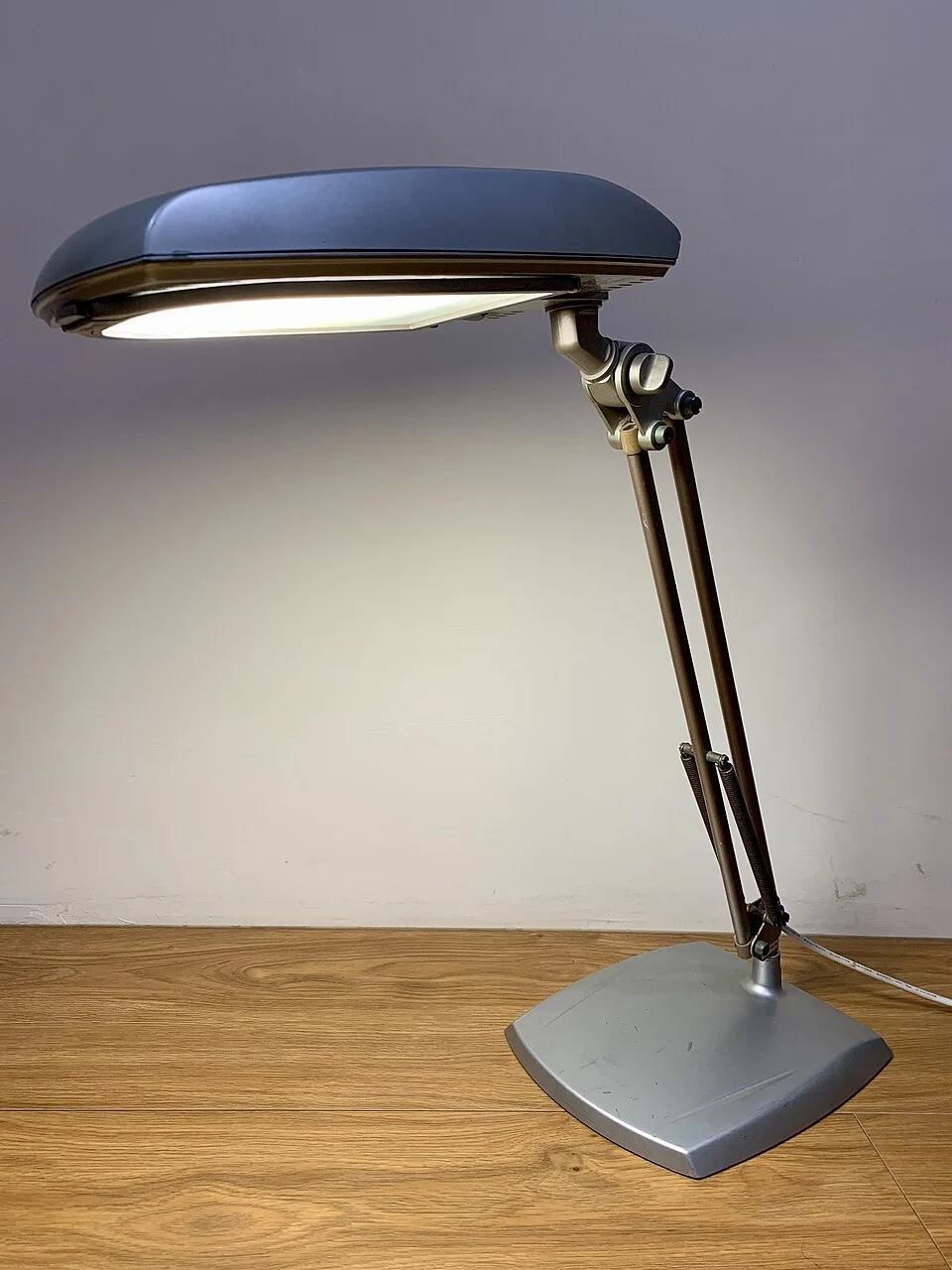
The lamp base and emerging lead are visible, while a complete control and socket path are not. In the bedside arrangement, trace the actual cord to its socket and check the real switch from the sleeping position. Keep leads away from feet, drawer travel and pinch points; the lit lamp alone establishes neither easy reach nor a suitable cable route.
Photo & usage
Tbatb · CC BY-SA 4.0 · Source. Display copies resized and encoded as WebP; no instructional details were fabricated or removed.
Trace charging and lamp leads to their sockets. Keep them away from the place your feet land and from moving bed mechanisms, drawers and sharp furniture edges. The CPSC — Safety for Older Consumers: Home Safety Checklist checklist identifies pinched and traffic-exposed cords as hazards. If the socket arrangement only works with a lead crossing the exit path, reconsider the position.
Keep devices and chargers in accordance with their makers' instructions, including ventilation and placement. Do not tuck charging equipment under bedding to clear the tabletop. A narrow surface should not require hiding powered equipment where it cannot be inspected. Reduce the kit or change the furniture arrangement if safe charging and ordinary access cannot coexist.
Inspect the route with drawers and bedding in use
Check the path from the bed to the room door with the bed made normally and with a bedside drawer open for retrieval. Bedcovers can drape beyond the frame, and drawer handles can project into the narrowest point. Include these edges when comparing the usable route before and after the change.
A drawer may be acceptable if opened while seated and closed before standing, provided the sequence is easy for the actual user. It is less suitable if it must remain open to hold everyday items. An open shelf or small accessible tray may better match that routine, although neither should project into the foot placement zone.
Avoid using lightweight bedside furniture as a transfer support or handhold unless it is specifically intended for that purpose. Stability during ordinary object placement does not establish capacity to support a person. Preserve suitable aids and consult an appropriate professional where support during standing is part of the room's requirements.
Confirm the setup through morning and evening routines
Use the small kit for several ordinary evenings, checking in good light first. Record items that fall behind the table, switches that wander and objects that are repeatedly moved onto the bed. Each is evidence of a placement or capacity problem. Correct that particular issue instead of adding a larger general-purpose organizer.
In the morning, retrieve glasses, operate the light and leave the bed through the ordinary route. Confirm that the table stays in place and that bedding or leads do not follow your feet. Ask each user whether the arrangement feels easy, and keep separate solutions when their needs differ.
Completion means the essential kit fits without piling, the light control is accessible and the route remains clear in normal use. Keep the final dimensions and object positions as a reference if the mattress or bed changes. A higher mattress can alter a once-convenient bedside arrangement even when the table itself remains the same.
THE REFERENCE FILE
Sources & scope
Documentation reviewed 1 Nov 2026. Examples are illustrative; this article does not claim hands-on product testing. Follow the instructions for your actual material, model and location.